



 Chat with AI
Exam 17: Financial Economics

Exam 1: Limits, Alternatives, and Choices212 Questions
Exam 2: The Market System and the Circular Flow141 Questions
Exam 3: Demand, Supply, and Market Equilibrium202 Questions
Exam 4: Market Failures: Public Goods and Externalities155 Questions
Exam 5: Governments Role and Government Failure148 Questions
Exam 6: An Introduction to Macroeconomics123 Questions
Exam 7: Measuring Domestic Output and National Income157 Questions
Exam 8: Economic Growth114 Questions
Exam 9: Business Cycles, Unemployment, and Inflation143 Questions
Exam 10: Basic Macroeconomic Relationships142 Questions
Exam 11: The Aggregate Expenditures Model143 Questions
Exam 12: Aggregate Demand and Aggregate Supply152 Questions
Exam 13: Fiscal Policy, Deficits, and Debt164 Questions
Exam 14: Money, Banking, and Financial Institutions130 Questions
Exam 15: Money Creation127 Questions
Exam 16: Interest Rates and Monetary Policy174 Questions
Exam 17: Financial Economics136 Questions
Exam 18: Extending the Analysis of Aggregate Supply135 Questions
Exam 19: Current Issues in Macro Theory and Policy134 Questions
Exam 20: International Trade151 Questions
Exam 21: The Balance of Payments, Exchange Rates, and Trade Deficits152 Questions
Exam 22: The Economics of Developing Countries135 Questions
Select questions type


If investors have two identical assets that have different rates of return, the investors will sell the asset with the higher rate of return to buy the asset with the lower rate of return.
(True/False)
4.9/5  (66)
(66) An investment's rate of return is positively related to the price paid for it.
(True/False)
4.7/5 (74)
(74) Before taking management and trading costs into account, arbitrage activities in the market ensure that the returns of actively managed funds are:
(Multiple Choice)
4.7/5 (82)
(82) If an asset has a risk-return combination that is above the Security Market Line (SML), then arbitrage will make that asset's:
(Multiple Choice)
4.8/5 (84)
(84) A bond pays a coupon (or interest) rate of 5 percent each year for five years, with a future (face) value of $200. If the bond was sold today, what would be the present value of the bond?
(Multiple Choice)
4.8/5 (77)
(77) 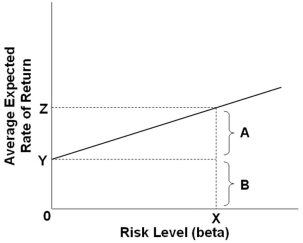 Refer to the graph above. The risk premium for an asset with a beta equal to X would be:
 (Multiple Choice)
4.9/5 (89)
(89) The risk-free market rate is essentially the rate of return that compensates solely for time preference.
(True/False)
4.8/5 (78)
(78) If an asset has a risk-return combination that is below the Security Market Line (SML), then this indicates that the asset's:
(Multiple Choice)
4.8/5 (83)
(83) The correct formula that relates present value (PV) to future value (FV), if interest rate is i% per year over n years is:
(Multiple Choice)
4.9/5 (80)
(80) Assume that there are two investments very similar in all respects, but Investment X has a higher rate of return than does Investment Y. As a result of the arbitrage process, the price of Investment:
(Multiple Choice)
4.9/5 (62)
(62) The Security Market line (SML) shows how the average expected rates of return on assets vary with:
(Multiple Choice)
4.9/5 (72)
(72) If investors started to prefer investing in more ethical companies, then it would be expected that the stock prices for those companies would:
(Multiple Choice)
4.7/5 (81)
(81) A bank account pays 4% interest per year. If you deposit $1,000 into this account at the start of each year for three years, how much will your account balance be at the end of three years?
(Multiple Choice)
4.9/5 (96)
(96) The Fed can regularly influence and change the risk-free rate of financial investments through its:
(Multiple Choice)
4.8/5 (95)
(95) 
Filters
- Essay(0)
- Multiple Choice(0)
- Short Answer(0)
- True False(0)
- Matching(0)