



 Chat with AI
Exam 15: Money Creation

Exam 1: Limits, Alternatives, and Choices212 Questions
Exam 2: The Market System and the Circular Flow141 Questions
Exam 3: Demand, Supply, and Market Equilibrium202 Questions
Exam 4: Market Failures: Public Goods and Externalities155 Questions
Exam 5: Governments Role and Government Failure148 Questions
Exam 6: An Introduction to Macroeconomics123 Questions
Exam 7: Measuring Domestic Output and National Income157 Questions
Exam 8: Economic Growth114 Questions
Exam 9: Business Cycles, Unemployment, and Inflation143 Questions
Exam 10: Basic Macroeconomic Relationships142 Questions
Exam 11: The Aggregate Expenditures Model143 Questions
Exam 12: Aggregate Demand and Aggregate Supply152 Questions
Exam 13: Fiscal Policy, Deficits, and Debt164 Questions
Exam 14: Money, Banking, and Financial Institutions130 Questions
Exam 15: Money Creation127 Questions
Exam 16: Interest Rates and Monetary Policy174 Questions
Exam 17: Financial Economics136 Questions
Exam 18: Extending the Analysis of Aggregate Supply135 Questions
Exam 19: Current Issues in Macro Theory and Policy134 Questions
Exam 20: International Trade151 Questions
Exam 21: The Balance of Payments, Exchange Rates, and Trade Deficits152 Questions
Exam 22: The Economics of Developing Countries135 Questions
Select questions type


The primary purpose of the reserve requirements for banks is not really to ensure liquidity to meet withdrawals, but rather to allow the Fed some control over the money supply.

Free
(True/False)
4.8/5  (63)
(63) Correct Answer: Verified
True
If a bank has excess reserves of $100,000, then it can lend out only up to $100,000; but if the banking system has excess reserves of $100,000, then the system can make additional loans totaling more than $100,000.
Free
(True/False)
4.9/5 (83)
(83) Correct Answer:Verified
VerifiedTrue
A checkable deposit at a commercial bank is a(n):
Free
(Multiple Choice)
5.0/5 (71)
(71) Correct Answer:Verified
VerifiedC
The commercial banking system, because of a recent change in the required reserve ratio from 8 percent to 10 percent, finds that it is $50 million short of reserves. If it is unable to obtain any additional reserves, it must reduce deposits and money supply by:
(Multiple Choice)
4.9/5 (84)
(84) A commercial bank's checkable-deposit liabilities can be estimated by:
(Multiple Choice)
4.9/5 (85)
(85) A check for $10,000 drawn on Bank A and deposited at Bank B will increase the excess reserves in Bank B by $10,000.
(True/False)
4.8/5 (78)
(78) A commercial bank buys a $50,000 government security from a securities dealer. The bank pays the dealer by increasing the dealer's checkable deposit balance by $50,000. The money supply has:
(Multiple Choice)
4.9/5 (93)
(93) If banks borrow from the Fed, the banking system's reserves will increase, but if banks borrow from one another, the banking system's reserves will not change.
(True/False)
4.7/5 (74)
(74) A commercial bank has checkable-deposit liabilities of $500,000, reserves of $150,000, and a required reserve ratio of 20 percent. The amount by which a single commercial bank and the amount by which the banking system can increase loans are respectively:
(Multiple Choice)
5.0/5 (90)
(90) Other things being equal, an expansion of commercial bank lending:
(Multiple Choice)
4.8/5 (72)
(72) When a bank buys government securities from the Fed, then the bank's ability to "create money" will be reduced.
(True/False)
4.9/5 (69)
(69) The figures in the table below are for a single commercial bank. All figures are in thousands of dollars. 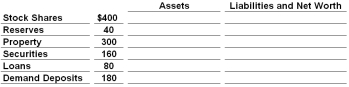 Refer to the data given above. This bank has total assets of:
 (Multiple Choice)
4.8/5 (76)
(76) The claims of creditors of a bank against the bank's assets are called:
(Multiple Choice)
4.9/5 (63)
(63) The fact that reserves lost by any particular bank will be gained by some other bank explains why the commercial banking system:
(Multiple Choice)
4.9/5 (77)
(77) A bank has reserves of $30,000 and deposits of $120,000. If the reserve ratio is 10%, then this bank can lend out a maximum of $12,000 in new loans.
(True/False)
4.8/5 (95)
(95) The fractional reserve system of banking started when goldsmiths began:
(Multiple Choice)
4.8/5 (81)
(81) When a bank grants a loan to a customer who gets the funds and keeps it at home for a while, then the money supply will:
(Multiple Choice)
4.9/5 (86)
(86) When cash is withdrawn from a checkable-deposit account at a bank:
(Multiple Choice)
4.9/5 (72)
(72) A commercial bank has actual reserves of $1 million and checkable-deposit liabilities of $9 million, and the required reserve ratio is 10 percent. The excess reserves of the bank are:
(Multiple Choice)
4.7/5 (73)
(73) 
Filters
- Essay(0)
- Multiple Choice(0)
- Short Answer(0)
- True False(0)
- Matching(0)