



 Chat with AI
Exam 15: Money Creation

Exam 1: Limits, Alternatives, and Choices212 Questions
Exam 2: The Market System and the Circular Flow141 Questions
Exam 3: Demand, Supply, and Market Equilibrium202 Questions
Exam 4: Market Failures: Public Goods and Externalities155 Questions
Exam 5: Governments Role and Government Failure148 Questions
Exam 6: An Introduction to Macroeconomics123 Questions
Exam 7: Measuring Domestic Output and National Income157 Questions
Exam 8: Economic Growth114 Questions
Exam 9: Business Cycles, Unemployment, and Inflation143 Questions
Exam 10: Basic Macroeconomic Relationships142 Questions
Exam 11: The Aggregate Expenditures Model143 Questions
Exam 12: Aggregate Demand and Aggregate Supply152 Questions
Exam 13: Fiscal Policy, Deficits, and Debt164 Questions
Exam 14: Money, Banking, and Financial Institutions130 Questions
Exam 15: Money Creation127 Questions
Exam 16: Interest Rates and Monetary Policy174 Questions
Exam 17: Financial Economics136 Questions
Exam 18: Extending the Analysis of Aggregate Supply135 Questions
Exam 19: Current Issues in Macro Theory and Policy134 Questions
Exam 20: International Trade151 Questions
Exam 21: The Balance of Payments, Exchange Rates, and Trade Deficits152 Questions
Exam 22: The Economics of Developing Countries135 Questions
Select questions type


Answer the question based on the following consolidated balance sheet for the commercial banking system. Assume the required reserve ratio is 12 percent. All figures are in billions of dollars: 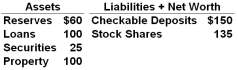 Refer to the above data. If the commercial banking system actually loans out the maximum amount it is able to lend, excess reserves will fall:
 (Multiple Choice)
4.8/5  (79)
(79) Assume the required reserve ratio is 16.67 percent and that the commercial banking system has $110 million in excess reserves. The maximum amount of new money which the banking system could create is about:
(Multiple Choice)
4.8/5 (91)
(91) If the banking system has $20 billion in excess reserves and if the reserve ratio is 10 percent, the system can increase its loans by a maximum of $22 billion.
(True/False)
4.8/5 (71)
(71) Which of the following factors can contribute to a further reduction in the money supply in addition to a massive withdrawal of cash from banks?
(Multiple Choice)
4.8/5 (79)
(79) When a bank grants a loan, the money supply M1 will increase, even if the funds from the loan are not spent.
(True/False)
4.7/5 (77)
(77) Answer the question based on the following balance sheet for the First National Bank. Assume the reserve ratio is 15 percent: 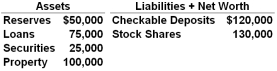 Refer to the above data. If the balance sheet was for the whole commercial banking system rather than a single bank, then loans and deposits could expand by a maximum of approximately:
 (Multiple Choice)
4.9/5 (76)
(76) The following table is the consolidated balance sheet for the commercial banking system. All figures are in billions. Assume that the required reserve ratio is 10 percent: 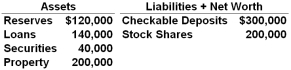 Refer to the above information. If there is a deposit of $10 billion of new currency into checking accounts in the banking system, excess reserves will increase by:
 (Multiple Choice)
4.8/5 (75)
(75) A commercial bank has no excess reserves until a depositor places $2,000 in cash in the bank. The reserve ratio is 10%. The bank then lends $1,500 to a borrower. As a consequence of these transactions the bank's excess reserves are:
(Multiple Choice)
4.9/5 (78)
(78) During a recession when banks tend to increase their excess reserves, the money supply M1 decreases.
(True/False)
4.8/5 (76)
(76) The multiple by which the commercial banking system can expand the supply of money is equal to:
(Multiple Choice)
4.8/5 (80)
(80) A bank has $2 million in checkable deposits. In the bank's balance sheet, this would be part of:
(Multiple Choice)
4.9/5 (74)
(74) When bank loans are repaid and the banks hold on to the funds as additional reserves, then the banking system's ability to "create" money decreases.
(True/False)
4.9/5 (82)
(82) The figures in the table below are for a single commercial bank. All figures are in thousands of dollars.  Refer to the data given above. If the reserve ratio is 10 percent and a check for $10,000 is drawn and cleared in favor of another bank, then the bank above will end up with excess reserves of:
 (Multiple Choice)
4.9/5 (83)
(83) The Norfolk Bank has $18,000 in excess reserves and the reserve ratio is 20 percent. How much checkable deposits and reserves does this bank hold?
(Multiple Choice)
4.8/5 (78)
(78) Assume that the reserve ratio is 20 percent and banks in the system are loaning out all their excess reserve. If people collectively cash out $10 billion from their checking accounts, then the lending ability of the banking system will be:
(Multiple Choice)
4.9/5 (67)
(67) The granting of a $10,000 loan and the purchase of a $10,000 government bond from a securities dealer by a commercial bank would have the same effect on the money supply.
(True/False)
4.7/5 (84)
(84) Answer the question based on the following balance sheet for the First National Bank. Assume the reserve ratio is 15 percent:  Refer to the data above. If a check for $14,000 is drawn and cleared against this bank, then its reserves and checkable deposits will be, respectively:
 (Multiple Choice)
4.8/5 (76)
(76) 
Filters
- Essay(0)
- Multiple Choice(0)
- Short Answer(0)
- True False(0)
- Matching(0)