



 Chat with AI
Exam 15: Money Creation

Exam 1: Limits, Alternatives, and Choices212 Questions
Exam 2: The Market System and the Circular Flow141 Questions
Exam 3: Demand, Supply, and Market Equilibrium202 Questions
Exam 4: Market Failures: Public Goods and Externalities155 Questions
Exam 5: Governments Role and Government Failure148 Questions
Exam 6: An Introduction to Macroeconomics123 Questions
Exam 7: Measuring Domestic Output and National Income157 Questions
Exam 8: Economic Growth114 Questions
Exam 9: Business Cycles, Unemployment, and Inflation143 Questions
Exam 10: Basic Macroeconomic Relationships142 Questions
Exam 11: The Aggregate Expenditures Model143 Questions
Exam 12: Aggregate Demand and Aggregate Supply152 Questions
Exam 13: Fiscal Policy, Deficits, and Debt164 Questions
Exam 14: Money, Banking, and Financial Institutions130 Questions
Exam 15: Money Creation127 Questions
Exam 16: Interest Rates and Monetary Policy174 Questions
Exam 17: Financial Economics136 Questions
Exam 18: Extending the Analysis of Aggregate Supply135 Questions
Exam 19: Current Issues in Macro Theory and Policy134 Questions
Exam 20: International Trade151 Questions
Exam 21: The Balance of Payments, Exchange Rates, and Trade Deficits152 Questions
Exam 22: The Economics of Developing Countries135 Questions
Select questions type


What is one significant consequence of fractional reserve banking?
(Multiple Choice)
4.8/5  (82)
(82) Maximum checkable-deposit expansion in the banking system is equal to:
(Multiple Choice)
4.7/5 (87)
(87) The amount of required reserves that a bank must hold is computed as a certain fraction of the bank's assets.
(True/False)
4.9/5 (82)
(82) In an unregulated environment, the commercial banking system would tend to vary the supply of money in a way that:
(Multiple Choice)
4.7/5 (80)
(80) One bank can borrow reserves from another bank, and the interest on the loan is called the federal funds rate.
(True/False)
4.8/5 (92)
(92) The primary reason commercial banks must keep required reserves on deposit at the Fed is to:
(Multiple Choice)
4.9/5 (85)
(85) Answer the question based on the following consolidated balance sheet for the commercial banking system. Assume the required reserve ratio is 12 percent. All figures are in billions of dollars: 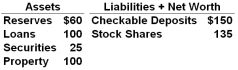 Refer to the above data. The commercial banking system has excess reserves of:
 (Multiple Choice)
4.9/5 (86)
(86) Henry deposits $2,000 in currency in the First Street Bank. Later that same day Jane Harris negotiates a loan for $5,400 at the same bank. After these transactions, the supply of money has:
(Multiple Choice)
4.8/5 (80)
(80) The federal funds rate is the interest rate that the Fed charges banks for its loans to them.
(True/False)
4.8/5 (92)
(92) An individual deposits $12,000 in a commercial bank. The bank is required to hold 10 percent of all deposits on reserve at the regional Federal Reserve Bank. The deposit increases the loan capacity of the bank by:
(Multiple Choice)
4.9/5 (73)
(73) One way to enhance the stability of the banking system is to:
(Multiple Choice)
4.8/5 (74)
(74) The following table is the consolidated balance sheet for the commercial banking system. All figures are in billions. Assume that the required reserve ratio is 10 percent: 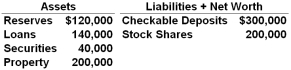 Refer to the above information. The maximum amount by which this commercial banking system can expand the supply of money by lending is:
 (Multiple Choice)
4.9/5 (67)
(67) The use of high leveraging by banks leads to the banking system's:
(Multiple Choice)
4.8/5 (87)
(87) If Bank A has excess reserves of $1 million and all other banks in the system do not have any excess reserves, then the amount of additional loans that can be made by the banking system will be:
(Multiple Choice)
4.8/5 (71)
(71) If the Federal Reserve System sells $5 billion of government securities to commercial banks, the banks' reserves would:
(Multiple Choice)
4.8/5 (74)
(74) Answer the question based on the following balance sheet for the First National Bank. Assume the reserve ratio is 15 percent: 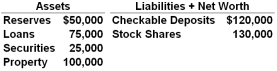 Refer to the above data. First National Bank can make new loans of up to:
 (Multiple Choice)
4.7/5 (66)
(66) Suppose the Northwestern Bank has excess reserves of $12,000 and checkable deposits of $125,000. If the reserve requirement is 20 percent, what are the bank's actual reserves?
(Multiple Choice)
4.8/5 (61)
(61) What is one significant characteristic of fractional reserve banking?
(Multiple Choice)
4.8/5 (73)
(73) 
Filters
- Essay(0)
- Multiple Choice(0)
- Short Answer(0)
- True False(0)
- Matching(0)