



 Chat with AI
Exam 15: Money Creation

Exam 1: Limits, Alternatives, and Choices212 Questions
Exam 2: The Market System and the Circular Flow141 Questions
Exam 3: Demand, Supply, and Market Equilibrium202 Questions
Exam 4: Market Failures: Public Goods and Externalities155 Questions
Exam 5: Governments Role and Government Failure148 Questions
Exam 6: An Introduction to Macroeconomics123 Questions
Exam 7: Measuring Domestic Output and National Income157 Questions
Exam 8: Economic Growth114 Questions
Exam 9: Business Cycles, Unemployment, and Inflation143 Questions
Exam 10: Basic Macroeconomic Relationships142 Questions
Exam 11: The Aggregate Expenditures Model143 Questions
Exam 12: Aggregate Demand and Aggregate Supply152 Questions
Exam 13: Fiscal Policy, Deficits, and Debt164 Questions
Exam 14: Money, Banking, and Financial Institutions130 Questions
Exam 15: Money Creation127 Questions
Exam 16: Interest Rates and Monetary Policy174 Questions
Exam 17: Financial Economics136 Questions
Exam 18: Extending the Analysis of Aggregate Supply135 Questions
Exam 19: Current Issues in Macro Theory and Policy134 Questions
Exam 20: International Trade151 Questions
Exam 21: The Balance of Payments, Exchange Rates, and Trade Deficits152 Questions
Exam 22: The Economics of Developing Countries135 Questions
Select questions type


The balance sheet below is for the First Federal Bank. Assume the required reserve ratio is 20 percent. 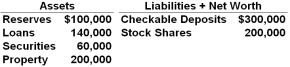 Refer to the above information. If the original bank balance sheet was for the whole commercial banking system rather than a single bank, loans and deposits could have been expanded by a maximum of:
 (Multiple Choice)
4.9/5  (84)
(84) A depositor places $10,000 in cash in a commercial bank, where the required reserve ratio is 10 percent. The bank sends the $10,000 to its Federal Reserve Bank. As a result, the actual reserves, required reserves, and excess reserves of the bank have been increased by:
(Multiple Choice)
4.9/5 (75)
(75) When a bank grants a loan to a customer who then keeps the funds in her checking account at that bank, then the bank's:
(Multiple Choice)
4.9/5 (79)
(79) If all depositors of a bank were to try withdrawing all their deposits at the same time, a good solid bank should be able to meet all the withdrawals.
(True/False)
4.8/5 (66)
(66) Only one commercial bank in the banking system has an excess reserve, and its excess reserve is $400,000. This bank makes a new loan of $300,000 and keeps an excess reserve of $100,000. If the required reserve ratio for all banks is 12.5 percent, the potential expansion of the money supply from this new loan is:
(Multiple Choice)
4.9/5 (83)
(83) The figures in the table below are for a single commercial bank. All figures are in thousands of dollars.  Refer to the data given above. If the reserve ratio is 10 percent and a check for $10,000 is drawn and cleared in favor of another bank, then the actual reserves of the bank above will:
 (Multiple Choice)
4.7/5 (68)
(68) A commercial bank has no excess reserves until a depositor places $5000 in cash at the bank. The commercial bank then lends $4000 to a borrower. As a consequence of these transactions the size of the money supply has:
(Multiple Choice)
4.9/5 (69)
(69) If the required reserve ratio is 20 percent and commercial bankers decide to hold additional excess reserves equal to 5 percent of any newly acquired checkable deposits, then the effective monetary multiplier for the banking system will be:
(Multiple Choice)
4.8/5 (80)
(80) If the reserve ratio is 25 percent, what level of excess reserves does a bank acquire when a customer deposits a $12,000 check drawn on another bank?
(Multiple Choice)
4.9/5 (80)
(80) A bank can get additional excess reserves by doing any of the following, except:
(Multiple Choice)
5.0/5 (80)
(80) A depositor places $5,000 in cash in a commercial bank, and the reserve ratio is 20 percent; the bank sends the $5,000 to the Federal Reserve Bank. As a result, the reserves and excess reserves of the bank have been increased, respectively, by:
(Multiple Choice)
5.0/5 (78)
(78) When a check is cleared against a bank, the bank will lose:
(Multiple Choice)
4.9/5 (79)
(79) The maximum deposit creation that can be made in the banking system is equal to the excess reserves divided by the required reserve ratio.
(True/False)
4.8/5 (76)
(76) A commercial bank sells a $10,000 government bond to a securities dealer. The dealer pays for the bond in cash, which the bank adds to its vault cash. The money supply has:
(Multiple Choice)
4.9/5 (86)
(86) The basic purpose of imposing legal reserve requirements on commercial banks is to:
(Multiple Choice)
5.0/5 (83)
(83) Suppose a commercial banking system has $240,000 of outstanding checkable deposits and actual reserves of $85,000. If the reserve ratio is 25 percent, the banking system can expand the supply of money by a maximum of:
(Multiple Choice)
4.8/5 (81)
(81) The relative importance of various asset items on a commercial bank's balance sheet reflects a bank's pursuit of which two conflicting goals?
(Multiple Choice)
4.9/5 (76)
(76) What percent of the money that a typical modern bank invests comes from borrowing?
(Multiple Choice)
4.7/5 (76)
(76) Answer the question based on the following consolidated balance sheet for the commercial banking system. Assume the required reserve ratio is 12 percent. All figures are in billions of dollars: 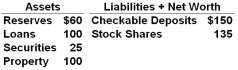 Refer to the above data. The maximum amount by which the commercial banking system can expand the supply of money by lending is:
 (Multiple Choice)
4.8/5 (78)
(78) 
Filters
- Essay(0)
- Multiple Choice(0)
- Short Answer(0)
- True False(0)
- Matching(0)