



 Chat with AI
Exam 15: Money Creation

Exam 1: Limits, Alternatives, and Choices212 Questions
Exam 2: The Market System and the Circular Flow141 Questions
Exam 3: Demand, Supply, and Market Equilibrium202 Questions
Exam 4: Market Failures: Public Goods and Externalities155 Questions
Exam 5: Governments Role and Government Failure148 Questions
Exam 6: An Introduction to Macroeconomics123 Questions
Exam 7: Measuring Domestic Output and National Income157 Questions
Exam 8: Economic Growth114 Questions
Exam 9: Business Cycles, Unemployment, and Inflation143 Questions
Exam 10: Basic Macroeconomic Relationships142 Questions
Exam 11: The Aggregate Expenditures Model143 Questions
Exam 12: Aggregate Demand and Aggregate Supply152 Questions
Exam 13: Fiscal Policy, Deficits, and Debt164 Questions
Exam 14: Money, Banking, and Financial Institutions130 Questions
Exam 15: Money Creation127 Questions
Exam 16: Interest Rates and Monetary Policy174 Questions
Exam 17: Financial Economics136 Questions
Exam 18: Extending the Analysis of Aggregate Supply135 Questions
Exam 19: Current Issues in Macro Theory and Policy134 Questions
Exam 20: International Trade151 Questions
Exam 21: The Balance of Payments, Exchange Rates, and Trade Deficits152 Questions
Exam 22: The Economics of Developing Countries135 Questions
Select questions type


The figures in the table below are for a single commercial bank. All figures are in thousands of dollars.  Refer to the data given above. If the required reserve ratio is 10 percent, the bank has excess reserves of:
 (Multiple Choice)
4.7/5  (82)
(82) A bank's checkable deposits shrinks from $40 million to $33 million. What happens to its required reserves if the required reserve ratio is 3%?
(Multiple Choice)
4.7/5 (76)
(76) A bank owns a 10-story office building. In the bank's balance sheet, this would be listed as part of:
(Multiple Choice)
4.9/5 (86)
(86) A bank is in the position to make loans when required reserves:
(Multiple Choice)
4.9/5 (71)
(71) Answer the question based on the following consolidated balance sheet for the commercial banking system. Assume the required reserve ratio is 12 percent. All figures are in billions of dollars: 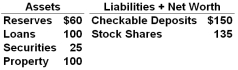 Refer to the above data. The claims of owners in the commercial banking system are equal to:
 (Multiple Choice)
4.8/5 (87)
(87) In the Federal funds market, a bank that needs to meet reserve requirements can borrow reserves, usually for a period:
(Multiple Choice)
4.9/5 (80)
(80) A commercial bank has excess reserves of $5000 and a required reserve ratio of 20 percent. It makes a loan of $6000 to a borrower. The borrower writes a check for $6000 that is deposited in another commercial bank. After the check clears, the first bank will be short of reserves in the amount of:
(Multiple Choice)
4.8/5 (67)
(67) When people withdraw money from their deposits in the banking system, the:
(Multiple Choice)
4.9/5 (71)
(71) The monetary multiplier can also be called the spending multiplier.
(True/False)
4.8/5 (88)
(88) A commercial bank has excess reserves of $10,000 and a required reserve ratio of 20%. It grants a loan of $8,000 to a customer, who then writes out a check for $8,000 that is deposited in another bank. The first bank will find its reserves decrease by:
(Multiple Choice)
4.8/5 (64)
(64) When a bank's loan defaults, then the bank's reserves will decrease.
(True/False)
4.8/5 (88)
(88) When a bank accepts additional deposits, its required reserves and excess reserves will both increase.
(True/False)
4.8/5 (77)
(77) A commercial bank has checkable-deposit liabilities of $50,000 and a required-reserve ratio of 20 percent. What is the amount of required reserves?
(Multiple Choice)
4.8/5 (90)
(90) A commercial bank has required reserves of $60 million and the reserve ratio is 20 percent. How much are the commercial bank's checkable-deposit liabilities?
(Multiple Choice)
4.8/5 (75)
(75) The figures in the table below are for a single commercial bank. All figures are in thousands of dollars.  Refer to the data given above. This bank has liabilities and net worth totaling:
 (Multiple Choice)
4.8/5 (85)
(85) The commercial banking system has excess reserves of $200,000. Then new loans of $800,000 are subsequently made, and the system ends up just meeting its reserve requirements. The required reserve ratio must be:
(Multiple Choice)
5.0/5 (81)
(81) 
Filters
- Essay(0)
- Multiple Choice(0)
- Short Answer(0)
- True False(0)
- Matching(0)