



 Chat with AI
Exam 16: Interest Rates and Monetary Policy

Exam 1: Limits, Alternatives, and Choices212 Questions
Exam 2: The Market System and the Circular Flow141 Questions
Exam 3: Demand, Supply, and Market Equilibrium202 Questions
Exam 4: Market Failures: Public Goods and Externalities155 Questions
Exam 5: Governments Role and Government Failure148 Questions
Exam 6: An Introduction to Macroeconomics123 Questions
Exam 7: Measuring Domestic Output and National Income157 Questions
Exam 8: Economic Growth114 Questions
Exam 9: Business Cycles, Unemployment, and Inflation143 Questions
Exam 10: Basic Macroeconomic Relationships142 Questions
Exam 11: The Aggregate Expenditures Model143 Questions
Exam 12: Aggregate Demand and Aggregate Supply152 Questions
Exam 13: Fiscal Policy, Deficits, and Debt164 Questions
Exam 14: Money, Banking, and Financial Institutions130 Questions
Exam 15: Money Creation127 Questions
Exam 16: Interest Rates and Monetary Policy174 Questions
Exam 17: Financial Economics136 Questions
Exam 18: Extending the Analysis of Aggregate Supply135 Questions
Exam 19: Current Issues in Macro Theory and Policy134 Questions
Exam 20: International Trade151 Questions
Exam 21: The Balance of Payments, Exchange Rates, and Trade Deficits152 Questions
Exam 22: The Economics of Developing Countries135 Questions
Select questions type


The major problem facing the economy is high unemployment and weak economic growth. The inflation rate is low and stable. Therefore, the Federal Reserve decides to pursue a policy to increase the rate of economic growth. Which policy changes by the Fed would reinforce each other to achieve that objective?
(Multiple Choice)
4.7/5  (76)
(76) 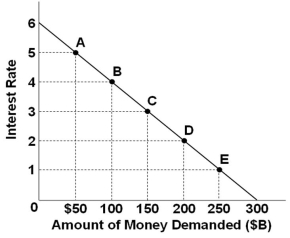 Refer to the graph above. If the interest rate rises from 2 percent to 3 percent, the supply of money must have:
 (Multiple Choice)
4.9/5 (83)
(83) 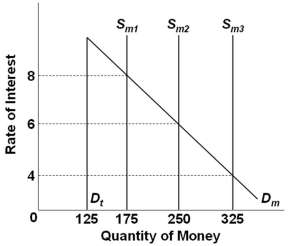 Refer to the graph above, in which Dt is the transactions demand for money, Dm is the total demand for money, and Sm is the supply of money. The market is initially in equilibrium at a 6 percent interest rate. If the money supply increases, then Sm2 will shift to:
 (Multiple Choice)
4.8/5 (84)
(84) Raising the interest paid on reserves has the effect of making it:
(Multiple Choice)
4.7/5 (81)
(81) After the Great Recession when the recovery turned out to be very weak, economic policy in the U.S. had to turn forcefully toward fiscal policy because of the following reasons, except:
(Multiple Choice)
4.7/5 (78)
(78) Answer the question based on the information given in the table below that shows the items and figures taken from a consolidated balance sheet of the twelve Federal Reserve Banks. All figures are in billions of dollars. 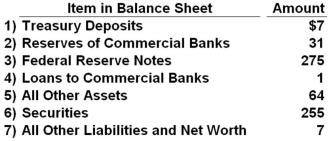 In the balance sheet above for the Federal Reserve, the liabilities and net worth would be items 7 and:
 (Multiple Choice)
4.9/5 (85)
(85) The Fed's response to the zero lower bound problem was quantitative easing (or "QE"), where the Fed buys large amounts of bonds in order to:
(Multiple Choice)
4.8/5 (81)
(81) Suppose the economy is at full employment with a high inflation rate. Which combination of government policies is most likely to reduce the inflation rate?
(Multiple Choice)
4.9/5 (75)
(75) 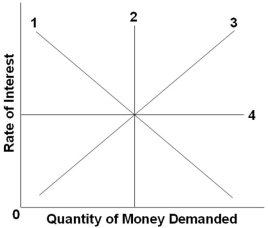 Which line in the graph above would best illustrate the supply of money curve?
 (Multiple Choice)
5.0/5 (69)
(69) If the Fed is trying to make the interest rates go down, it wants:
(Multiple Choice)
4.9/5 (80)
(80) According to the Taylor rule, if the target rate of inflation for the Fed is two percent and real GDP rises by one percent above potential GDP, then the Fed should:
(Multiple Choice)
5.0/5 (86)
(86) Assume that the required reserve ratio for the commercial banks is 25 percent. If the Federal Reserve Banks buy $3 billion in government securities from the non-bank securities dealers, then as a result of this transaction, the lending ability of the commercial banking system will increase by:
(Multiple Choice)
4.8/5 (84)
(84) 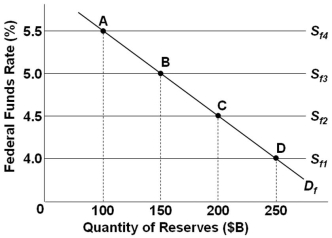 Refer to the figure above. Which change would be consistent with an attempt by the Federal Reserve to rein in inflation?
 (Multiple Choice)
4.9/5 (82)
(82) Assume that the required reserve ratio is 20 percent. If the Federal Reserve buys $80 million in government securities from the general public, then the money supply will immediately:
(Multiple Choice)
4.9/5 (75)
(75) 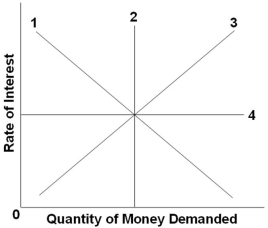 Which line in the graph above would best illustrate the transactions demand for money curve?
 (Multiple Choice)
4.7/5 (79)
(79) The important effects of ZIRP, QE, and Operation Twist include the following, except:
(Multiple Choice)
5.0/5 (81)
(81) If the Fed sells $10 million in government securities to commercial banks, the size of the effect on the banks' excess reserves is not the same as if the Fed sold the securities to the public instead.
(True/False)
4.8/5 (78)
(78) When the Fed lowered short-term interest rates to near zero but the policy didn't seem to stimulate the economy enough, the Fed in 2009 also began conducting the policy of expansive buying of bonds now known as:
(Multiple Choice)
4.8/5 (79)
(79) 
Filters
- Essay(0)
- Multiple Choice(0)
- Short Answer(0)
- True False(0)
- Matching(0)