



 Chat with AI
Exam 1: Limits, Alternatives, and Choices

Exam 1: Limits, Alternatives, and Choices212 Questions
Exam 2: The Market System and the Circular Flow141 Questions
Exam 3: Demand, Supply, and Market Equilibrium202 Questions
Exam 4: Market Failures: Public Goods and Externalities155 Questions
Exam 5: Governments Role and Government Failure148 Questions
Exam 6: An Introduction to Macroeconomics123 Questions
Exam 7: Measuring Domestic Output and National Income157 Questions
Exam 8: Economic Growth114 Questions
Exam 9: Business Cycles, Unemployment, and Inflation143 Questions
Exam 10: Basic Macroeconomic Relationships142 Questions
Exam 11: The Aggregate Expenditures Model143 Questions
Exam 12: Aggregate Demand and Aggregate Supply152 Questions
Exam 13: Fiscal Policy, Deficits, and Debt164 Questions
Exam 14: Money, Banking, and Financial Institutions130 Questions
Exam 15: Money Creation127 Questions
Exam 16: Interest Rates and Monetary Policy174 Questions
Exam 17: Financial Economics136 Questions
Exam 18: Extending the Analysis of Aggregate Supply135 Questions
Exam 19: Current Issues in Macro Theory and Policy134 Questions
Exam 20: International Trade151 Questions
Exam 21: The Balance of Payments, Exchange Rates, and Trade Deficits152 Questions
Exam 22: The Economics of Developing Countries135 Questions
Select questions type


A person observes that consumer prices often fall when a nation experiences economic growth. The person then concludes that falling consumer prices leads to economic growth. This would be an example of:
(Multiple Choice)
4.7/5  (75)
(75) Suppose that a consumer purchases just two goods, X and Y. The slope of the budget line would indicate the:
(Multiple Choice)
4.8/5 (80)
(80) Increasing the share of your income that you save is good for you. Therefore it would be good for the whole economy if everyone saved more. This exemplifies the:
(Multiple Choice)
4.8/5 (82)
(82) A nation's production possibilities curve shows the maximum combinations of resources that a nation can use.
(True/False)
4.9/5 (84)
(84) Economics is a social science that studies how individuals, institutions, and society may:
(Multiple Choice)
4.9/5 (78)
(78) Economic analysis is primarily concerned with marginal changes from the status quo, as a result of a certain action or decision.
(True/False)
4.9/5 (83)
(83) If two variables are directly related, the relationship will have a graph that:
(Multiple Choice)
4.8/5 (72)
(72) If a linear relation is described by the equation was C = 35 - 5D, then the vertical intercept of the graph (where C is on the vertical axis) is:
(Multiple Choice)
4.8/5 (78)
(78) A society can consume a combination of goods outside its production possibilities if there is:
(Multiple Choice)
4.8/5 (80)
(80) 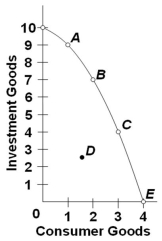 Refer to the above graph. Which point in the graph would allow a simultaneous increase in the production of both investment and consumer goods?
 (Multiple Choice)
4.7/5 (81)
(81) Which of the following statements is an explanation for the law of increasing opportunity costs?
(Multiple Choice)
4.8/5 (93)
(93) If a nation is initially on its production possibilities curve, then it can increase its production of one good only by:
(Multiple Choice)
4.9/5 (78)
(78) In the graph for the linear equation S = 15 - 5T, with T on the horizontal axis, the vertical intercept of the graph is -5.
(True/False)
4.7/5 (85)
(85) In graphing a relationship between two variables, economists always follow the mathematical convention. Thus, if price is the independent variable then it is measured on the horizontal axis.
(True/False)
4.8/5 (83)
(83) When a state government chooses to build more roads, the resources used are no longer available for public education programs. This dilemma illustrates the concept of:
(Multiple Choice)
4.9/5 (85)
(85) Which of the following is considered a firm's "factor of production"?
(Multiple Choice)
4.8/5 (77)
(77) Economic models do not reflect the full complexity of reality, but instead are based on:
(Multiple Choice)
4.9/5 (84)
(84) What does "there is no such thing as a free lunch" mean in economics?
(Multiple Choice)
4.8/5 (81)
(81) 
Filters
- Essay(0)
- Multiple Choice(0)
- Short Answer(0)
- True False(0)
- Matching(0)