



 Chat with AI
Exam 1: Limits, Alternatives, and Choices

Exam 1: Limits, Alternatives, and Choices212 Questions
Exam 2: The Market System and the Circular Flow141 Questions
Exam 3: Demand, Supply, and Market Equilibrium202 Questions
Exam 4: Market Failures: Public Goods and Externalities155 Questions
Exam 5: Governments Role and Government Failure148 Questions
Exam 6: An Introduction to Macroeconomics123 Questions
Exam 7: Measuring Domestic Output and National Income157 Questions
Exam 8: Economic Growth114 Questions
Exam 9: Business Cycles, Unemployment, and Inflation143 Questions
Exam 10: Basic Macroeconomic Relationships142 Questions
Exam 11: The Aggregate Expenditures Model143 Questions
Exam 12: Aggregate Demand and Aggregate Supply152 Questions
Exam 13: Fiscal Policy, Deficits, and Debt164 Questions
Exam 14: Money, Banking, and Financial Institutions130 Questions
Exam 15: Money Creation127 Questions
Exam 16: Interest Rates and Monetary Policy174 Questions
Exam 17: Financial Economics136 Questions
Exam 18: Extending the Analysis of Aggregate Supply135 Questions
Exam 19: Current Issues in Macro Theory and Policy134 Questions
Exam 20: International Trade151 Questions
Exam 21: The Balance of Payments, Exchange Rates, and Trade Deficits152 Questions
Exam 22: The Economics of Developing Countries135 Questions
Select questions type


You observe that when stock prices rise, interest rates soon fall, and therefore conclude that higher stock prices lead to lower interest rates. This would be an example of:
(Multiple Choice)
4.9/5  (82)
(82) A nation can produce two products: steel and wheat. The table below is the nation's production possibilities schedule: 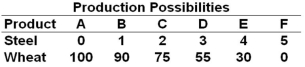 Refer to the above table. In moving from combination E to F, the opportunity cost of an additional unit of steel is:
 (Multiple Choice)
4.8/5 (69)
(69) Which of the following is another way of saying "marginal benefits of an action"?
(Multiple Choice)
4.8/5 (78)
(78) One major part of the opportunity costs of one's decision to go to college after high-school graduation is the:
(Multiple Choice)
4.8/5 (85)
(85) The question below are based on the following four sets of data-pairs: (1) A and B, (2) C and D, (3) E and F, and (4) G and H. In each set, the independent variable is in the left column and the dependent variable is in the right column. 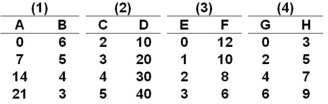 The slope of the linear graph that pictures data set 2 above is:
 (Multiple Choice)
5.0/5 (86)
(86) If the opportunity cost of producing extra units of one good (expressed in terms of the amount of another good given up) remains constant, then the shape of the production possibilities curve is:
(Multiple Choice)
4.9/5 (83)
(83) In analyzing human decision and action, economists assume that:
(Multiple Choice)
4.8/5 (79)
(79) Consider an economy that is producing inside its production possibilities curve. This economy could move closer towards its production possibilities curve by:
(Multiple Choice)
4.8/5 (71)
(71) An assumption is usually made in a two-axes (or two-dimensional) graph that, aside from the two variables under study, the influence of all other variables or factors is assumed to be constant.
(True/False)
4.8/5 (90)
(90) The question below are based on the following four sets of data-pairs: (1) A and B, (2) C and D, (3) E and F, and (4) G and H. In each set, the independent variable is in the left column and the dependent variable is in the right column. 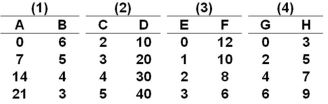 The linear equation for the relationship in data set 1 above is:
 (Multiple Choice)
4.9/5 (84)
(84) A nation can produce two products: tanks and autos. The table below is the nation's production possibilities: 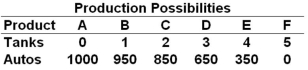 Refer to the above table. The total opportunity cost of three units of tanks is:
 (Multiple Choice)
4.8/5 (69)
(69) One basic difference between "labor" and "entrepreneur" is that:
(Multiple Choice)
4.7/5 (73)
(73) If falling gasoline prices are good for the consumers, then it must be good everyone in the economy.
(True/False)
4.8/5 (86)
(86) If two sets of data are inversely related, they will appear on a graph as an upward-sloping line.
(True/False)
4.7/5 (78)
(78) From an economic perspective, when consumers leave a fast-food restaurant because the lines to be served are too long, they have concluded that the:
(Multiple Choice)
4.7/5 (81)
(81) A linear relationship only refers to one whose graph is either vertical or horizontal.
(True/False)
4.8/5 (77)
(77) 
Filters
- Essay(0)
- Multiple Choice(0)
- Short Answer(0)
- True False(0)
- Matching(0)