



 Chat with AI
Exam 1: Limits, Alternatives, and Choices

Exam 1: Limits, Alternatives, and Choices212 Questions
Exam 2: The Market System and the Circular Flow141 Questions
Exam 3: Demand, Supply, and Market Equilibrium202 Questions
Exam 4: Market Failures: Public Goods and Externalities155 Questions
Exam 5: Governments Role and Government Failure148 Questions
Exam 6: An Introduction to Macroeconomics123 Questions
Exam 7: Measuring Domestic Output and National Income157 Questions
Exam 8: Economic Growth114 Questions
Exam 9: Business Cycles, Unemployment, and Inflation143 Questions
Exam 10: Basic Macroeconomic Relationships142 Questions
Exam 11: The Aggregate Expenditures Model143 Questions
Exam 12: Aggregate Demand and Aggregate Supply152 Questions
Exam 13: Fiscal Policy, Deficits, and Debt164 Questions
Exam 14: Money, Banking, and Financial Institutions130 Questions
Exam 15: Money Creation127 Questions
Exam 16: Interest Rates and Monetary Policy174 Questions
Exam 17: Financial Economics136 Questions
Exam 18: Extending the Analysis of Aggregate Supply135 Questions
Exam 19: Current Issues in Macro Theory and Policy134 Questions
Exam 20: International Trade151 Questions
Exam 21: The Balance of Payments, Exchange Rates, and Trade Deficits152 Questions
Exam 22: The Economics of Developing Countries135 Questions
Select questions type


The fundamental economic problem faced by a society is that productive resources are so varied and versatile, that it is hard to decide what to do with them.
(True/False)
4.8/5  (88)
(88) Money is not considered to be an economic resource because:
(Multiple Choice)
4.9/5 (89)
(89) If the marginal benefits are greater than the marginal cost of an activity, then society should allocate fewer resources to this activity.
(True/False)
4.8/5 (76)
(76) A nation that devotes more of its resources to the production of capital goods is likely to:
(Multiple Choice)
4.9/5 (90)
(90) If A is the dependent variable and B is the independent variable, then a change in A results in a change in
B.
(True/False)
4.9/5 (72)
(72) Assume that a consumer has a given budget or income of $12, and that she can buy only two goods, apples or bananas. The price of an apple is $1.50 and the price of a banana is $0.75. Refer to the information given above. If the consumer decides to buy 4 apples, how many bananas can she also buy with the remainder of her budget?
(Multiple Choice)
4.8/5 (80)
(80) The economizing problem is essentially one of deciding how to make the best use of:
(Multiple Choice)
4.9/5 (85)
(85) The economizing problem for individuals is a consequence of the fact that:
(Multiple Choice)
4.8/5 (93)
(93) If the marginal benefit of a good is less than its marginal cost, then the nation should:
(Multiple Choice)
4.9/5 (61)
(61) Imagine an ideal scenario where world peace prevails and all nations are led by peace-minded leaders. In such a world, the:
(Multiple Choice)
4.9/5 (80)
(80) 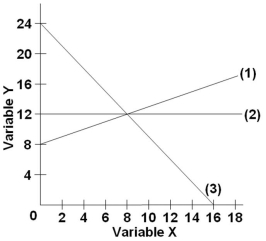 The slope of line (2) on the above graph is:
A point or combination that is on the production possibilities curve is:
(Multiple Choice)
5.0/5 (77)
(77) An economic model is a purposeful simplification of reality, whose function includes:
(Multiple Choice)
4.9/5 (76)
(76) 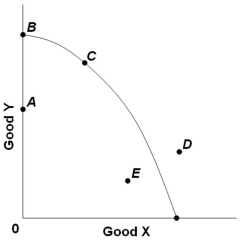 The graph above shows the production possibilities curve for an economy producing two goods, X and Y. Which of the points on the graph indicate unemployed resources?
 (Multiple Choice)
4.8/5 (84)
(84) Which of the following illustrates a macroeconomic question?
(Multiple Choice)
4.7/5 (72)
(72) The following graph is the production possibilities curve of a nation: 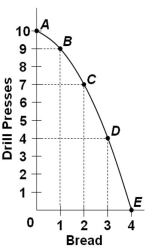 Refer to the above graph. Which of the following combinations would be unattainable?
 (Multiple Choice)
4.9/5 (82)
(82) The study of economics is not useful for consumers because economic analysis focuses only on businesses and the economy.
(True/False)
4.9/5 (80)
(80) 
Filters
- Essay(0)
- Multiple Choice(0)
- Short Answer(0)
- True False(0)
- Matching(0)