



 Chat with AI
Exam 1: Limits, Alternatives, and Choices

Exam 1: Limits, Alternatives, and Choices212 Questions
Exam 2: The Market System and the Circular Flow141 Questions
Exam 3: Demand, Supply, and Market Equilibrium202 Questions
Exam 4: Market Failures: Public Goods and Externalities155 Questions
Exam 5: Governments Role and Government Failure148 Questions
Exam 6: An Introduction to Macroeconomics123 Questions
Exam 7: Measuring Domestic Output and National Income157 Questions
Exam 8: Economic Growth114 Questions
Exam 9: Business Cycles, Unemployment, and Inflation143 Questions
Exam 10: Basic Macroeconomic Relationships142 Questions
Exam 11: The Aggregate Expenditures Model143 Questions
Exam 12: Aggregate Demand and Aggregate Supply152 Questions
Exam 13: Fiscal Policy, Deficits, and Debt164 Questions
Exam 14: Money, Banking, and Financial Institutions130 Questions
Exam 15: Money Creation127 Questions
Exam 16: Interest Rates and Monetary Policy174 Questions
Exam 17: Financial Economics136 Questions
Exam 18: Extending the Analysis of Aggregate Supply135 Questions
Exam 19: Current Issues in Macro Theory and Policy134 Questions
Exam 20: International Trade151 Questions
Exam 21: The Balance of Payments, Exchange Rates, and Trade Deficits152 Questions
Exam 22: The Economics of Developing Countries135 Questions
Select questions type


A nation can produce two products: steel and wheat. The table below is the nation's production possibilities schedule: 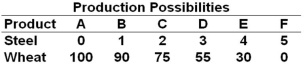 Refer to the above table. In moving stepwise from possibility A to B to C … to F, the opportunity cost of a unit of steel in terms of wheat:
 (Multiple Choice)
4.8/5  (81)
(81) In a graph of the relationship between income and saving, economists generally consider:
(Multiple Choice)
4.9/5 (70)
(70) The idea in economics that "there is no free lunch" means that:
(Multiple Choice)
4.9/5 (81)
(81) The process of observing real-world behavior, developing hypotheses, testing them against facts, then using the results to construct theories is called:
(Multiple Choice)
4.9/5 (75)
(75) Assume that a consumer purchases only two products. Suppose that the consumer's money income doubles, and the prices of the two products also double. These changes in income and prices will result in:
(Multiple Choice)
4.9/5 (81)
(81) Assume that a consumer spends a given budget on only two goods, and that the prices of the two goods are constant. The budget line in this case would:
(Multiple Choice)
4.9/5 (92)
(92) Which one of the following is a normative economic statement?
(Multiple Choice)
4.9/5 (72)
(72) Suppose there are two economies, Alpha and Beta, which have the same production possibilities curves. If Beta devotes more resources to produce capital goods than consumer goods as compared to Alpha, then in the future:
(Multiple Choice)
4.7/5 (86)
(86) Which of the following suggests a direct relationship between x and y?
(Multiple Choice)
4.8/5 (74)
(74) "The role of government in the economy should be kept to a minimum" is an example of a positive economic statement.
(True/False)
4.8/5 (69)
(69) Assume that a consumer purchases only two products and there is a decrease in the consumer's income. The prices of the two products stay constant. The decrease in income will result in a:
(Multiple Choice)
4.9/5 (76)
(76) A point inside the production possibilities curve is ____ while a point outside the curve is ____.
(Multiple Choice)
4.8/5 (93)
(93) A nation can produce two products: tanks and autos. The table below is the nation's production possibilities: 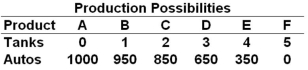 Refer to the above table. According to the production possibilities schedule, a combination of 4 tanks and 650 autos is:
 (Multiple Choice)
4.9/5 (73)
(73) The opportunity cost to a consumer who smokes cigarettes consists of the:
(Multiple Choice)
4.8/5 (84)
(84) A nation's consumption is strictly limited by its production possibilities, even with international trade.
(True/False)
4.8/5 (76)
(76) 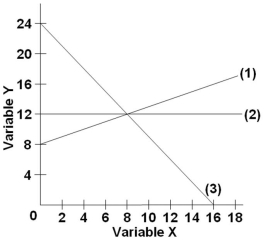 The vertical intercept of line (3) on the above graph is:
Cuba is a command economy that suffered a decline in economic growth because of a cut in the aid provided by the former Soviet Union when the latter collapsed. As a consequence, Cuba:
(Multiple Choice)
5.0/5 (85)
(85) 
Filters
- Essay(0)
- Multiple Choice(0)
- Short Answer(0)
- True False(0)
- Matching(0)