



 Chat with AI
Exam 13: Fiscal Policy, Deficits, and Debt

Exam 1: Limits, Alternatives, and Choices212 Questions
Exam 2: The Market System and the Circular Flow141 Questions
Exam 3: Demand, Supply, and Market Equilibrium202 Questions
Exam 4: Market Failures: Public Goods and Externalities155 Questions
Exam 5: Governments Role and Government Failure148 Questions
Exam 6: An Introduction to Macroeconomics123 Questions
Exam 7: Measuring Domestic Output and National Income157 Questions
Exam 8: Economic Growth114 Questions
Exam 9: Business Cycles, Unemployment, and Inflation143 Questions
Exam 10: Basic Macroeconomic Relationships142 Questions
Exam 11: The Aggregate Expenditures Model143 Questions
Exam 12: Aggregate Demand and Aggregate Supply152 Questions
Exam 13: Fiscal Policy, Deficits, and Debt164 Questions
Exam 14: Money, Banking, and Financial Institutions130 Questions
Exam 15: Money Creation127 Questions
Exam 16: Interest Rates and Monetary Policy174 Questions
Exam 17: Financial Economics136 Questions
Exam 18: Extending the Analysis of Aggregate Supply135 Questions
Exam 19: Current Issues in Macro Theory and Policy134 Questions
Exam 20: International Trade151 Questions
Exam 21: The Balance of Payments, Exchange Rates, and Trade Deficits152 Questions
Exam 22: The Economics of Developing Countries135 Questions
Select questions type


As of 2012, more than half of the total debt of the U.S. government was owed to foreigners.
(True/False)
4.8/5  (79)
(79) A decrease in government spending and a cut in taxes would be a pair of fiscal policies that reinforce each other.
(True/False)
4.9/5 (85)
(85) One timing problem in using fiscal policy to counter a recession is the "administrative lag" that occurs between the:
(Multiple Choice)
4.8/5 (76)
(76) The cyclically-adjusted budget deficit in an economy is zero. If this economy goes into recession, then the actual government budget will be:
(Multiple Choice)
4.8/5 (79)
(79)  Refer to the graph above. A budget surplus would be associated with GDP level:
 (Multiple Choice)
4.9/5 (69)
(69) Assume that the economy is in a recession and there is a budget deficit. A strict balanced-budget rule that would require the Federal government to balance its budget during a recession would be:
(Multiple Choice)
4.9/5 (76)
(76) When changes in taxes and government spending occur in the economy without explicit action by Congress, such policy is called ______ fiscal policy:
(Multiple Choice)
4.8/5 (80)
(80) Incurring an internal debt to finance a war like World War II does not pass the true cost of the war on to future generations because:
(Multiple Choice)
4.9/5 (83)
(83) One advantage of automatic fiscal policy over discretionary fiscal policy is that automatic fiscal policy:
(Multiple Choice)
4.9/5 (74)
(74) Transfer payments that increase as GDP falls are a type of automatic stabilizer in the economy.
(True/False)
4.8/5 (88)
(88) One of the potential consequences of the public debt is that it may:
(Multiple Choice)
4.8/5 (79)
(79) 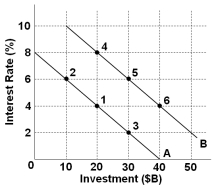 Refer to the above graph. If the economy was initially in equilibrium at point 3 and a government deficit makes interest rates increase by 4 percentage points, then the crowding-out effect would be a reduction of:
 (Multiple Choice)
4.8/5 (75)
(75) You are given the following information about aggregate demand at the existing price level for an economy: (1) consumption = $500 billion; (2) investment = $50 billion; (3) government purchases = $100 billion; and (4) net export = $20 billion. If the full-employment level of GDP for this economy is $620 billion, then what combination of actions would be most consistent with closing the GDP-gap here?
(Multiple Choice)
4.9/5 (80)
(80) The following is budget information for a hypothetical economy. All data are in billions of dollars. 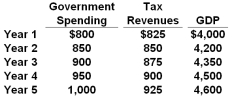 Refer to the above table. Assume that Year 1 is the first year for this economy and Year 5 is the current year. What is the public debt in this economy at Year 5?
 (Multiple Choice)
4.8/5 (85)
(85) If the crowding-out effect is at its maximum strength, it follows that an increase in government spending would:
(Multiple Choice)
4.9/5 (89)
(89) In Year 1, the actual budget deficit was $150 billion and the cyclically-adjusted deficit was $125 billion. In Year 2, the actual budget deficit was $130 billion and the cyclically-adjusted deficit was $125 billion. It can be concluded that from Year 1 to Year 2:
(Multiple Choice)
4.7/5 (79)
(79) If the government wants to reduce unemployment using fiscal policy, it may do so by increasing government spending.
(True/False)
4.8/5 (86)
(86) In 2012, the public debt in the U.S. on a per capita basis was about:
(Multiple Choice)
4.9/5 (93)
(93) 
Filters
- Essay(0)
- Multiple Choice(0)
- Short Answer(0)
- True False(0)
- Matching(0)