



 Chat with AI
Exam 13: Fiscal Policy, Deficits, and Debt

Exam 1: Limits, Alternatives, and Choices212 Questions
Exam 2: The Market System and the Circular Flow141 Questions
Exam 3: Demand, Supply, and Market Equilibrium202 Questions
Exam 4: Market Failures: Public Goods and Externalities155 Questions
Exam 5: Governments Role and Government Failure148 Questions
Exam 6: An Introduction to Macroeconomics123 Questions
Exam 7: Measuring Domestic Output and National Income157 Questions
Exam 8: Economic Growth114 Questions
Exam 9: Business Cycles, Unemployment, and Inflation143 Questions
Exam 10: Basic Macroeconomic Relationships142 Questions
Exam 11: The Aggregate Expenditures Model143 Questions
Exam 12: Aggregate Demand and Aggregate Supply152 Questions
Exam 13: Fiscal Policy, Deficits, and Debt164 Questions
Exam 14: Money, Banking, and Financial Institutions130 Questions
Exam 15: Money Creation127 Questions
Exam 16: Interest Rates and Monetary Policy174 Questions
Exam 17: Financial Economics136 Questions
Exam 18: Extending the Analysis of Aggregate Supply135 Questions
Exam 19: Current Issues in Macro Theory and Policy134 Questions
Exam 20: International Trade151 Questions
Exam 21: The Balance of Payments, Exchange Rates, and Trade Deficits152 Questions
Exam 22: The Economics of Developing Countries135 Questions
Select questions type


One important reason why the United States government is not likely to go bankrupt even with a large public debt is that it has:
(Multiple Choice)
4.8/5  (78)
(78) Most of the U.S. public debt is owed to the nation's citizens and domestic institutions. This is one reason that the public debt:
(Multiple Choice)
4.8/5 (87)
(87) The American Recovery and Reinvestment Act of 2009 included mostly:
(Multiple Choice)
4.9/5 (73)
(73) When the U.S. economy reached full employment in 2007, the cyclically-adjusted deficit that year was -1.3% of GDP. From this information, we know that the:
(Multiple Choice)
4.9/5 (74)
(74) The following is budget information for a hypothetical economy. All data are in billions of dollars. 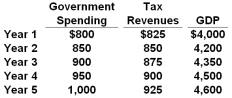 Refer to the above table. In which year is there a budget surplus?
 (Multiple Choice)
4.9/5 (88)
(88) If the cyclically-adjusted budget has a zero deficit but the actual budget has a $100 billion deficit, then that means that the government is pursuing an expansionary fiscal policy.
(True/False)
5.0/5 (85)
(85) When the Federal government takes budgetary action to stimulate the economy or rein in inflation, such policy is:
(Multiple Choice)
4.9/5 (84)
(84) The cyclically-adjusted surplus as a percentage of GDP is 1 percent in Year 1. This surplus becomes a deficit of 2 percent of GDP in Year 2. It can be concluded from Year 1 to Year 2 that:
(Multiple Choice)
5.0/5 (82)
(82) The actual and cyclically-adjusted budgets will be equal when the economy is at full employment.
(True/False)
4.9/5 (82)
(82) The set of fiscal policies that would be most contractionary would be a(n):
(Multiple Choice)
4.8/5 (83)
(83) Which of the following fiscal policy changes would be the most contractionary?
(Multiple Choice)
4.9/5 (82)
(82) The portion of the public debt owed to foreigners does not represent any real economic burden to Americans because we received money from foreigners when we incurred the debt.
(True/False)
4.9/5 (79)
(79) Built-in stability is exemplified by the fact that with a progressive tax system, net tax revenues decrease when GDP decreases.
(True/False)
4.9/5 (99)
(99) The United States is experiencing a recession and Congress decides to adopt an expansionary fiscal policy to stimulate the economy. In this case, the crowding-out effect suggests that investment spending would:
(Multiple Choice)
4.9/5 (82)
(82) Assume that if there was no crowding-out, an increase in government spending would increase GDP by $100 billion. If there had been partial crowding-out, however, then GDP would have:
(Multiple Choice)
4.8/5 (87)
(87) A given reduction in government spending will dampen demand-pull inflation by a greater amount when the:
(Multiple Choice)
4.8/5 (83)
(83) The last year when there was a surplus in the actual U.S. Federal budget was in:
(Multiple Choice)
4.8/5 (76)
(76) A major concern with the Social Security trust fund is that:
(Multiple Choice)
4.8/5 (60)
(60) 
Filters
- Essay(0)
- Multiple Choice(0)
- Short Answer(0)
- True False(0)
- Matching(0)