



 Chat with AI
Exam 20: International Trade

Exam 1: Limits, Alternatives, and Choices212 Questions
Exam 2: The Market System and the Circular Flow141 Questions
Exam 3: Demand, Supply, and Market Equilibrium202 Questions
Exam 4: Market Failures: Public Goods and Externalities155 Questions
Exam 5: Governments Role and Government Failure148 Questions
Exam 6: An Introduction to Macroeconomics123 Questions
Exam 7: Measuring Domestic Output and National Income157 Questions
Exam 8: Economic Growth114 Questions
Exam 9: Business Cycles, Unemployment, and Inflation143 Questions
Exam 10: Basic Macroeconomic Relationships142 Questions
Exam 11: The Aggregate Expenditures Model143 Questions
Exam 12: Aggregate Demand and Aggregate Supply152 Questions
Exam 13: Fiscal Policy, Deficits, and Debt164 Questions
Exam 14: Money, Banking, and Financial Institutions130 Questions
Exam 15: Money Creation127 Questions
Exam 16: Interest Rates and Monetary Policy174 Questions
Exam 17: Financial Economics136 Questions
Exam 18: Extending the Analysis of Aggregate Supply135 Questions
Exam 19: Current Issues in Macro Theory and Policy134 Questions
Exam 20: International Trade151 Questions
Exam 21: The Balance of Payments, Exchange Rates, and Trade Deficits152 Questions
Exam 22: The Economics of Developing Countries135 Questions
Select questions type


The Smoot-Hawley Tariff Act of 1930 is notorious for which of the following reasons?
(Multiple Choice)
4.8/5  (73)
(73) A key difference between import quotas and voluntary export restraints (VERs) is that the:
(Multiple Choice)
4.8/5 (84)
(84) Nation Alpha has a comparative advantage in product X and nation Beta has a comparative advantage in product Y. Trade in the two products will only benefit the two nations if:
(Multiple Choice)
5.0/5 (86)
(86) Use the following table for Country X to answer the question below. Column 1 of the table is the price of a product. Column 2 is the quantity demanded domestically (Qdd) and Column 3 is the quantity supplied domestically (Qsd). 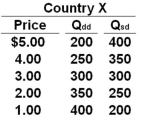 Refer to the table above. If Country X opens itself up to international trade, at what world price will it begin importing some units of the product?
 (Multiple Choice)
5.0/5 (81)
(81) Which of the following countries had the smallest share of exports as a percentage of GDP in 2011?
(Multiple Choice)
4.8/5 (73)
(73) From an economic perspective, studies of the costs of trade barriers show that they:
(Multiple Choice)
4.8/5 (81)
(81) An excise tax that is applied to an imported product which is not at all produced domestically is called a(n):
(Multiple Choice)
4.8/5 (80)
(80) What is one of the major shortcomings of using tariffs or quotas to "save American jobs"?
(Multiple Choice)
4.9/5 (68)
(68) When a tariff or quota on a product is removed, this policy action:
(Multiple Choice)
4.9/5 (76)
(76) The United States can be classified as an "open" economy in that foreign trade accounts for more than 50% of its GDP.
(True/False)
4.8/5 (82)
(82) What other economic process needs to accompany international trade, for nations to benefit from such trade?
(Multiple Choice)
4.8/5 (75)
(75) The productivity table given below shows how many bushels of either wheat or rice can be produced in India and Canada with 1 unit of input. To achieve gains from specialization and trade: 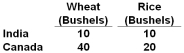
(Multiple Choice)
4.9/5 (86)
(86) Specialization and trade between individuals or between nations leads to:
(Multiple Choice)
4.9/5 (79)
(79) 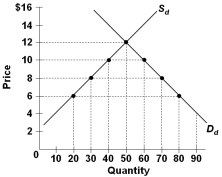 Refer to the graph above, where Sd and Dd are the domestic supply and demand for a product. The world price of the product is $6. What would be the difference in the total revenue received by foreign producers after a quota of 20 units is imposed compared with the total revenue received by foreign producers when a $4 per unit tariff is imposed?
 (Multiple Choice)
4.8/5 (81)
(81) In a world with two products, wheat (W) and coffee (C), nation Alpha produces wheat and nation Beta produces coffee. Nation Alpha prefers an exchange rate of 1W = 2C and nation Beta prefers an exchange rate of 1W = 1C. The exchange rate preferred by nation:
(Multiple Choice)
4.9/5 (79)
(79) If a nation agrees to set an upper limit on the total amount of a product that it exports to another nation, then this situation would be an example of:
(Multiple Choice)
4.8/5 (69)
(69) A voluntary export restraint (VER) is similar to an import quota; except that the former benefits the foreign producers while the latter benefits the domestic producers.
(True/False)
5.0/5 (71)
(71) 
Filters
- Essay(0)
- Multiple Choice(0)
- Short Answer(0)
- True False(0)
- Matching(0)