



 Chat with AI
Exam 20: International Trade

Exam 1: Limits, Alternatives, and Choices212 Questions
Exam 2: The Market System and the Circular Flow141 Questions
Exam 3: Demand, Supply, and Market Equilibrium202 Questions
Exam 4: Market Failures: Public Goods and Externalities155 Questions
Exam 5: Governments Role and Government Failure148 Questions
Exam 6: An Introduction to Macroeconomics123 Questions
Exam 7: Measuring Domestic Output and National Income157 Questions
Exam 8: Economic Growth114 Questions
Exam 9: Business Cycles, Unemployment, and Inflation143 Questions
Exam 10: Basic Macroeconomic Relationships142 Questions
Exam 11: The Aggregate Expenditures Model143 Questions
Exam 12: Aggregate Demand and Aggregate Supply152 Questions
Exam 13: Fiscal Policy, Deficits, and Debt164 Questions
Exam 14: Money, Banking, and Financial Institutions130 Questions
Exam 15: Money Creation127 Questions
Exam 16: Interest Rates and Monetary Policy174 Questions
Exam 17: Financial Economics136 Questions
Exam 18: Extending the Analysis of Aggregate Supply135 Questions
Exam 19: Current Issues in Macro Theory and Policy134 Questions
Exam 20: International Trade151 Questions
Exam 21: The Balance of Payments, Exchange Rates, and Trade Deficits152 Questions
Exam 22: The Economics of Developing Countries135 Questions
Select questions type


If demand for a product is increasing, an import tariff is less restrictive than an import quota.
(True/False)
4.7/5  (77)
(77) If the United States government were to impose a quota on wristwatches imported from Switzerland, then the:
(Multiple Choice)
4.8/5 (81)
(81) In a two-nation two-good world, if both nations have identical production possibilities curves with constant costs, then one nation would have:
(Multiple Choice)
4.9/5 (89)
(89) 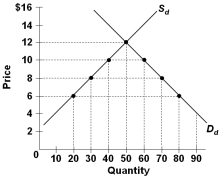 Refer to the graph above, where Sd and Dd are the domestic supply and demand curves for a product. The world price of the product is $6. If an import quota of 40 units were imposed on the product, then the equilibrium price would be:
 (Multiple Choice)
4.8/5 (80)
(80) Autos and chemicals are in million of units in the following production possibilities tables: 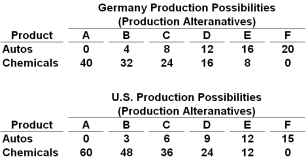 Refer to the tables above. Suppose that each nation specialized in producing the product for which it has a comparative advantage, and the terms of trade were set at 3 units of chemicals for 1 unit of autos. In this case, Germany could obtain and consume a maximum combination of 8 million units of autos and:
 (Multiple Choice)
4.8/5 (81)
(81) Use the following table to answer the question below for Country Y. Column 1 is the price of a product. Column 2 is the quantity demanded domestically (Qdd) and Column 3 is the quantity supplied domestically (Qsd). 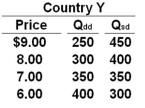 Refer to the table above. If the world price of the product is $6, then Country Y will:
 (Multiple Choice)
4.9/5 (79)
(79) In terms of trade volume, China is the largest trading partner of the United States.
(True/False)
5.0/5 (76)
(76) In a two-nation, two-good world, which of the following statements is true?
(Multiple Choice)
4.9/5 (83)
(83) The ratio at which nations will exchange one product for another is known as the:
(Multiple Choice)
4.9/5 (76)
(76) Which organization meets regularly to establish rules and settle disputes related to international trade?
(Multiple Choice)
4.9/5 (83)
(83) Tariffs and import quotas would benefit the following groups, except:
(Multiple Choice)
5.0/5 (89)
(89) Which of the following is a valid counterargument against using tariffs to protect high wages from cheap foreign labor?
(Multiple Choice)
4.9/5 (76)
(76) Trade protection in most instances transfers wealth from consumers to domestic producers.
(True/False)
4.9/5 (80)
(80) 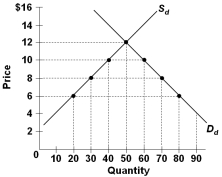 Refer to the graph above, where Sd and Dd are the domestic supply and demand curves for a product. The world price of the product is $6. If this market were closed to international trade, the total revenue that would go to domestic producers would be:
 (Multiple Choice)
4.9/5 (81)
(81) Use the following table for Country X to answer the question below. Column 1 of the table is the price of a product. Column 2 is the quantity demanded domestically (Qdd) and Column 3 is the quantity supplied domestically (Qsd). 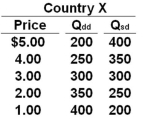 Refer to the table above. If Country X opens itself up to international trade, at what world price will it begin exporting some units of the product?
 (Multiple Choice)
4.9/5 (91)
(91) The principal concept behind comparative advantage is that a nation should:
(Multiple Choice)
4.9/5 (82)
(82) Which is a valid counter-argument to the infant industry argument for protective tariffs?
(Multiple Choice)
4.9/5 (92)
(92) 
Filters
- Essay(0)
- Multiple Choice(0)
- Short Answer(0)
- True False(0)
- Matching(0)