



 Chat with AI
Exam 20: International Trade

Exam 1: Limits, Alternatives, and Choices212 Questions
Exam 2: The Market System and the Circular Flow141 Questions
Exam 3: Demand, Supply, and Market Equilibrium202 Questions
Exam 4: Market Failures: Public Goods and Externalities155 Questions
Exam 5: Governments Role and Government Failure148 Questions
Exam 6: An Introduction to Macroeconomics123 Questions
Exam 7: Measuring Domestic Output and National Income157 Questions
Exam 8: Economic Growth114 Questions
Exam 9: Business Cycles, Unemployment, and Inflation143 Questions
Exam 10: Basic Macroeconomic Relationships142 Questions
Exam 11: The Aggregate Expenditures Model143 Questions
Exam 12: Aggregate Demand and Aggregate Supply152 Questions
Exam 13: Fiscal Policy, Deficits, and Debt164 Questions
Exam 14: Money, Banking, and Financial Institutions130 Questions
Exam 15: Money Creation127 Questions
Exam 16: Interest Rates and Monetary Policy174 Questions
Exam 17: Financial Economics136 Questions
Exam 18: Extending the Analysis of Aggregate Supply135 Questions
Exam 19: Current Issues in Macro Theory and Policy134 Questions
Exam 20: International Trade151 Questions
Exam 21: The Balance of Payments, Exchange Rates, and Trade Deficits152 Questions
Exam 22: The Economics of Developing Countries135 Questions
Select questions type


Which country is the United States' largest trading partner in terms of volume of trade?
(Multiple Choice)
4.9/5  (73)
(73) With constant costs in production, specialization tends to proceed to complete-specialization; but with increasing costs, specialization will not be complete.
(True/False)
4.8/5 (92)
(92) In which of the following countries did exports account for the biggest percent of GDP in 2011?
(Multiple Choice)
4.7/5 (70)
(70) A maximum limit set on the amount of a specific good that may be imported into a country over a given period of time is called a:
(Multiple Choice)
4.8/5 (88)
(88) Use the following table for Country X to answer the question below. Column 1 of the table is the price of a product. Column 2 is the quantity demanded domestically (Qdd) and Column 3 is the quantity supplied domestically (Qsd). 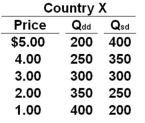 Refer to the table above. If the world price is $5.00, there will be:
 (Multiple Choice)
4.7/5 (84)
(84) 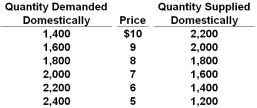 Refer to the table above for a certain product's market in Econland. If the world price of the product were $6 and a tariff of $1 per unit were applied to imports of the product, then the total revenue (after tariff) going to domestic producers would be:
 (Multiple Choice)
4.8/5 (82)
(82) If Countries A and B produce only either rubber bands or paper clips, their maximum outputs are shown in the production possibilities schedules below:  In country A the opportunity cost of 1 paper clip is:
 (Multiple Choice)
4.8/5 (69)
(69) When tariffs on imported products are removed by a nation, it will result in:
(Multiple Choice)
4.9/5 (75)
(75) In Germany, one worker can produce either one cuckoo clock or one beer mug. In Taiwan, one worker can produce either two cuckoo clocks or three beer mugs. Who has the comparative advantage in each good?
(Multiple Choice)
4.9/5 (73)
(73) Suppose the world economy is composed of just two countries: Italy and Greece. Each can produce steel or chemicals, but at different levels of economic efficiency. The production possibilities curves for the two countries are shown in the graphs below. 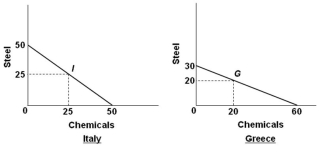 Refer to the graphs and information above. It can be deduced that:
 (Multiple Choice)
4.9/5 (75)
(75) The NAFTA established a free-trade area and eliminated trade barriers between:
(Multiple Choice)
4.8/5 (94)
(94) The table below shows labor-productivity figures in two countries facing constant costs: 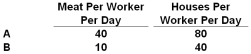 Refer to the table above. Based on the data provided, it can be deduced that:
 (Multiple Choice)
4.8/5 (71)
(71) Which of the following product-groups is a leading export of the United States?
(Multiple Choice)
4.9/5 (83)
(83) If the world price of a product rises relative to the domestic price in a trading nation, then for that product:
(Multiple Choice)
4.7/5 (80)
(80) Which of the following is a valid counterargument to a call for higher tariffs "to save U.S. jobs"?
(Multiple Choice)
4.8/5 (73)
(73) When a nation starts opening up to international trade, it will see falling prices for:
(Multiple Choice)
4.8/5 (70)
(70) Which of the following is a likely result of imposing tariffs to increase domestic employment?
(Multiple Choice)
4.9/5 (76)
(76) 
Filters
- Essay(0)
- Multiple Choice(0)
- Short Answer(0)
- True False(0)
- Matching(0)