



 Chat with AI
Exam 20: International Trade

Exam 1: Limits, Alternatives, and Choices212 Questions
Exam 2: The Market System and the Circular Flow141 Questions
Exam 3: Demand, Supply, and Market Equilibrium202 Questions
Exam 4: Market Failures: Public Goods and Externalities155 Questions
Exam 5: Governments Role and Government Failure148 Questions
Exam 6: An Introduction to Macroeconomics123 Questions
Exam 7: Measuring Domestic Output and National Income157 Questions
Exam 8: Economic Growth114 Questions
Exam 9: Business Cycles, Unemployment, and Inflation143 Questions
Exam 10: Basic Macroeconomic Relationships142 Questions
Exam 11: The Aggregate Expenditures Model143 Questions
Exam 12: Aggregate Demand and Aggregate Supply152 Questions
Exam 13: Fiscal Policy, Deficits, and Debt164 Questions
Exam 14: Money, Banking, and Financial Institutions130 Questions
Exam 15: Money Creation127 Questions
Exam 16: Interest Rates and Monetary Policy174 Questions
Exam 17: Financial Economics136 Questions
Exam 18: Extending the Analysis of Aggregate Supply135 Questions
Exam 19: Current Issues in Macro Theory and Policy134 Questions
Exam 20: International Trade151 Questions
Exam 21: The Balance of Payments, Exchange Rates, and Trade Deficits152 Questions
Exam 22: The Economics of Developing Countries135 Questions
Select questions type


The Trade Adjustment Assistance Act of 2002 focused mainly on assisting:
(Multiple Choice)
4.9/5  (84)
(84) 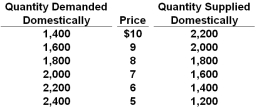 Refer to the table above for a certain product's market in Econland. Assume that the world price of the product is $6. What would be the difference in the total revenue received by foreign producers after a quota of 400 units is imposed, compared against the total revenue received by foreign producers when a $1 per unit tariff is paid?
 (Multiple Choice)
4.8/5 (88)
(88) Suppose the world economy is composed of just two countries: Italy and Greece. Each can produce steel or chemicals, but at different levels of economic efficiency. The production possibilities curves for the two countries are shown in the graphs below. 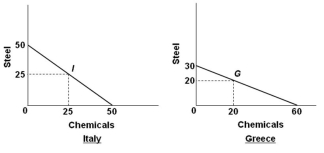 Refer to the graphs and information above. The assumption made about the domestic production opportunity costs in both countries is that they are:
 (Multiple Choice)
4.8/5 (91)
(91) In a two-nation, two-good world, if country A has the comparative advantage in producing good X over country B, then country A:
(Multiple Choice)
4.8/5 (79)
(79) Suppose the world economy is composed of just two countries: Italy and Greece. Each can produce steel or chemicals, but at different levels of economic efficiency. The production possibilities curves for the two countries are shown in the graphs below. 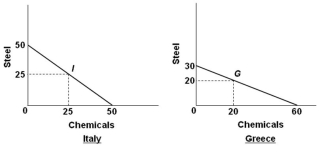 Refer to the graphs and information above. If Italy and Greece should open up trade with each other, which of the following terms of trade is mutually beneficial?
 (Multiple Choice)
4.7/5 (76)
(76) Given the following maximum-output alternatives for Brazil and Poland, it can be seen that if the two nations open up trade with each other, then: 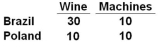
(Multiple Choice)
4.8/5 (80)
(80) 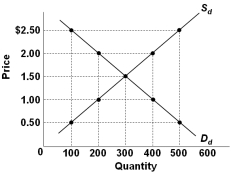 Refer to the graph above showing the domestic demand and supply curves for a specific product in a hypothetical nation called Econland. If the world price for this product is $2.00, then Econland will:
 (Multiple Choice)
4.9/5 (77)
(77) If a nation imposes a tariff on an imported product, then the nation will experience a(n):
(Multiple Choice)
4.9/5 (67)
(67) In a two-nation two-good world, if one nation is more efficient in producing both goods than the other nation, then the more-efficient nation cannot gain from trading with the other nation.
(True/False)
4.8/5 (78)
(78) Nation Alpha can produce employing all its available resources either 800 units of chemicals or 1,600 units of clothing. Nation Beta can produce either 200 units of chemicals or 800 units of clothing:
(Multiple Choice)
4.7/5 (89)
(89) The higher price of imported products due to trade barriers causes some consumers to shift their purchases to a domestically-produced product which is now:
(Multiple Choice)
4.8/5 (75)
(75) A natural-resource abundant nation would be expected to export a land-intensive commodity such as:
(Multiple Choice)
5.0/5 (83)
(83) A nation with abundant capital resources tends to be an exporter of:
(Multiple Choice)
4.7/5 (92)
(92) NAFTA is a trade agreement that covers trade between the United States and the European Union.
(True/False)
4.8/5 (77)
(77) If a nation starts exporting a product to the rest of the world, then the price of that product in the exporting nation will rise.
(True/False)
4.9/5 (65)
(65) The domestic opportunity cost of producing a television in the United States is 20 bushels of wheat. In Korea, the domestic opportunity cost of producing a television is 10 bushels of wheat. In this case:
(Multiple Choice)
4.9/5 (71)
(71) 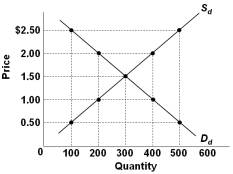 Refer to the graph above showing the domestic demand and supply curves for a specific product in a hypothetical nation called Econland. When the world price for this product is $0.50, Econland will:
 (Multiple Choice)
4.9/5 (82)
(82) 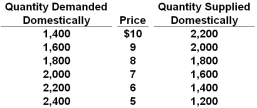 Refer to the table above for a certain product's market in Econland. If the world price of the product were $6 and an import quota of 400 units were imposed on the product, then the equilibrium price in Econland would be:
 (Multiple Choice)
4.7/5 (85)
(85) The domestic opportunity cost of producing 100 barrels of chemicals in Germany is one ton of steel. In France, the domestic opportunity cost of producing 100 barrels of chemicals is two tons of steel. In this case:
(Multiple Choice)
4.8/5 (75)
(75) 
Filters
- Essay(0)
- Multiple Choice(0)
- Short Answer(0)
- True False(0)
- Matching(0)