



 Chat with AI
Exam 11: Technology, production, and Costs

Exam 1: Economics: Foundations and Models142 Questions
Exam 2: Trade-Offs, comparative Advantage, and the Market System152 Questions
Exam 3: Where Prices Come From: the Interaction of Demand and Supply149 Questions
Exam 4: Economic Efficiency, government Price Setting, and Taxes137 Questions
Exam 5: Externalities, environmental Policy, and Public Goods139 Questions
Exam 6: Elasticity: The Responsiveness of Demand and Supply149 Questions
Exam 7: The Economics of Health Care117 Questions
Exam 8: Firms, the Stock Market, and Corporate Governance140 Questions
Exam 9: Comparative Advantage and the Gains From International Trade124 Questions
Exam 10: Consumer Choice and Behavioral Economics154 Questions
Exam 11: Technology, production, and Costs174 Questions
Exam 12: Firms in Perfectly Competitive Markets153 Questions
Exam 13: Monopolistic Competition: The Competitive Model in a More Realistic Setting137 Questions
Exam 14: Oligopoly: Firms in Less Competitive Markets129 Questions
Exam 15: Monopoly and Antitrust Policy148 Questions
Exam 16: Pricing Strategy134 Questions
Exam 17: The Markets for Labor and Other Factors of Production149 Questions
Exam 18: Public Choice, taxes, and the Distribution of Income134 Questions
Exam 19: GDP: Measuring Total Production and Income135 Questions
Exam 20: Unemployment and Inflation148 Questions
Exam 21: Economic Growth, the Financial System, and Business Cycles130 Questions
Exam 22: Long-Run Economic Growth: Sources and Policies134 Questions
Exam 23: Aggregate Expenditure and Output in the Short Run157 Questions
Exam 24: Aggregate Demand and Aggregate Supply Analysis145 Questions
Exam 25: Money, banks, and the Federal Reserve System144 Questions
Exam 26: Monetary Policy145 Questions
Exam 27: Fiscal Policy155 Questions
Exam 28: Inflation, unemployment, and Federal Reserve Policy135 Questions
Exam 29: Macroeconomics in an Open Economy145 Questions
Exam 30: The International Financial System139 Questions
Select questions type


Suppose you have just opened a store to sell espresso machines.Both you and a competing store buy this machine from a manufacturer for $130 each.Your competitor who has a store of the same size as yours is currently selling about 10 machines a month at a price of $200 per machine.You expect to sell about 6 machines a month at a price of $220 per machine.If you lower your price,you expect to make a loss.Which of the following could explain why your competitor is able to profitably sell the machine at a lower price although the cost of purchasing the machine is the same for the both of you?
(Multiple Choice)
4.9/5  (78)
(78) If the long-run average total cost curve is downward-sloping,then the firm is experiencing decreasing returns to scale.
(True/False)
4.9/5 (82)
(82) Table 11-3
 Table 11-3 shows cost data for Lotus Lanterns, a producer of whimsical night lights.
-Refer to Table 11-3.What is the marginal cost per unit of production when the firm produces 100 lanterns?
Table 11-3 shows cost data for Lotus Lanterns, a producer of whimsical night lights.
-Refer to Table 11-3.What is the marginal cost per unit of production when the firm produces 100 lanterns? (Multiple Choice)
4.8/5 (87)
(87) Figure 11-2  -Refer to Figure 11-2.The curve labeled "E" is
 (Multiple Choice)
4.8/5 (88)
(88) Figure 11-5 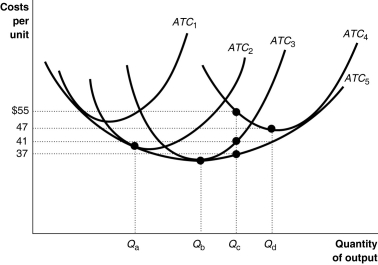 -Refer to Figure 11-5.Suppose for the past 8 years the firm has been producing Qd units per period using plant size ATC4.Now,following a permanent change in demand,it plans to cut production to Qc units.What will happen to its average cost of production?
 (Multiple Choice)
4.8/5 (93)
(93) As the level of output increases,what happens to the value of average fixed cost,and what happens to the difference between the value of average total cost and average variable cost?
(Essay)
4.9/5 (75)
(75) In economics,what is the difference between the short run and the long run?
(Essay)
4.7/5 (80)
(80) Figure 11-8 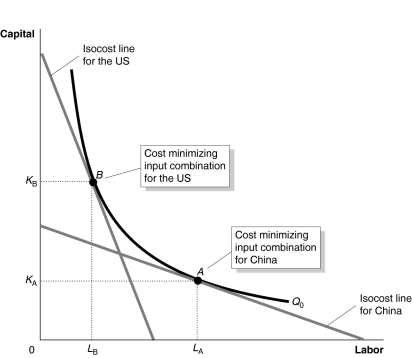 Figure 11-8 shows the optimal input combinations for the production of a given quantity of cotton in the United States and in China.
-Refer to Figure 11-8.Consider the following statements:
a.For each country,the marginal product per dollar spent on labor equals to the marginal product per dollar spent on capital.
b.The price of labor is relatively higher in the United States than in China and the price of capital is relatively lower in the United States than in China.
c.The price of labor and the price of capital are relatively higher in the United States than in China.Based on the figure,which of the statements above is true?
Figure 11-8 shows the optimal input combinations for the production of a given quantity of cotton in the United States and in China.
-Refer to Figure 11-8.Consider the following statements:
a.For each country,the marginal product per dollar spent on labor equals to the marginal product per dollar spent on capital.
b.The price of labor is relatively higher in the United States than in China and the price of capital is relatively lower in the United States than in China.
c.The price of labor and the price of capital are relatively higher in the United States than in China.Based on the figure,which of the statements above is true? (Multiple Choice)
4.7/5 (82)
(82) Vipsana's Gyros House sells gyros.The cost of ingredients (pita,meat,spices,etc.)to make a gyro is $2.00.Vipsana pays her employees $60 per day.She also incurs a fixed cost of $120 per day.Calculate Vipsana's average fixed cost per day when she produces 50 gyros using two workers?
(Multiple Choice)
4.9/5 (72)
(72) If a producer is not able to expand its plant capacity immediately,it is
(Multiple Choice)
4.9/5 (75)
(75) Ford Motor Company started producing the Model A at plants scattered around the United States
(Multiple Choice)
4.8/5 (66)
(66) Figure 11-7  -Refer to Figure 11-7.The lines shown in the diagram are isocost lines.A movement from CE to BD occurs when
 (Multiple Choice)
4.8/5 (88)
(88) Describe the relationship between marginal cost and average total cost.
(Essay)
4.8/5 (81)
(81) A firm has successfully adopted a positive technological change when
(Multiple Choice)
5.0/5 (71)
(71) Maximizing the level of output for a given total cost of production
(Multiple Choice)
4.8/5 (74)
(74) An isoquant is a curve that shows all the combinations of two inputs that will produce the same level of output.
(True/False)
4.9/5 (90)
(90) Explain how the listed events (a-d)would affect the following at Hilton Hotels.
i.Marginal cost
ii.Average variable cost
iii.Average fixed cost
iv.Average total cost
a.Hilton decides on an across-the-board 5 percent increase in executive salaries.
b.Hilton decides to eliminate all print advertising.
c.Hilton signs a new contract with the Culinary Workers Union that requires the company to increase wages for all its kitchen workers.
d.The federal government starts to levy a $5 room tax on all hotel rooms.
(Essay)
4.9/5 (90)
(90) 
Filters
- Essay(0)
- Multiple Choice(0)
- Short Answer(0)
- True False(0)
- Matching(0)