



 Chat with AI
Exam 30: The International Financial System

Exam 1: Economics: Foundations and Models142 Questions
Exam 2: Trade-Offs, comparative Advantage, and the Market System152 Questions
Exam 3: Where Prices Come From: the Interaction of Demand and Supply149 Questions
Exam 4: Economic Efficiency, government Price Setting, and Taxes137 Questions
Exam 5: Externalities, environmental Policy, and Public Goods139 Questions
Exam 6: Elasticity: The Responsiveness of Demand and Supply149 Questions
Exam 7: The Economics of Health Care117 Questions
Exam 8: Firms, the Stock Market, and Corporate Governance140 Questions
Exam 9: Comparative Advantage and the Gains From International Trade124 Questions
Exam 10: Consumer Choice and Behavioral Economics154 Questions
Exam 11: Technology, production, and Costs174 Questions
Exam 12: Firms in Perfectly Competitive Markets153 Questions
Exam 13: Monopolistic Competition: The Competitive Model in a More Realistic Setting137 Questions
Exam 14: Oligopoly: Firms in Less Competitive Markets129 Questions
Exam 15: Monopoly and Antitrust Policy148 Questions
Exam 16: Pricing Strategy134 Questions
Exam 17: The Markets for Labor and Other Factors of Production149 Questions
Exam 18: Public Choice, taxes, and the Distribution of Income134 Questions
Exam 19: GDP: Measuring Total Production and Income135 Questions
Exam 20: Unemployment and Inflation148 Questions
Exam 21: Economic Growth, the Financial System, and Business Cycles130 Questions
Exam 22: Long-Run Economic Growth: Sources and Policies134 Questions
Exam 23: Aggregate Expenditure and Output in the Short Run157 Questions
Exam 24: Aggregate Demand and Aggregate Supply Analysis145 Questions
Exam 25: Money, banks, and the Federal Reserve System144 Questions
Exam 26: Monetary Policy145 Questions
Exam 27: Fiscal Policy155 Questions
Exam 28: Inflation, unemployment, and Federal Reserve Policy135 Questions
Exam 29: Macroeconomics in an Open Economy145 Questions
Exam 30: The International Financial System139 Questions
Select questions type


How were exchange rates determined under the gold standard? How did the Bretton Woods system differ from the gold standard?

Free
(Essay)
4.9/5  (75)
(75) Correct Answer: Verified
Under the gold standard,exchange rates were determined by the relative amounts of gold in each country's currency.Both the gold standard and Bretton Woods systems were fixed exchange rate systems,but people were able to redeem paper currency for gold domestically only under the gold standard.
Airbus is a passenger aircraft manufacturer based in Europe,but like the rest of the global aerospace industry,conducts is business in U.S.dollars.Suppose Airbus sells an aircraft to Air France,and Air France pays Airbus in U.S.dollars.If the value of the U.S.dollar rises relative to the euro,Airbus's profits in Europe will ________ because it will receive ________ when it converts the dollars it earns from the sale into euros.
Free
(Multiple Choice)
4.9/5 (87)
(87) Correct Answer:Verified
VerifiedA
If speculators believe a currency is soon going to be revalued,they will increase their demand for that currency.
Free
(True/False)
4.9/5 (83)
(83) Correct Answer:Verified
VerifiedTrue
A Big Mac costs $4.00 in the United States and 9.00 reals in Brazil.If the exchange rate is 2 reals per dollar,what is the dollar cost of a Big Mac in Brazil?
(Multiple Choice)
4.9/5 (81)
(81) If the purchasing power of the dollar is greater than the purchasing power of the euro,purchasing power parity predicts that the exchange rate will
(Multiple Choice)
4.9/5 (68)
(68) Which of the following is not an advantage to a country of choosing to fix its exchange rate against a major currency,rather than choosing a floating exchange rate?
(Multiple Choice)
4.8/5 (88)
(88) Why might a developing country choose to peg the value of its currency to the dollar?
(Essay)
4.8/5 (86)
(86) Investors in which country accounted for about half of all foreign purchases of U.S.stocks and bonds in 2010?
(Multiple Choice)
4.9/5 (87)
(87) Expanding,contracting,and managing the money supply is easier for a central bank under the gold standard.
(True/False)
4.8/5 (90)
(90) A currency pegged at a value below the market equilibrium exchange rate is
(Multiple Choice)
4.9/5 (72)
(72) Thailand's experience with pegging the baht to the dollar failed because the baht was ________ relative to the dollar,and China's experience with pegging the yuan to the dollar has run into difficulties because the yuan has been ________ relative to the dollar.
(Multiple Choice)
4.9/5 (65)
(65) China's exchange rate system from 1994 through 2005 is an example of
(Multiple Choice)
4.8/5 (84)
(84) Pegging a country's exchange rate to the dollar can be advantageous if
(Multiple Choice)
4.9/5 (82)
(82) Although the pegged exchange rate between the yuan and the dollar has undervalued the yuan,China has been reluctant to abandon the peg for fear that abandoning the peg would
(Multiple Choice)
4.8/5 (87)
(87) The "Big Mac Theory of Exchange Rates" tests the accuracy of the purchasing power parity theory.In July 2011,the Economist reported that the average price of a Big Mac in the United States was $4.07.In Mexico,the average price of a Big Mac at that time was 32 pesos.If the exchange rate between the dollar and the peso was 13.60 pesos per dollar,explain how it would be profitable to buy Big Macs in Mexico instead of in the United States.
(Essay)
4.9/5 (88)
(88) Which of the following is a drawback to having a common currency across countries,as in the European Union?
(Multiple Choice)
4.7/5 (60)
(60) Figure 30-2 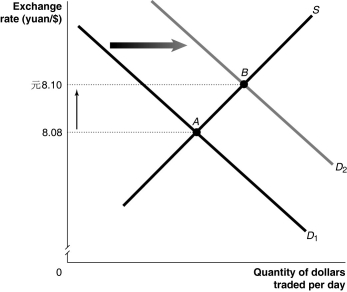 -Refer to Figure 30-2.Which of the following would cause the change depicted in the figure above?
 (Multiple Choice)
4.7/5 (70)
(70) If the GDP deflator in the United States is 114,and the GDP deflator in Ukraine is 142,which of the following changes would the theory of purchasing power parity predict? (The Ukrainian currency is the hryvnia.)
(Multiple Choice)
4.7/5 (80)
(80) Figure 30-3  -Refer to Figure 30-3.At what level should the Thai government peg its currency to the dollar to make Thai exports cheaper to the United States?
 (Multiple Choice)
4.7/5 (70)
(70) 
Filters
- Essay(0)
- Multiple Choice(0)
- Short Answer(0)
- True False(0)
- Matching(0)