



 Chat with AI
Exam 30: The International Financial System

Exam 1: Economics: Foundations and Models142 Questions
Exam 2: Trade-Offs, comparative Advantage, and the Market System152 Questions
Exam 3: Where Prices Come From: the Interaction of Demand and Supply149 Questions
Exam 4: Economic Efficiency, government Price Setting, and Taxes137 Questions
Exam 5: Externalities, environmental Policy, and Public Goods139 Questions
Exam 6: Elasticity: The Responsiveness of Demand and Supply149 Questions
Exam 7: The Economics of Health Care117 Questions
Exam 8: Firms, the Stock Market, and Corporate Governance140 Questions
Exam 9: Comparative Advantage and the Gains From International Trade124 Questions
Exam 10: Consumer Choice and Behavioral Economics154 Questions
Exam 11: Technology, production, and Costs174 Questions
Exam 12: Firms in Perfectly Competitive Markets153 Questions
Exam 13: Monopolistic Competition: The Competitive Model in a More Realistic Setting137 Questions
Exam 14: Oligopoly: Firms in Less Competitive Markets129 Questions
Exam 15: Monopoly and Antitrust Policy148 Questions
Exam 16: Pricing Strategy134 Questions
Exam 17: The Markets for Labor and Other Factors of Production149 Questions
Exam 18: Public Choice, taxes, and the Distribution of Income134 Questions
Exam 19: GDP: Measuring Total Production and Income135 Questions
Exam 20: Unemployment and Inflation148 Questions
Exam 21: Economic Growth, the Financial System, and Business Cycles130 Questions
Exam 22: Long-Run Economic Growth: Sources and Policies134 Questions
Exam 23: Aggregate Expenditure and Output in the Short Run157 Questions
Exam 24: Aggregate Demand and Aggregate Supply Analysis145 Questions
Exam 25: Money, banks, and the Federal Reserve System144 Questions
Exam 26: Monetary Policy145 Questions
Exam 27: Fiscal Policy155 Questions
Exam 28: Inflation, unemployment, and Federal Reserve Policy135 Questions
Exam 29: Macroeconomics in an Open Economy145 Questions
Exam 30: The International Financial System139 Questions
Select questions type


If the GDP deflator in the United States is 114,and the GDP deflator in Ukraine is 142,which of the following exchange rates would the theory of purchasing power parity predict in the long run? (The Ukrainian currency is the hryvnia.)
(Multiple Choice)
4.9/5  (76)
(76) In 1991,Argentina decided to peg its currency (the Argentinean peso)to the U.S.dollar.Most of Argentina's trading,however,was with Brazil and Europe,not the United States.What result would pegging the Argentinean peso to the U.S.dollar have on the cost of imports from and exports to Brazil and Europe?
(Essay)
4.9/5 (78)
(78) Figure 30-4  -Refer to Figure 30-4.The equilibrium exchange rate is at A,$3/pound.Suppose the British government pegs its currency at $4/pound.At the pegged exchange rate,
 (Multiple Choice)
4.8/5 (74)
(74) South Korea suffered a destabilizing speculation in the late 1990s.This had the effect of ________ for the won.South Korean government tried to counteract this by raising interest rates which should have ________ the won.
(Multiple Choice)
4.7/5 (80)
(80) The United States abandoned the Bretton Woods system of exchange rates in
(Multiple Choice)
4.9/5 (84)
(84) What three real-world complications keep purchasing power parity from being a complete explanation of exchange rate fluctuations in the long run? Explain.
(Essay)
4.9/5 (85)
(85) Figure 30-3  -Refer to Figure 30-3.If the Thai government pegs its currency to the dollar at a value above $.03/baht,we would say the currency is
 (Multiple Choice)
4.8/5 (82)
(82) Will the use of the euro help increase economic growth in countries in the European Union? Will it help individual countries using the euro in times of recession? Explain.
(Essay)
4.8/5 (78)
(78) Managed float exchange systems were abandoned with the implementation of the gold standard.
(True/False)
4.9/5 (91)
(91) If a country's currency is determined only by the demand and supply for that country's currency,the country is said to have a
(Multiple Choice)
4.7/5 (82)
(82) China began pegging its currency,the yuan,to the dollar in 1994.Because the yuan has been ________ at the pegged exchange rate,the Chinese government ________ its reserves of dollars as the government purchased more ________ to maintain the pegged exchange rate.
(Multiple Choice)
5.0/5 (78)
(78) Figure 30-1 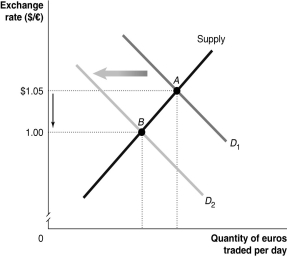 -Refer to Figure 30-1.Which of the following would cause the change depicted in the figure above?
 (Multiple Choice)
4.8/5 (69)
(69) In order to reduce or eliminate a chronic shortage in the market for a currency under a fixed exchange rate system,we must devalue the currency.
(True/False)
4.8/5 (77)
(77) Because the value of the euro is determined by factors that affect the entire euro zone,during the recession of 2007-2009,individual countries using the euro
(Multiple Choice)
4.8/5 (89)
(89) Figure 30-7  -Refer to Figure 30-7.Under the Bretton Woods System of exchange rates,if the par exchange rate was $2 per pound in the figure above,and equilibrium persisted at $3,then this was evidence of ________ and the IMF would allow a ________ in the exchange rate?
 (Multiple Choice)
4.9/5 (74)
(74) Figure 30-8 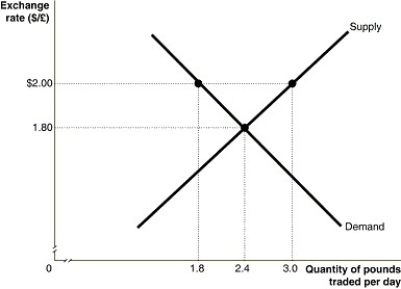 -Refer to Figure 30-8.The graph above depicts supply and demand for British pounds during a trading day,where the quantity is millions of pounds.In order to support a fixed exchange rate of $2.00 per pound,the U.S.central bank must
 (Multiple Choice)
4.9/5 (84)
(84) If the implied exchange rate between Big Mac prices in the United States and Poland is 2.13 zlotys per dollar,but the actual exchange rate between the United States and Poland is 3.16 zlotys per dollar,which of the following would you expect to see?
(Multiple Choice)
4.8/5 (89)
(89) Explain why international capital markets have expanded since the 1980s.
(Essay)
4.8/5 (75)
(75) If a country sets a pegged exchange rate that is above the equilibrium exchange rate,how can the country maintain the peg?
(Multiple Choice)
4.8/5 (88)
(88) 
Filters
- Essay(0)
- Multiple Choice(0)
- Short Answer(0)
- True False(0)
- Matching(0)