



 Chat with AI
Exam 2: Trade-Offs, comparative Advantage, and the Market System

Exam 1: Economics: Foundations and Models142 Questions
Exam 2: Trade-Offs, comparative Advantage, and the Market System152 Questions
Exam 3: Where Prices Come From: the Interaction of Demand and Supply149 Questions
Exam 4: Economic Efficiency, government Price Setting, and Taxes137 Questions
Exam 5: Externalities, environmental Policy, and Public Goods139 Questions
Exam 6: Elasticity: The Responsiveness of Demand and Supply149 Questions
Exam 7: The Economics of Health Care117 Questions
Exam 8: Firms, the Stock Market, and Corporate Governance140 Questions
Exam 9: Comparative Advantage and the Gains From International Trade124 Questions
Exam 10: Consumer Choice and Behavioral Economics154 Questions
Exam 11: Technology, production, and Costs174 Questions
Exam 12: Firms in Perfectly Competitive Markets153 Questions
Exam 13: Monopolistic Competition: The Competitive Model in a More Realistic Setting137 Questions
Exam 14: Oligopoly: Firms in Less Competitive Markets129 Questions
Exam 15: Monopoly and Antitrust Policy148 Questions
Exam 16: Pricing Strategy134 Questions
Exam 17: The Markets for Labor and Other Factors of Production149 Questions
Exam 18: Public Choice, taxes, and the Distribution of Income134 Questions
Exam 19: GDP: Measuring Total Production and Income135 Questions
Exam 20: Unemployment and Inflation148 Questions
Exam 21: Economic Growth, the Financial System, and Business Cycles130 Questions
Exam 22: Long-Run Economic Growth: Sources and Policies134 Questions
Exam 23: Aggregate Expenditure and Output in the Short Run157 Questions
Exam 24: Aggregate Demand and Aggregate Supply Analysis145 Questions
Exam 25: Money, banks, and the Federal Reserve System144 Questions
Exam 26: Monetary Policy145 Questions
Exam 27: Fiscal Policy155 Questions
Exam 28: Inflation, unemployment, and Federal Reserve Policy135 Questions
Exam 29: Macroeconomics in an Open Economy145 Questions
Exam 30: The International Financial System139 Questions
Select questions type


Figure 2-9 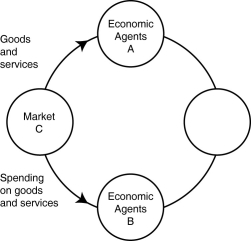 -Refer to Figure 2-9.One segment of the circular flow diagram in the figure shows the flow of goods and services from market C to economic agents A.What is market C and who are economic agents A?
Free
(Multiple Choice)
4.9/5  (82)
(82) Correct Answer: Verified
B
The primary purpose of ________ is to encourage the expenditure of funds on research and development to create new products.
Free
(Multiple Choice)
4.8/5 (72)
(72) Correct Answer:Verified
VerifiedD
Suppose your expenses for this term are as follows: tuition: $12,000,room and board: $6,500,books and other educational supplies: $1,500.Further,during the term,you can only work part-time and earn $3,500 instead of your full-time salary of $14,000.What is the opportunity cost of going to college this term,assuming that your room and board expenses would be the same even if you did not go to college?
Free
(Multiple Choice)
4.7/5 (82)
(82) Correct Answer:Verified
VerifiedC
If society decides it wants more of one good and all resources are fully utilized,then
(Multiple Choice)
4.8/5 (76)
(76) If a nation changes its laws to more actively enforce intellectual property rights,all of the following will most likely take place except
(Multiple Choice)
4.9/5 (72)
(72) In a two-good,two country world,if one country has an absolute advantage in the production of both goods,it cannot benefit by trading with the other country.
(True/False)
4.7/5 (73)
(73) Figure 2-7  Figure 2-7 shows the production possibilities frontiers for Pakistan and Indonesia. Each country produces two goods, cotton and cashews.
-Refer to Figure 2-7.Which country has a comparative advantage in the production of cotton?
Figure 2-7 shows the production possibilities frontiers for Pakistan and Indonesia. Each country produces two goods, cotton and cashews.
-Refer to Figure 2-7.Which country has a comparative advantage in the production of cotton? (Multiple Choice)
4.9/5 (75)
(75) In a report made to the U.S.Congress in 2001,the National Academy of Sciences cautioned that if fuel economy encourages the production of smaller and lighter cars,"Some additional traffic fatalities would be expected." This statement suggests that
(Multiple Choice)
4.7/5 (92)
(92) Figure 2-2  Figure 2-2 above shows the production possibilities frontier for Mendonca, an agrarian nation that produces two goods, meat and vegetables.
-Refer to Figure 2-2.What is the opportunity cost of one pound of vegetables?
Figure 2-2 above shows the production possibilities frontier for Mendonca, an agrarian nation that produces two goods, meat and vegetables.
-Refer to Figure 2-2.What is the opportunity cost of one pound of vegetables? (Multiple Choice)
4.7/5 (71)
(71) Figure 2-3  -Refer to Figure 2-3.Sergio Vignetto raises cattle and llamas on his land.A portion of his land is more suitable for raising cattle,and the other portion is better suited for raising llamas.Which of the graphs in Figure 2-3 represent his production possibilities frontier?
 (Multiple Choice)
4.9/5 (83)
(83) Which of the following are separate flows in the circular flow model?
(Multiple Choice)
4.8/5 (79)
(79)  -Refer to Figure 2-1.Point B is
The Great Depression of the 1930s with a large number of workers and factories unemployed would be represented in a production possibilities frontier graph by
(Multiple Choice)
4.9/5 (80)
(80) All of the following are examples of spending on factors of production in the circular flow model except
(Multiple Choice)
4.8/5 (77)
(77) Figure 2-4  Figure 2-4 shows various points on three different production possibilities frontiers for a nation.
-Refer to Figure 2-4.A movement from X to Y
Figure 2-4 shows various points on three different production possibilities frontiers for a nation.
-Refer to Figure 2-4.A movement from X to Y (Multiple Choice)
5.0/5 (71)
(71) Specializing in the production of a good or service in which one has a comparative advantage enables a country to do all of the following except
(Multiple Choice)
4.9/5 (79)
(79) Figure 2-7
Figure 2-7 shows the production possibilities frontiers for Pakistan and Indonesia. Each country produces two goods, cotton and cashews.
-Refer to Figure 2-7.If the two countries have the same amount of resources and the same technological knowledge,which country has an absolute advantage in the production of cotton?
Figure 2-7 shows the production possibilities frontiers for Pakistan and Indonesia. Each country produces two goods, cotton and cashews.
-Refer to Figure 2-7.If the two countries have the same amount of resources and the same technological knowledge,which country has an absolute advantage in the production of cotton? (Multiple Choice)
4.9/5 (81)
(81) Table 2-4
 Table 2-4 shows the number of labor hours required to produce a digital camera and a pound of wheat in China and South Korea.
-Refer to Table 2-4.If the two countries specialize and trade,who should export wheat?
Table 2-4 shows the number of labor hours required to produce a digital camera and a pound of wheat in China and South Korea.
-Refer to Table 2-4.If the two countries specialize and trade,who should export wheat? (Multiple Choice)
4.9/5 (76)
(76) Table 2-1
Production choices for Tomaso's Trattoria
 -Refer to Table 2-1.Assume Tomaso's Trattoria only produces pizzas and calzones.Tomaso faces ________ opportunity costs in the production of pizzas and calzones.
 (Multiple Choice)
4.8/5 (74)
(74) 
Filters
- Essay(0)
- Multiple Choice(0)
- Short Answer(0)
- True False(0)
- Matching(0)