



 Chat with AI
Exam 2: Trade-Offs, comparative Advantage, and the Market System

Exam 1: Economics: Foundations and Models142 Questions
Exam 2: Trade-Offs, comparative Advantage, and the Market System152 Questions
Exam 3: Where Prices Come From: the Interaction of Demand and Supply149 Questions
Exam 4: Economic Efficiency, government Price Setting, and Taxes137 Questions
Exam 5: Externalities, environmental Policy, and Public Goods139 Questions
Exam 6: Elasticity: The Responsiveness of Demand and Supply149 Questions
Exam 7: The Economics of Health Care117 Questions
Exam 8: Firms, the Stock Market, and Corporate Governance140 Questions
Exam 9: Comparative Advantage and the Gains From International Trade124 Questions
Exam 10: Consumer Choice and Behavioral Economics154 Questions
Exam 11: Technology, production, and Costs174 Questions
Exam 12: Firms in Perfectly Competitive Markets153 Questions
Exam 13: Monopolistic Competition: The Competitive Model in a More Realistic Setting137 Questions
Exam 14: Oligopoly: Firms in Less Competitive Markets129 Questions
Exam 15: Monopoly and Antitrust Policy148 Questions
Exam 16: Pricing Strategy134 Questions
Exam 17: The Markets for Labor and Other Factors of Production149 Questions
Exam 18: Public Choice, taxes, and the Distribution of Income134 Questions
Exam 19: GDP: Measuring Total Production and Income135 Questions
Exam 20: Unemployment and Inflation148 Questions
Exam 21: Economic Growth, the Financial System, and Business Cycles130 Questions
Exam 22: Long-Run Economic Growth: Sources and Policies134 Questions
Exam 23: Aggregate Expenditure and Output in the Short Run157 Questions
Exam 24: Aggregate Demand and Aggregate Supply Analysis145 Questions
Exam 25: Money, banks, and the Federal Reserve System144 Questions
Exam 26: Monetary Policy145 Questions
Exam 27: Fiscal Policy155 Questions
Exam 28: Inflation, unemployment, and Federal Reserve Policy135 Questions
Exam 29: Macroeconomics in an Open Economy145 Questions
Exam 30: The International Financial System139 Questions
Select questions type


An outward shift of a nation's production possibilities frontier represents
(Multiple Choice)
4.9/5  (76)
(76) Suppose in Belize,the opportunity cost of producing a sailboat is 5 hang gliders.In Honduras,the opportunity cost of producing a sailboat is 8 hang gliders.
a.What is the opportunity cost of producing a hang glider for Belize?
b.What is the opportunity cost of producing a hang glider for Honduras?
c.Which country has a comparative advantage in the production of hang gliders?
d.Which country has a comparative advantage in the production of sailboats?
(Essay)
4.8/5 (85)
(85) Figure 2-7 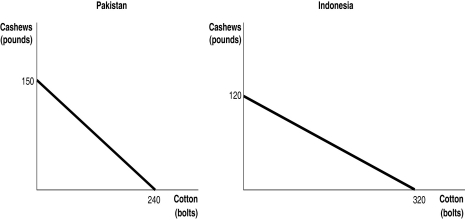 Figure 2-7 shows the production possibilities frontiers for Pakistan and Indonesia. Each country produces two goods, cotton and cashews.
-Refer to Figure 2-7.What is the opportunity cost of producing 1 pound of cashews in Pakistan?
Figure 2-7 shows the production possibilities frontiers for Pakistan and Indonesia. Each country produces two goods, cotton and cashews.
-Refer to Figure 2-7.What is the opportunity cost of producing 1 pound of cashews in Pakistan? (Multiple Choice)
4.9/5 (70)
(70) Figure 2-2 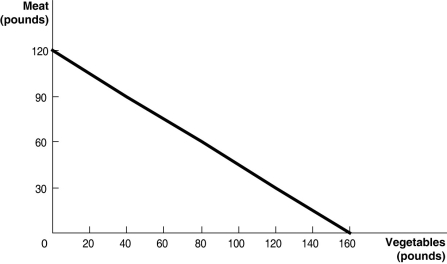 Figure 2-2 above shows the production possibilities frontier for Mendonca, an agrarian nation that produces two goods, meat and vegetables.
-Refer to Figure 2-2.The linear production possibilities frontier in the figure indicates that
Figure 2-2 above shows the production possibilities frontier for Mendonca, an agrarian nation that produces two goods, meat and vegetables.
-Refer to Figure 2-2.The linear production possibilities frontier in the figure indicates that (Multiple Choice)
4.9/5 (78)
(78) In the circular flow model,households supply resources such as labor services in the product market.
(True/False)
4.8/5 (79)
(79) What is a production possibilities frontier? What do points along the frontier represent? What do points inside and outside the frontier represent?
(Essay)
5.0/5 (86)
(86) 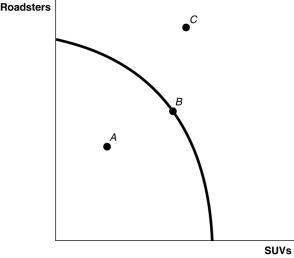 -Refer to Figure 2-1.Point A is
All of the following are critical functions of the government in facilitating the operation of a market economy except
(Multiple Choice)
4.8/5 (82)
(82) Comparative advantage means the ability to produce a good or service
(Multiple Choice)
4.8/5 (81)
(81) Figure 2-2
Figure 2-2 above shows the production possibilities frontier for Mendonca, an agrarian nation that produces two goods, meat and vegetables.
-Refer to Figure 2-2.What is the opportunity cost of one pound of meat?
Figure 2-2 above shows the production possibilities frontier for Mendonca, an agrarian nation that produces two goods, meat and vegetables.
-Refer to Figure 2-2.What is the opportunity cost of one pound of meat? (Multiple Choice)
4.9/5 (82)
(82) Consider the following items: a.the novel "The DaVinci Code" by Dan Brown
B)the "The Spirited Shipper",an innovative wine shipping box
C)a Swiss chef's award-winning recipe
D)an original fabric design,for example,the fabric used for "Coach" bags and luggage
Which of the items listed is an example of intellectual property?
A) a and b only
B) a, b, and c
C) a and d only
D) all of the items listed
(Not Answered)
This question doesn't have any answer yet
Table 2-1
Production choices for Tomaso's Trattoria
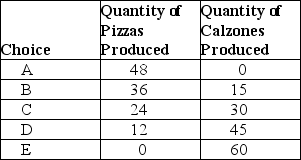 -Refer to Table 2-1.Assume Tomaso's Trattoria only produces pizzas and calzones.A combination of 24 pizzas and 15 calzones would appear
 (Multiple Choice)
4.7/5 (79)
(79) Figure 2-2
Figure 2-2 above shows the production possibilities frontier for Mendonca, an agrarian nation that produces two goods, meat and vegetables.
-Refer to Figure 2-2.Suppose Mendonca is currently producing 60 pounds of vegetables per period.How much meat is it also producing,assuming that resources are fully utilized?
Figure 2-2 above shows the production possibilities frontier for Mendonca, an agrarian nation that produces two goods, meat and vegetables.
-Refer to Figure 2-2.Suppose Mendonca is currently producing 60 pounds of vegetables per period.How much meat is it also producing,assuming that resources are fully utilized? (Multiple Choice)
4.8/5 (74)
(74) Table 2-1
Production choices for Tomaso's Trattoria
-Refer to Table 2-1.Assume Tomaso's Trattoria only produces pizzas and calzones.A combination of 24 pizzas and 30 calzones would appear
-Refer to Table 2-1.Assume Tomaso's Trattoria only produces pizzas and calzones.A combination of 24 pizzas and 30 calzones would appear (Multiple Choice)
4.9/5 (74)
(74) Figure 2-6 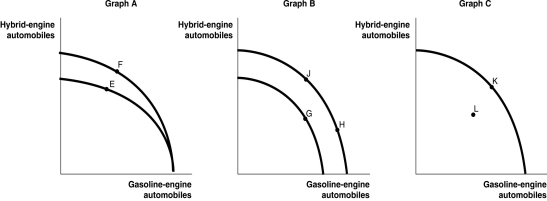 General Motors recently approved for production the Cadillac Converj, an electric car based on its Chevy Volt. The Converj will feature a "Generation 1.5 Voltec" powertrain, with a hybrid engine that runs on a combination of electricity and gasoline. Assume GM chooses to produce both hybrid-engine vehicles and gasoline-engine vehicles for its Cadillac brand. Figure 2-6 shows changes to its production possibilities frontier in response to new developments and different strategic production decisions.
-Refer to Figure 2-6.Assume a technological advancement greatly reduces the cost to produce hybrid-engine vehicles.This is best represented by the
General Motors recently approved for production the Cadillac Converj, an electric car based on its Chevy Volt. The Converj will feature a "Generation 1.5 Voltec" powertrain, with a hybrid engine that runs on a combination of electricity and gasoline. Assume GM chooses to produce both hybrid-engine vehicles and gasoline-engine vehicles for its Cadillac brand. Figure 2-6 shows changes to its production possibilities frontier in response to new developments and different strategic production decisions.
-Refer to Figure 2-6.Assume a technological advancement greatly reduces the cost to produce hybrid-engine vehicles.This is best represented by the (Multiple Choice)
4.9/5 (79)
(79) How does Adam Smith's idea of the "invisible hand" apply to the various parts,made by many different manufacturers in many different countries,that are used by Apple to produce an iPad?
(Essay)
4.8/5 (81)
(81) Figure 2-3 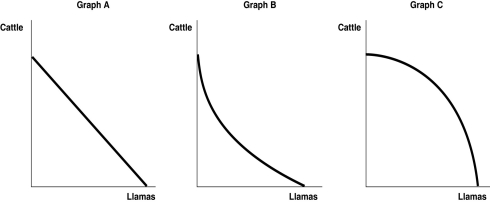 -Refer to Figure 2-3.Sergio Vignetto raises cattle and llamas on his land.His land is equally suitable for raising either animal.Which of the graphs in Figure 2-3 represent his production possibilities frontier?
 (Multiple Choice)
4.9/5 (96)
(96) 
Filters
- Essay(0)
- Multiple Choice(0)
- Short Answer(0)
- True False(0)
- Matching(0)