



 Chat with AI
Exam 2: Trade-Offs, comparative Advantage, and the Market System

Exam 1: Economics: Foundations and Models142 Questions
Exam 2: Trade-Offs, comparative Advantage, and the Market System152 Questions
Exam 3: Where Prices Come From: the Interaction of Demand and Supply149 Questions
Exam 4: Economic Efficiency, government Price Setting, and Taxes137 Questions
Exam 5: Externalities, environmental Policy, and Public Goods139 Questions
Exam 6: Elasticity: The Responsiveness of Demand and Supply149 Questions
Exam 7: The Economics of Health Care117 Questions
Exam 8: Firms, the Stock Market, and Corporate Governance140 Questions
Exam 9: Comparative Advantage and the Gains From International Trade124 Questions
Exam 10: Consumer Choice and Behavioral Economics154 Questions
Exam 11: Technology, production, and Costs174 Questions
Exam 12: Firms in Perfectly Competitive Markets153 Questions
Exam 13: Monopolistic Competition: The Competitive Model in a More Realistic Setting137 Questions
Exam 14: Oligopoly: Firms in Less Competitive Markets129 Questions
Exam 15: Monopoly and Antitrust Policy148 Questions
Exam 16: Pricing Strategy134 Questions
Exam 17: The Markets for Labor and Other Factors of Production149 Questions
Exam 18: Public Choice, taxes, and the Distribution of Income134 Questions
Exam 19: GDP: Measuring Total Production and Income135 Questions
Exam 20: Unemployment and Inflation148 Questions
Exam 21: Economic Growth, the Financial System, and Business Cycles130 Questions
Exam 22: Long-Run Economic Growth: Sources and Policies134 Questions
Exam 23: Aggregate Expenditure and Output in the Short Run157 Questions
Exam 24: Aggregate Demand and Aggregate Supply Analysis145 Questions
Exam 25: Money, banks, and the Federal Reserve System144 Questions
Exam 26: Monetary Policy145 Questions
Exam 27: Fiscal Policy155 Questions
Exam 28: Inflation, unemployment, and Federal Reserve Policy135 Questions
Exam 29: Macroeconomics in an Open Economy145 Questions
Exam 30: The International Financial System139 Questions
Select questions type


Without an increase in the supplies of factors of production,how can a nation achieve economic growth?
(Multiple Choice)
4.9/5  (73)
(73) The payment received by suppliers of entrepreneurial skills is called interest.
(True/False)
4.9/5 (77)
(77) Table 2-4
 Table 2-4 shows the number of labor hours required to produce a digital camera and a pound of wheat in China and South Korea.
-Refer to Table 2-4.China has a comparative advantage in the production of
Table 2-4 shows the number of labor hours required to produce a digital camera and a pound of wheat in China and South Korea.
-Refer to Table 2-4.China has a comparative advantage in the production of (Multiple Choice)
4.9/5 (84)
(84) A decrease in the unemployment rate may be represented as a movement from a point on the production possibilities frontier to a point outside the frontier.
(True/False)
4.8/5 (76)
(76) Figure 2-4 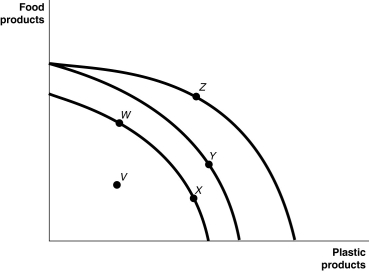 Figure 2-4 shows various points on three different production possibilities frontiers for a nation.
-Refer to Figure 2-4.A movement from Y to Z
Figure 2-4 shows various points on three different production possibilities frontiers for a nation.
-Refer to Figure 2-4.A movement from Y to Z (Multiple Choice)
4.9/5 (77)
(77) Which of the following is an example of spending on goods and services in the circular flow model?
(Multiple Choice)
4.8/5 (94)
(94) Figure 2-4
Figure 2-4 shows various points on three different production possibilities frontiers for a nation.
-Refer to Figure 2-4.Consider the following events: a.an increase in the unemployment rate
b.a decrease in a nation's money supply
c.a war that kills a significant portion of a nation's population
Which of the events listed above could cause a movement from Y to W ?
Figure 2-4 shows various points on three different production possibilities frontiers for a nation.
-Refer to Figure 2-4.Consider the following events: a.an increase in the unemployment rate
b.a decrease in a nation's money supply
c.a war that kills a significant portion of a nation's population
Which of the events listed above could cause a movement from Y to W ? (Multiple Choice)
4.9/5 (98)
(98) Figure 2-4
Figure 2-4 shows various points on three different production possibilities frontiers for a nation.
-Refer to Figure 2-4.Consider the following events:
a.a decrease in the unemployment rate
b.general technological advancement
c.an increase in consumer wealth
Which of the events listed above could cause a movement from V to W ?
Figure 2-4 shows various points on three different production possibilities frontiers for a nation.
-Refer to Figure 2-4.Consider the following events:
a.a decrease in the unemployment rate
b.general technological advancement
c.an increase in consumer wealth
Which of the events listed above could cause a movement from V to W ? (Multiple Choice)
4.8/5 (74)
(74) The basis for trade is comparative advantage,not absolute advantage.
(True/False)
4.7/5 (76)
(76) In a production possibilities frontier model,a point ________ the frontier is productively inefficient.
(Multiple Choice)
4.8/5 (78)
(78) Adam Smith's behavioral assumption about humans was that people
(Multiple Choice)
4.9/5 (74)
(74) On a diagram of a production possibility frontier,opportunity cost is represented by the production possibility frontier shifting outward.
(True/False)
4.7/5 (81)
(81) Crude oil is not an example of a factor of production,but when crude oil is processed into gasoline,it is a factor of production.
(True/False)
4.9/5 (88)
(88) Table 2-3
 Table 2-3 shows the output per week of two jewelers, Serena and Haley. They can either devote their time to making bracelets or making necklaces.
-Refer to Table 2-3.Which of the following statements is true?
Table 2-3 shows the output per week of two jewelers, Serena and Haley. They can either devote their time to making bracelets or making necklaces.
-Refer to Table 2-3.Which of the following statements is true? (Multiple Choice)
4.8/5 (71)
(71) 
Filters
- Essay(0)
- Multiple Choice(0)
- Short Answer(0)
- True False(0)
- Matching(0)