



 Chat with AI
Exam 21: Economic Growth, the Financial System, and Business Cycles

Exam 1: Economics: Foundations and Models142 Questions
Exam 2: Trade-Offs, comparative Advantage, and the Market System152 Questions
Exam 3: Where Prices Come From: the Interaction of Demand and Supply149 Questions
Exam 4: Economic Efficiency, government Price Setting, and Taxes137 Questions
Exam 5: Externalities, environmental Policy, and Public Goods139 Questions
Exam 6: Elasticity: The Responsiveness of Demand and Supply149 Questions
Exam 7: The Economics of Health Care117 Questions
Exam 8: Firms, the Stock Market, and Corporate Governance140 Questions
Exam 9: Comparative Advantage and the Gains From International Trade124 Questions
Exam 10: Consumer Choice and Behavioral Economics154 Questions
Exam 11: Technology, production, and Costs174 Questions
Exam 12: Firms in Perfectly Competitive Markets153 Questions
Exam 13: Monopolistic Competition: The Competitive Model in a More Realistic Setting137 Questions
Exam 14: Oligopoly: Firms in Less Competitive Markets129 Questions
Exam 15: Monopoly and Antitrust Policy148 Questions
Exam 16: Pricing Strategy134 Questions
Exam 17: The Markets for Labor and Other Factors of Production149 Questions
Exam 18: Public Choice, taxes, and the Distribution of Income134 Questions
Exam 19: GDP: Measuring Total Production and Income135 Questions
Exam 20: Unemployment and Inflation148 Questions
Exam 21: Economic Growth, the Financial System, and Business Cycles130 Questions
Exam 22: Long-Run Economic Growth: Sources and Policies134 Questions
Exam 23: Aggregate Expenditure and Output in the Short Run157 Questions
Exam 24: Aggregate Demand and Aggregate Supply Analysis145 Questions
Exam 25: Money, banks, and the Federal Reserve System144 Questions
Exam 26: Monetary Policy145 Questions
Exam 27: Fiscal Policy155 Questions
Exam 28: Inflation, unemployment, and Federal Reserve Policy135 Questions
Exam 29: Macroeconomics in an Open Economy145 Questions
Exam 30: The International Financial System139 Questions
Select questions type


Inflation tends to ________ during the expansion phase of the business cycle and ________ during the recession phase of the business cycle.

Free
(Multiple Choice)
4.8/5  (77)
(77) Correct Answer: Verified
A
As the economy nears the end of an expansion,which of the following do we typically see?
Free
(Multiple Choice)
4.8/5 (83)
(83) Correct Answer:Verified
VerifiedC
If the U.S.government decided to regulate the prices of airline tickets to keep them from falling when the economy is weak,there would tend to be a ________ of airline tickets in the market and this would likely ________ the profits of U.S.airlines.
Free
(Multiple Choice)
4.9/5 (91)
(91) Correct Answer:Verified
VerifiedD
In a closed economy,public saving is equal to which of the following? (Y = GDP,C = Consumption,G = Government purchases,T = Taxes,and TR = Transfers)
(Multiple Choice)
4.9/5 (86)
(86) If the growth rate of real GDP rises from 3% to 4% per year,then the number of years required to double real GDP will decrease from
(Multiple Choice)
4.9/5 (86)
(86) Growth in potential GDP in the United States is estimated to be about
(Multiple Choice)
4.9/5 (74)
(74) Refer to Scenario 21-1.Based on the information above,what is the level of private saving in the economy?
(Multiple Choice)
4.9/5 (84)
(84) Explain and show graphically how government deficits can "crowd out" private investment.
(Essay)
4.9/5 (80)
(80) If,in an economy experiencing inflation,the government decided to tax real interest income rather than nominal interest income,this change would cause the real interest rate to ________ and the equilibrium quantity of loanable funds to ________.
(Multiple Choice)
4.8/5 (67)
(67) Increases in real GDP since 1900 can actually underestimate growth in the standard of living for Americans since 1900 because
(Multiple Choice)
4.8/5 (86)
(86) Increases in capital per hour worked cannot sustain high rates of economic growth unless accompanied by technological change.
(True/False)
4.8/5 (93)
(93) Figure 21-3 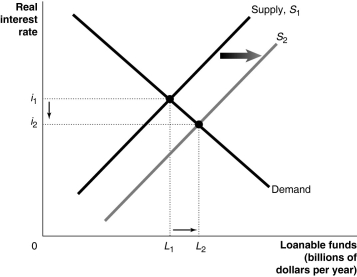 -Refer to Figure 21-3.Which of the following is consistent with the graph depicted above?
 (Multiple Choice)
4.8/5 (93)
(93) Since 1900,real GDP per capita has ________ and this measure ________ the actual growth in standards of living in the United States over this time.
(Multiple Choice)
4.9/5 (69)
(69) The period between a business cycle peak and a business cycle trough is called
(Multiple Choice)
4.9/5 (87)
(87) 
Filters
- Essay(0)
- Multiple Choice(0)
- Short Answer(0)
- True False(0)
- Matching(0)