



 Chat with AI
Exam 21: Economic Growth, the Financial System, and Business Cycles

Exam 1: Economics: Foundations and Models142 Questions
Exam 2: Trade-Offs, comparative Advantage, and the Market System152 Questions
Exam 3: Where Prices Come From: the Interaction of Demand and Supply149 Questions
Exam 4: Economic Efficiency, government Price Setting, and Taxes137 Questions
Exam 5: Externalities, environmental Policy, and Public Goods139 Questions
Exam 6: Elasticity: The Responsiveness of Demand and Supply149 Questions
Exam 7: The Economics of Health Care117 Questions
Exam 8: Firms, the Stock Market, and Corporate Governance140 Questions
Exam 9: Comparative Advantage and the Gains From International Trade124 Questions
Exam 10: Consumer Choice and Behavioral Economics154 Questions
Exam 11: Technology, production, and Costs174 Questions
Exam 12: Firms in Perfectly Competitive Markets153 Questions
Exam 13: Monopolistic Competition: The Competitive Model in a More Realistic Setting137 Questions
Exam 14: Oligopoly: Firms in Less Competitive Markets129 Questions
Exam 15: Monopoly and Antitrust Policy148 Questions
Exam 16: Pricing Strategy134 Questions
Exam 17: The Markets for Labor and Other Factors of Production149 Questions
Exam 18: Public Choice, taxes, and the Distribution of Income134 Questions
Exam 19: GDP: Measuring Total Production and Income135 Questions
Exam 20: Unemployment and Inflation148 Questions
Exam 21: Economic Growth, the Financial System, and Business Cycles130 Questions
Exam 22: Long-Run Economic Growth: Sources and Policies134 Questions
Exam 23: Aggregate Expenditure and Output in the Short Run157 Questions
Exam 24: Aggregate Demand and Aggregate Supply Analysis145 Questions
Exam 25: Money, banks, and the Federal Reserve System144 Questions
Exam 26: Monetary Policy145 Questions
Exam 27: Fiscal Policy155 Questions
Exam 28: Inflation, unemployment, and Federal Reserve Policy135 Questions
Exam 29: Macroeconomics in an Open Economy145 Questions
Exam 30: The International Financial System139 Questions
Select questions type


Centrally-planned economies tend to grow more quickly than market economies.
(True/False)
4.7/5  (78)
(78) Typically,as an economy begins to emerge from a recessionary phase of the business cycle,
(Multiple Choice)
4.9/5 (85)
(85) How will an increase in the government budget surplus as a result of lower government spending (with no change in net taxes)affect private saving in the economy?
(Multiple Choice)
4.9/5 (83)
(83) Which of the following does not describe governmental policy actions that are helpful in supporting growth in an economy? Governmental policies that
(Multiple Choice)
5.0/5 (87)
(87) If labor productivity growth slows down in a country,this means that the growth rate in ________ has declined.
(Multiple Choice)
4.8/5 (74)
(74) When potential GDP increases,is it necessarily the case that real GDP increases as well? Explain.
(Essay)
4.9/5 (73)
(73) What factors increase potential GDP? Include a definition of potential GDP in your answer.
(Essay)
4.9/5 (71)
(71) Figure 21-2 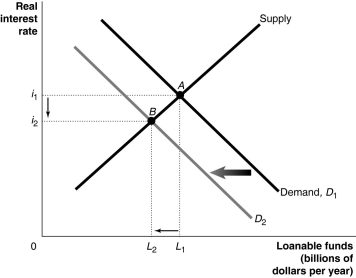 -Refer to Figure 21-2.Which of the following is consistent with the graph depicted above?
 (Multiple Choice)
4.8/5 (63)
(63) Figure 21-5 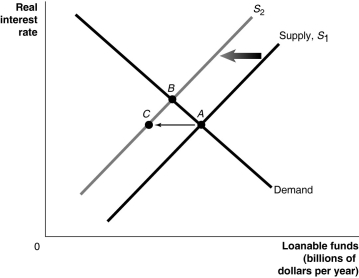 -Refer to Figure 21-5."Crowding out" of firm investment as a result of a budget deficit is illustrated by the movement from ________ in the graph above.
 (Multiple Choice)
4.9/5 (79)
(79) Economist Robert Fogel has estimated that by the year 2040,individuals in the United States will be spending
(Multiple Choice)
4.9/5 (87)
(87) Which of the following will increase investment spending in the economy,holding everything else constant?
(Multiple Choice)
4.8/5 (91)
(91) What is investment in a closed economy if you have the following economic data? Y = $10 trillion
C = $5 trillion
TR = $2 trillion
G = $2 trillion
(Multiple Choice)
4.8/5 (69)
(69) The growth rate of real GDP in the United States rises from 4.2% to 4.4%.Explain and calculate how this increase in the growth rate of real GDP affects the number of years it will take for real GDP to double.
(Essay)
4.7/5 (82)
(82) According to the "Rule of 70",it will take 4 years for real GDP per capita to double when the growth rate of real GDP per capita is
(Multiple Choice)
4.8/5 (72)
(72) Table 21-1
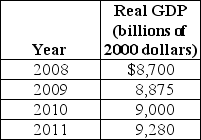 -Refer to Table 21-1.Using the table above,what is the approximate growth rate of real GDP from 2010 to 2011?
 (Multiple Choice)
4.8/5 (97)
(97) Which of the following will not occur as the result of a decrease in net taxes?
(Multiple Choice)
4.8/5 (83)
(83) If real GDP in a small country in 2010 is $8 billion and real GDP in the same country in 2011 is $8.3 billion,the growth rate of real GDP between 2010 and 2011
(Multiple Choice)
4.7/5 (79)
(79) During the expansion phase of the business cycle,which of the following eventually increases?
(Multiple Choice)
4.9/5 (83)
(83) Countries without well-developed financial systems are able to sustain high levels of economic growth.
(True/False)
4.9/5 (82)
(82) 
Filters
- Essay(0)
- Multiple Choice(0)
- Short Answer(0)
- True False(0)
- Matching(0)