



 Chat with AI
Exam 10: Consumer Choice and Behavioral Economics

Exam 1: Economics: Foundations and Models142 Questions
Exam 2: Trade-Offs, comparative Advantage, and the Market System152 Questions
Exam 3: Where Prices Come From: the Interaction of Demand and Supply149 Questions
Exam 4: Economic Efficiency, government Price Setting, and Taxes137 Questions
Exam 5: Externalities, environmental Policy, and Public Goods139 Questions
Exam 6: Elasticity: The Responsiveness of Demand and Supply149 Questions
Exam 7: The Economics of Health Care117 Questions
Exam 8: Firms, the Stock Market, and Corporate Governance140 Questions
Exam 9: Comparative Advantage and the Gains From International Trade124 Questions
Exam 10: Consumer Choice and Behavioral Economics154 Questions
Exam 11: Technology, production, and Costs174 Questions
Exam 12: Firms in Perfectly Competitive Markets153 Questions
Exam 13: Monopolistic Competition: The Competitive Model in a More Realistic Setting137 Questions
Exam 14: Oligopoly: Firms in Less Competitive Markets129 Questions
Exam 15: Monopoly and Antitrust Policy148 Questions
Exam 16: Pricing Strategy134 Questions
Exam 17: The Markets for Labor and Other Factors of Production149 Questions
Exam 18: Public Choice, taxes, and the Distribution of Income134 Questions
Exam 19: GDP: Measuring Total Production and Income135 Questions
Exam 20: Unemployment and Inflation148 Questions
Exam 21: Economic Growth, the Financial System, and Business Cycles130 Questions
Exam 22: Long-Run Economic Growth: Sources and Policies134 Questions
Exam 23: Aggregate Expenditure and Output in the Short Run157 Questions
Exam 24: Aggregate Demand and Aggregate Supply Analysis145 Questions
Exam 25: Money, banks, and the Federal Reserve System144 Questions
Exam 26: Monetary Policy145 Questions
Exam 27: Fiscal Policy155 Questions
Exam 28: Inflation, unemployment, and Federal Reserve Policy135 Questions
Exam 29: Macroeconomics in an Open Economy145 Questions
Exam 30: The International Financial System139 Questions
Select questions type


Figure 10-1 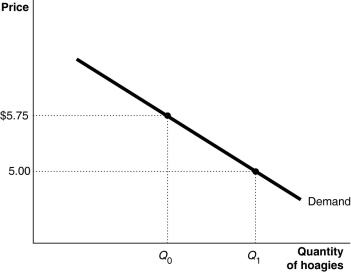 -Refer to Figure 10-1.Which of the following statements is true?
Free
(Multiple Choice)
4.9/5  (81)
(81) Correct Answer: Verified
A
Aisha and Debbie both purchase milk and bread at the same Quik Mart.They have different tastes for milk and bread and different incomes.They both buy some milk and some bread,but they buy considerably different quantities of the two goods.Which of the following statements is true,given that Aisha and Debbie are utility-maximizers?
Free
(Multiple Choice)
4.8/5 (72)
(72) Correct Answer:Verified
VerifiedA
Standard economic theory asserts that sunk costs are irrelevant in making economic decisions,yet studies conducted by behavioral economists reveal that sunk costs often affect economic decisions.Which of the following could explain this observation?
(Multiple Choice)
4.9/5 (74)
(74) Many airlines have not reduced or eliminated fuel surcharges despite the price of oil dropping.A logical reason for this is that the decline in fuel prices
(Multiple Choice)
4.8/5 (89)
(89) A network externality refers to a situation in which the usefulness of a product decreases with the number of consumers who use it.
(True/False)
4.7/5 (90)
(90) Figure 10-1
-Refer to Figure 10-1.When the price of hoagies increases from $5.00 to $5.75,quantity demanded decreases from Q1 to Q0.This change in quantity demanded is due to
-Refer to Figure 10-1.When the price of hoagies increases from $5.00 to $5.75,quantity demanded decreases from Q1 to Q0.This change in quantity demanded is due to (Multiple Choice)
4.9/5 (84)
(84) Grace Makutsi finally bought a pair of blue shoes that she had been coveting for a long time.In less than a week she discovered that the shoes were uncomfortable.Grace went back to wearing her old pair and stashed away the new pair.When asked by her boss,Mme.Ramotswe why does she not simply give away the new pair,she said: "But I paid so much for them." Grace's behavior
(Multiple Choice)
4.9/5 (81)
(81) Economists have shown that when the ultimatum game experiment is carried out,both allocators and recipients act as if fairness is important.
(True/False)
4.9/5 (75)
(75) Identify the one statement that does not demonstrate how social effects influence consumer choice.
(Multiple Choice)
4.9/5 (79)
(79) Why might network externalities result in products that contain inferior technologies?
(Essay)
4.8/5 (89)
(89) Suppose the consumer's income increases while the prices of the goods remain constant.Then the
(Multiple Choice)
4.9/5 (90)
(90) Each price-quantity combination on a consumer's demand curve shows the utility-maximizing quantity at the given price.
(True/False)
4.9/5 (86)
(86) Suppose Joe is maximizing total utility within his budget constraint.If the price of the last pair of jeans purchased is $25 and it yields 100 units of extra satisfaction and the price of the last shirt purchased is $20,then,using the rule of equal marginal utility per dollar spent,the extra satisfaction received from the last shirt must be
(Multiple Choice)
4.8/5 (89)
(89) Firms pay famous individuals to endorse their products because
(Multiple Choice)
4.8/5 (86)
(86) Consumers maximize total utility within their budget constraint by
(Multiple Choice)
4.9/5 (83)
(83) The substitution effect of a price increase causes a decrease in the quantity demanded of an inferior good.
(True/False)
4.8/5 (71)
(71) Consider the following hypothetical scenarios: Scenario A: You are about to purchase a pair of 7 for All Mankind jeans for $175 and a t-shirt for $45.The sales attendant at the store tells you that the pair of jeans you wish to buy is on sale for $160 at another store,located about a 20-minute drive away.
Scenario B: You are about to purchase a pair of 7 for All Mankind jeans for $175 and a t-shirt for $45.The sales attendant at the store tells you that the t-shirt you wish to buy is on sale for $30 at another store,located about a 20-minute drive away.
Based on standard economic theory,under which scenario would you make the 20-minute trip to the other store?
(Multiple Choice)
4.7/5 (79)
(79) 
Filters
- Essay(0)
- Multiple Choice(0)
- Short Answer(0)
- True False(0)
- Matching(0)