



 Chat with AI
Exam 10: Consumer Choice and Behavioral Economics

Exam 1: Economics: Foundations and Models142 Questions
Exam 2: Trade-Offs, comparative Advantage, and the Market System152 Questions
Exam 3: Where Prices Come From: the Interaction of Demand and Supply149 Questions
Exam 4: Economic Efficiency, government Price Setting, and Taxes137 Questions
Exam 5: Externalities, environmental Policy, and Public Goods139 Questions
Exam 6: Elasticity: The Responsiveness of Demand and Supply149 Questions
Exam 7: The Economics of Health Care117 Questions
Exam 8: Firms, the Stock Market, and Corporate Governance140 Questions
Exam 9: Comparative Advantage and the Gains From International Trade124 Questions
Exam 10: Consumer Choice and Behavioral Economics154 Questions
Exam 11: Technology, production, and Costs174 Questions
Exam 12: Firms in Perfectly Competitive Markets153 Questions
Exam 13: Monopolistic Competition: The Competitive Model in a More Realistic Setting137 Questions
Exam 14: Oligopoly: Firms in Less Competitive Markets129 Questions
Exam 15: Monopoly and Antitrust Policy148 Questions
Exam 16: Pricing Strategy134 Questions
Exam 17: The Markets for Labor and Other Factors of Production149 Questions
Exam 18: Public Choice, taxes, and the Distribution of Income134 Questions
Exam 19: GDP: Measuring Total Production and Income135 Questions
Exam 20: Unemployment and Inflation148 Questions
Exam 21: Economic Growth, the Financial System, and Business Cycles130 Questions
Exam 22: Long-Run Economic Growth: Sources and Policies134 Questions
Exam 23: Aggregate Expenditure and Output in the Short Run157 Questions
Exam 24: Aggregate Demand and Aggregate Supply Analysis145 Questions
Exam 25: Money, banks, and the Federal Reserve System144 Questions
Exam 26: Monetary Policy145 Questions
Exam 27: Fiscal Policy155 Questions
Exam 28: Inflation, unemployment, and Federal Reserve Policy135 Questions
Exam 29: Macroeconomics in an Open Economy145 Questions
Exam 30: The International Financial System139 Questions
Select questions type


Table 10-1
 Keegan has $30 to spend on Pita Wraps and Bubble Tea. The price of a Pita Wrap is $6 and the price of a glass of Bubble Tea is $3. Table 10-1 shows his total utility from different quantities of the two items.
-Refer to Table 10-1.If Keegan can drink all the bubble tea he wants for free,how many glasses will he consume?
Keegan has $30 to spend on Pita Wraps and Bubble Tea. The price of a Pita Wrap is $6 and the price of a glass of Bubble Tea is $3. Table 10-1 shows his total utility from different quantities of the two items.
-Refer to Table 10-1.If Keegan can drink all the bubble tea he wants for free,how many glasses will he consume? (Multiple Choice)
4.8/5  (74)
(74) If a consumer receives 20 units of utility from consuming two candy bars,and 25 units of utility from consuming three candy bars,the marginal utility of the third candy bar is
(Multiple Choice)
4.9/5 (82)
(82) If Dawson prefers pizza to hamburgers and hamburgers to hot dogs,then if preferences are transitive,
(Multiple Choice)
4.8/5 (77)
(77) The economic model of consumer behavior explains how consumers' tastes and preferences are formed.
(True/False)
4.9/5 (76)
(76) Which of the following is an experiment which tests whether fairness is important in consumer decision making?
(Multiple Choice)
4.9/5 (83)
(83) Figure 10-5  -Refer to Figure 10-5.A change in the price of popcorn only is shown in
 (Multiple Choice)
4.9/5 (80)
(80) List three reasons why demand for a product will often increase if the product is endorsed by a celebrity.
(Essay)
4.7/5 (79)
(79) A Giffen good could be either a normal good or an inferior good.
(True/False)
4.9/5 (68)
(68) Figure 10-6 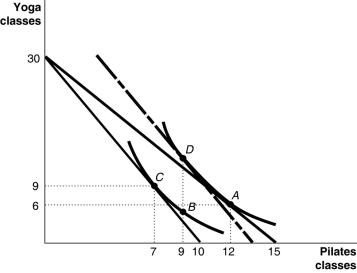 Manuri has $300 to spend on Pilates classes and Yoga classes. The price of a group Pilates class is $20 and the price of a group Yoga class is $10. Manuri's optimal bundle is given by "A" in Figure 9-6.
-Refer to Figure 10-6.Suppose the price of Pilates sessions rises to $30 while income and the price of Yoga sessions remain unchanged.What is her new optimal bundle?
Manuri has $300 to spend on Pilates classes and Yoga classes. The price of a group Pilates class is $20 and the price of a group Yoga class is $10. Manuri's optimal bundle is given by "A" in Figure 9-6.
-Refer to Figure 10-6.Suppose the price of Pilates sessions rises to $30 while income and the price of Yoga sessions remain unchanged.What is her new optimal bundle? (Multiple Choice)
4.8/5 (94)
(94) What is marginal utility and what is the law of diminishing marginal utility?
(Essay)
4.8/5 (74)
(74) In order to derive an individual's demand curve for salmon,we would observe what happens to the utility-maximizing bundle when we change
(Multiple Choice)
4.7/5 (85)
(85) The marginal rate of substitution is determined by the slope of an indifference curve.
(True/False)
4.8/5 (71)
(71) Farah has $100 to spend each month on bread and chicken.Suppose the price of bread is $4 a loaf and the price of chicken is $5 per pound.
a.Draw her budget constraint and label it BC0.Put bread on the horizontal axis and chicken on the vertical axis.Be sure to identify the intercept values.
b.Suppose Farah is a utility maximizer and she consumes 10 loaves of bread and 12 pounds of chicken.On the same graph you drew in part (a),draw an indifference curve to identify her optimal bundle.Label this bundle "E."
c.Is her budget exhausted? Verify your answer.
d.Now suppose Farah's income falls to so that she can now devote $80 to the two goods.Prices however remain unchanged.In the same diagram,graph her new budget constraint and label it BC1.Be sure to identify any new intercept values.
e.Following the change in income,can Farah consume the same bundle "E"? Explain your answer.
f.What must happen to her total utility following the decrease in her income?
(Essay)
4.9/5 (73)
(73) Gowri has $6 per day to purchase lunch.She spends all of her lunch money on pizza and iced-tea.The price of pizza is $2.00 per slice and iced-tea costs $1 per bottle.
a.Draw Gowri's budget constraint and label it BC0.Put pizza on the horizontal axis and iced-tea on the vertical axis.Be sure to identify the intercept values.
b.If the price of iced-tea rises to $1.20 per bottle,show what will happen to her budget constraint in your diagram.Be sure to indicate any new intercept values.
(Essay)
4.9/5 (84)
(84) 
Filters
- Essay(0)
- Multiple Choice(0)
- Short Answer(0)
- True False(0)
- Matching(0)