



 Chat with AI
Exam 10: Consumer Choice and Behavioral Economics

Exam 1: Economics: Foundations and Models142 Questions
Exam 2: Trade-Offs, comparative Advantage, and the Market System152 Questions
Exam 3: Where Prices Come From: the Interaction of Demand and Supply149 Questions
Exam 4: Economic Efficiency, government Price Setting, and Taxes137 Questions
Exam 5: Externalities, environmental Policy, and Public Goods139 Questions
Exam 6: Elasticity: The Responsiveness of Demand and Supply149 Questions
Exam 7: The Economics of Health Care117 Questions
Exam 8: Firms, the Stock Market, and Corporate Governance140 Questions
Exam 9: Comparative Advantage and the Gains From International Trade124 Questions
Exam 10: Consumer Choice and Behavioral Economics154 Questions
Exam 11: Technology, production, and Costs174 Questions
Exam 12: Firms in Perfectly Competitive Markets153 Questions
Exam 13: Monopolistic Competition: The Competitive Model in a More Realistic Setting137 Questions
Exam 14: Oligopoly: Firms in Less Competitive Markets129 Questions
Exam 15: Monopoly and Antitrust Policy148 Questions
Exam 16: Pricing Strategy134 Questions
Exam 17: The Markets for Labor and Other Factors of Production149 Questions
Exam 18: Public Choice, taxes, and the Distribution of Income134 Questions
Exam 19: GDP: Measuring Total Production and Income135 Questions
Exam 20: Unemployment and Inflation148 Questions
Exam 21: Economic Growth, the Financial System, and Business Cycles130 Questions
Exam 22: Long-Run Economic Growth: Sources and Policies134 Questions
Exam 23: Aggregate Expenditure and Output in the Short Run157 Questions
Exam 24: Aggregate Demand and Aggregate Supply Analysis145 Questions
Exam 25: Money, banks, and the Federal Reserve System144 Questions
Exam 26: Monetary Policy145 Questions
Exam 27: Fiscal Policy155 Questions
Exam 28: Inflation, unemployment, and Federal Reserve Policy135 Questions
Exam 29: Macroeconomics in an Open Economy145 Questions
Exam 30: The International Financial System139 Questions
Select questions type


The endowment effect is the tendency of people to be unwilling to sell a good they already own even if they are offered a price greater than they would be willing to pay to buy the good if they did not already own it.
(True/False)
4.8/5  (87)
(87) If Ewan is consuming his utility maximizing bundle and the price of one good falls,what happens to the marginal utility per dollar spent on this good (MU/P),and what should Ewan do?
(Multiple Choice)
4.8/5 (87)
(87) If a consumer receives 20 units of utility from consuming two candy bars,and 25 units of utility from consuming three candy bars,the marginal utility of the second candy bar is
(Multiple Choice)
4.9/5 (72)
(72) Molly received an autographed poster of David Hasselhoff for her 21st birthday.Her friend Helga offered her $50 for the poster,but Molly refused to sell the poster even though she knows she would never pay that much to replace it if it was ever damaged or destroyed.Explain this inconsistency in Molly's behavior.
(Essay)
4.7/5 (87)
(87) The absolute value of the slope of the budget constraint is equal to
(Multiple Choice)
5.0/5 (74)
(74) Consider a good whose consumption takes place publicly.Your decision to buy that good depends
(Multiple Choice)
4.8/5 (89)
(89) Table 10-2
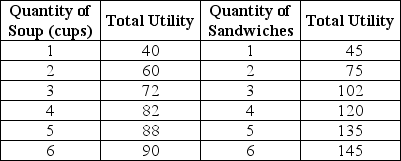 Table 10-2 above shows Keira's utility from soup and sandwiches. The price of soup is $2 per cup and the price of a sandwich is $3. Keira has $18 to spend on these two goods.
-Refer to Table 10-2.What is Keira's marginal utility per dollar spent on the third cup of soup?
Table 10-2 above shows Keira's utility from soup and sandwiches. The price of soup is $2 per cup and the price of a sandwich is $3. Keira has $18 to spend on these two goods.
-Refer to Table 10-2.What is Keira's marginal utility per dollar spent on the third cup of soup? (Multiple Choice)
4.8/5 (71)
(71) Table 10-2
Table 10-2 above shows Keira's utility from soup and sandwiches. The price of soup is $2 per cup and the price of a sandwich is $3. Keira has $18 to spend on these two goods.
-Refer to Table 10-2.If Keira maximizes her utility,how many units of each good should she buy?
Table 10-2 above shows Keira's utility from soup and sandwiches. The price of soup is $2 per cup and the price of a sandwich is $3. Keira has $18 to spend on these two goods.
-Refer to Table 10-2.If Keira maximizes her utility,how many units of each good should she buy? (Multiple Choice)
4.8/5 (68)
(68) Consider a downward-sloping demand curve.When the price of an inferior good decreases,the income and substitution effects
(Multiple Choice)
4.9/5 (73)
(73) The demand curve for canned peas is downward sloping.If the price of canned peas,an inferior good,rises,
(Multiple Choice)
4.8/5 (92)
(92) If you exhibit the endowment effect as a decision maker,then you are
(Multiple Choice)
4.8/5 (86)
(86) Consider a downward-sloping demand curve.When the price of an inferior good increases,the income and substitution effects
(Multiple Choice)
4.9/5 (85)
(85) If Valerie purchases ankle socks at $5 and gets 25 units of marginal utility from the last unit,and bandanas at $3 and gets 12 units of marginal utility from the last bandana purchased,she
(Multiple Choice)
4.8/5 (85)
(85) Music writer Anthony Kuzminski praised rock star Tom Petty in a 2007 article in the online Unrated Magazine.Kuzminski wrote: "Something Petty never can get enough credit for is his fan-friendly attitude.He kept ticket prices for [his concerts] at $50 when other acts this summer are charging upwards of $100 for stadium gigs.Petty could charge more,but he doesn't see the point.He has stated time and time again he still makes millions when he's on the road,regardless of his ticket prices.He is the last of the fan friendly rock stars out there." Use economic reasoning to write a rationale for Tom Petty's decision to charge prices for his band's ("Tom Petty and the Heartbreakers")concerts that are less than market clearing prices.
Source: Anthony Kuzminski,"Tom Petty & The Heartbreakers at the Vic Theater" http://www.unratedmagazine.com/
(Essay)
4.7/5 (91)
(91) Figure 10-5  -Refer to Figure 10-5.A change in income is shown in
 (Multiple Choice)
4.7/5 (70)
(70) What is the common feature displayed by the following items? a.eating in a newly opened "fusion" cuisine restaurant
B)attending a Red Sox game in Fenway Park
C)wearing Lucky Brand designer jeans
A) They are all highly inelastic goods.
B) The consumption of these goods takes place privately.
C) The consumption of these goods takes place publicly.
D) They tend to be consumed by better educated people.
(Not Answered)
This question doesn't have any answer yet
Professor Parallax chooses two students in his economics class,Jasmine and Cassandra,to participate in the ultimatum game.He chooses Jasmine to be the allocator and Cassandra to be the recipient.He gives Jasmine $50 and as the allocator,she gets to decide how to split the money with Cassandra.If Cassandra decides to accept the amount allocated to her by Jasmine,both students get to keep the money.If Cassandra decides to reject her allocation,neither student gets to keep the money.How much will each student end up with if each student acts as if fairness is important? How much will each student end up with if only Cassandra acts as if fairness is important? How much will each student end up with if neither student cares about fairness?
(Essay)
4.9/5 (69)
(69) If Marlowe obtains 9 units of utility per dollar spent on apples and 6 units of utility per dollar spent on oranges,then Marlowe
(Multiple Choice)
4.8/5 (81)
(81) 
Filters
- Essay(0)
- Multiple Choice(0)
- Short Answer(0)
- True False(0)
- Matching(0)