



 Chat with AI
Exam 10: Consumer Choice and Behavioral Economics

Exam 1: Economics: Foundations and Models142 Questions
Exam 2: Trade-Offs, comparative Advantage, and the Market System152 Questions
Exam 3: Where Prices Come From: the Interaction of Demand and Supply149 Questions
Exam 4: Economic Efficiency, government Price Setting, and Taxes137 Questions
Exam 5: Externalities, environmental Policy, and Public Goods139 Questions
Exam 6: Elasticity: The Responsiveness of Demand and Supply149 Questions
Exam 7: The Economics of Health Care117 Questions
Exam 8: Firms, the Stock Market, and Corporate Governance140 Questions
Exam 9: Comparative Advantage and the Gains From International Trade124 Questions
Exam 10: Consumer Choice and Behavioral Economics154 Questions
Exam 11: Technology, production, and Costs174 Questions
Exam 12: Firms in Perfectly Competitive Markets153 Questions
Exam 13: Monopolistic Competition: The Competitive Model in a More Realistic Setting137 Questions
Exam 14: Oligopoly: Firms in Less Competitive Markets129 Questions
Exam 15: Monopoly and Antitrust Policy148 Questions
Exam 16: Pricing Strategy134 Questions
Exam 17: The Markets for Labor and Other Factors of Production149 Questions
Exam 18: Public Choice, taxes, and the Distribution of Income134 Questions
Exam 19: GDP: Measuring Total Production and Income135 Questions
Exam 20: Unemployment and Inflation148 Questions
Exam 21: Economic Growth, the Financial System, and Business Cycles130 Questions
Exam 22: Long-Run Economic Growth: Sources and Policies134 Questions
Exam 23: Aggregate Expenditure and Output in the Short Run157 Questions
Exam 24: Aggregate Demand and Aggregate Supply Analysis145 Questions
Exam 25: Money, banks, and the Federal Reserve System144 Questions
Exam 26: Monetary Policy145 Questions
Exam 27: Fiscal Policy155 Questions
Exam 28: Inflation, unemployment, and Federal Reserve Policy135 Questions
Exam 29: Macroeconomics in an Open Economy145 Questions
Exam 30: The International Financial System139 Questions
Select questions type


Eliza consumes 12 cappuccinos and 8 apple turnovers per week.The price of cappuccino is $4 each and apple turnovers are $1 each.
a.What is the amount of income allocated to cappuccino and apple turnover consumption?
b.What is the price ratio (the price of cappuccino relative to the price of apple turnovers)?
c.Explain the meaning of the price ratio you computed.
d.If Eliza maximize utility,what is the ratio of the marginal utility of cappuccino to the marginal utility of apple turnovers?
e.If the price of apple turnovers falls,will Eliza consume more apple turnovers,fewer apple turnovers or the same amount of apple turnovers? Explain your answer using the rule of equal marginal utility per dollar.
(Essay)
4.8/5  (70)
(70) One explanation for the increase in product sales because of celebrity endorsements is that people seem to receive ________ from goods they believe are popular.
(Multiple Choice)
4.7/5 (74)
(74) Figure 10-5  -Refer to Figure 10-5.Which diagram demonstrates a decrease in total utility following an increase in the price of candy?
 (Multiple Choice)
4.8/5 (76)
(76) The demand curve for an inferior good can never be downward-sloping.
(True/False)
4.8/5 (86)
(86) Which of the following is not a common mistake made by consumers?
(Multiple Choice)
4.7/5 (78)
(78) When diminishing marginal utility sets in,total utility must be negative.
(True/False)
4.9/5 (80)
(80) Arnie Ziffel has $20 per week to spend on any combination of pineapples and green tea.The price of a pineapple is $4 and the price of a bottle of green tea is $2.The table below shows Arnie's utility values.Use the table to answer the questions that follow the table.
 a.Complete the table by filling in the blank spaces.
b.Suppose Arnold purchases 4 pineapples and 2 bottles of green tea.Is he consuming the optimal consumption bundle? If so,explain why.If not,what combination should he buy and why?
a.Complete the table by filling in the blank spaces.
b.Suppose Arnold purchases 4 pineapples and 2 bottles of green tea.Is he consuming the optimal consumption bundle? If so,explain why.If not,what combination should he buy and why? (Essay)
4.9/5 (80)
(80) The income effect of a price increase for a Giffen good outweighs the substitution effect.
(True/False)
4.8/5 (90)
(90) Consumers have to make tradeoffs in deciding what to consume because
(Multiple Choice)
4.8/5 (78)
(78) The substitution effect of an increase in the price of Raisin Bran refers to
(Multiple Choice)
4.9/5 (91)
(91) Once a product becomes established,network externalities may create ________ costs that make consumers reluctant to buy a new product with better technology.
(Multiple Choice)
4.9/5 (81)
(81) Figure 10-2 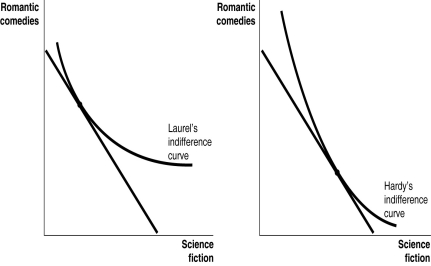 -Refer to Figure 10-2.The Bobsey twins,Laurel and Hardy,both enjoy watching romantic comedies and science fiction movies.Based on the diagrams above what can you conclude about their movie preferences?
 (Multiple Choice)
4.9/5 (80)
(80) Figure 10-5
-Refer to Figure 10-5.A change in the price of candy only is shown in
-Refer to Figure 10-5.A change in the price of candy only is shown in (Multiple Choice)
4.9/5 (92)
(92) Figure 10-6 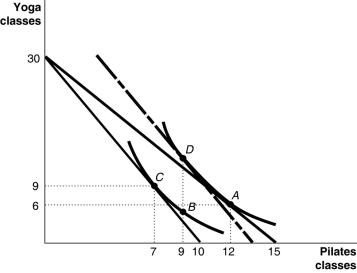 Manuri has $300 to spend on Pilates classes and Yoga classes. The price of a group Pilates class is $20 and the price of a group Yoga class is $10. Manuri's optimal bundle is given by "A" in Figure 9-6.
-Refer to Figure 10-6.Suppose the price of Pilates sessions rise to $30 while income and the price of Yoga sessions remain unchanged.The income effect of this price change is represented by the movement from
Manuri has $300 to spend on Pilates classes and Yoga classes. The price of a group Pilates class is $20 and the price of a group Yoga class is $10. Manuri's optimal bundle is given by "A" in Figure 9-6.
-Refer to Figure 10-6.Suppose the price of Pilates sessions rise to $30 while income and the price of Yoga sessions remain unchanged.The income effect of this price change is represented by the movement from (Multiple Choice)
4.8/5 (80)
(80) When the price of audio books,a normal good,falls,causing your purchasing power to rise,you buy more of them due to
(Multiple Choice)
4.8/5 (68)
(68) By hiring Justin Bieber to advertise its electronics Buy Back program,Best Buy is hoping to change its image and reach a new,younger target market.By using celebrities such as Bieber to endorse products,companies are hoping that its customers will respond positively and business will increase.All of the following are reasons why celebrity endorsements may increase sales for advertised products except
(Multiple Choice)
4.9/5 (88)
(88) Figure 10-4  -Refer to Figure 10-4.Suppose the price of pizza increases while the price of hamburger remains constant.Then,the consumer's
 (Multiple Choice)
4.8/5 (79)
(79) Most film processing companies have a policy of printing every picture on a roll of film and allowing customers to request a refund for pictures that were not clearly developed.The companies do this knowing that most customers do not ask for refunds.This is an example of consumers
(Multiple Choice)
4.8/5 (76)
(76) 
Filters
- Essay(0)
- Multiple Choice(0)
- Short Answer(0)
- True False(0)
- Matching(0)