



 Chat with AI
Exam 10: Consumer Choice and Behavioral Economics

Exam 1: Economics: Foundations and Models142 Questions
Exam 2: Trade-Offs, comparative Advantage, and the Market System152 Questions
Exam 3: Where Prices Come From: the Interaction of Demand and Supply149 Questions
Exam 4: Economic Efficiency, government Price Setting, and Taxes137 Questions
Exam 5: Externalities, environmental Policy, and Public Goods139 Questions
Exam 6: Elasticity: The Responsiveness of Demand and Supply149 Questions
Exam 7: The Economics of Health Care117 Questions
Exam 8: Firms, the Stock Market, and Corporate Governance140 Questions
Exam 9: Comparative Advantage and the Gains From International Trade124 Questions
Exam 10: Consumer Choice and Behavioral Economics154 Questions
Exam 11: Technology, production, and Costs174 Questions
Exam 12: Firms in Perfectly Competitive Markets153 Questions
Exam 13: Monopolistic Competition: The Competitive Model in a More Realistic Setting137 Questions
Exam 14: Oligopoly: Firms in Less Competitive Markets129 Questions
Exam 15: Monopoly and Antitrust Policy148 Questions
Exam 16: Pricing Strategy134 Questions
Exam 17: The Markets for Labor and Other Factors of Production149 Questions
Exam 18: Public Choice, taxes, and the Distribution of Income134 Questions
Exam 19: GDP: Measuring Total Production and Income135 Questions
Exam 20: Unemployment and Inflation148 Questions
Exam 21: Economic Growth, the Financial System, and Business Cycles130 Questions
Exam 22: Long-Run Economic Growth: Sources and Policies134 Questions
Exam 23: Aggregate Expenditure and Output in the Short Run157 Questions
Exam 24: Aggregate Demand and Aggregate Supply Analysis145 Questions
Exam 25: Money, banks, and the Federal Reserve System144 Questions
Exam 26: Monetary Policy145 Questions
Exam 27: Fiscal Policy155 Questions
Exam 28: Inflation, unemployment, and Federal Reserve Policy135 Questions
Exam 29: Macroeconomics in an Open Economy145 Questions
Exam 30: The International Financial System139 Questions
Select questions type


A consumer maximizes her total utility from a bundle of goods when her marginal utility from each good is equal.
(True/False)
4.9/5  (83)
(83) Figure 10-4  -Refer to Figure 10-4.Which of the following statements is true?
 (Multiple Choice)
4.8/5 (88)
(88) In the ultimatum game,allocators usually offer recipients at least a 40 percent share of the money,and recipients almost always reject offers of less than a 10 percent share.Which of the following does not explain why allocators offer recipients a relatively generous share and why recipients reject meager offers?
(Multiple Choice)
4.8/5 (79)
(79) The average price of gasoline in your neighborhood is $3.53 per gallon.Your neighbor,Diana tells you that you can "save a lot" by frequenting a gas station 20 miles outside your neighborhood where the price of gasoline is $3.46 per gallon However,she cautions you that there usually long lines at that station.Is her suggestion beneficial to you?
(Multiple Choice)
4.9/5 (72)
(72) The income effect of a price increase causes a decrease in the quantity demanded of a normal good.
(True/False)
4.9/5 (85)
(85) A common mistake made by consumers is the failure to take into account the sunk costs of their actions.
(True/False)
4.9/5 (76)
(76) A construction project in Congressman Foghorn's district is unfinished.Foghorn has asked that a new appropriations bill include funds to complete the project,despite a report by an independent agency that the project is a waste of taxpayer money.Foghorn's project is a bridge that crosses a river between two cities in his district.The press has criticized Foghorn and dubbed the project "a bridge too far" since another bridge,located closer to the same two cities Foghorn's bridge will connect,already exists and can accommodate all traffic between the two cities.Foghorn argues that if the bridge project is not completed,the $50 million already spent will have been wasted.Is Foghorn's argument economically rational? Explain your answer.
(Essay)
4.8/5 (90)
(90) If,when you consume another piece of candy,your marginal utility is zero,then
(Multiple Choice)
4.8/5 (89)
(89) A fair number of people buy expensive gym memberships to commit themselves to exercising.Yet,data from health clubs show that many do not follow through with their intentions and end up losing money on their membership contracts.Which of the following could explain this behavior?
(Multiple Choice)
4.8/5 (69)
(69) Figure 10-5  -Refer to Figure 10-5.Which diagram demonstrates an increase in total utility following a decrease in the price of popcorn?
 (Multiple Choice)
4.8/5 (73)
(73) Which of the following is a common mistake consumers commit when they make decisions?
(Multiple Choice)
4.8/5 (74)
(74) Research by Daniel Kahneman,Jack Knetch,and Richard Thaler has shown that companies like airlines were explicitly able to include a fuel surcharge in their prices because
(Multiple Choice)
5.0/5 (85)
(85) Arnold Kim began blogging about Apple products during his fourth year of medical school.Kim's Website,MacRumors.com,became so successful that he decided to give up his medical career and work full time on his Website,despite the nearly $200,000 he had invested in his education.In making his decision,Kim decided to ignore the money and time he spent on his education.Economists would say that Kim made a
(Multiple Choice)
4.9/5 (85)
(85) Adhira buys chocolates and almonds.She has 3 bars of chocolates and 4 bags of almonds.The marginal utility of the third chocolate bar is 18 units of utility and the marginal utility from the fourth bag of almonds is also 18.Is Adhira maximizing her utility?
(Multiple Choice)
4.9/5 (89)
(89) The observation that people tend to value something more highly when they own it than when they don't is called the
(Multiple Choice)
4.8/5 (80)
(80) Table 10-2
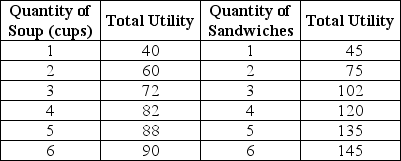 Table 10-2 above shows Keira's utility from soup and sandwiches. The price of soup is $2 per cup and the price of a sandwich is $3. Keira has $18 to spend on these two goods.
-Refer to Table 10-2.Holding prices constant,when Keira's income changed from $18 to $23,what happens to her total utility and to the marginal utilities of the last cup of soup and the last sandwich purchased?
Table 10-2 above shows Keira's utility from soup and sandwiches. The price of soup is $2 per cup and the price of a sandwich is $3. Keira has $18 to spend on these two goods.
-Refer to Table 10-2.Holding prices constant,when Keira's income changed from $18 to $23,what happens to her total utility and to the marginal utilities of the last cup of soup and the last sandwich purchased? (Multiple Choice)
4.9/5 (76)
(76) Economists Robert Jensen and Nolan Miller reasoned that to be a Giffen good,with an income effect larger than its substitution effect,a good must be ________ and make up a ________ portion of a consumer's budget.
(Multiple Choice)
4.8/5 (85)
(85) 
Filters
- Essay(0)
- Multiple Choice(0)
- Short Answer(0)
- True False(0)
- Matching(0)