



 Chat with AI
Exam 16: Pricing Strategy

Exam 1: Economics: Foundations and Models142 Questions
Exam 2: Trade-Offs, comparative Advantage, and the Market System152 Questions
Exam 3: Where Prices Come From: the Interaction of Demand and Supply149 Questions
Exam 4: Economic Efficiency, government Price Setting, and Taxes137 Questions
Exam 5: Externalities, environmental Policy, and Public Goods139 Questions
Exam 6: Elasticity: The Responsiveness of Demand and Supply149 Questions
Exam 7: The Economics of Health Care117 Questions
Exam 8: Firms, the Stock Market, and Corporate Governance140 Questions
Exam 9: Comparative Advantage and the Gains From International Trade124 Questions
Exam 10: Consumer Choice and Behavioral Economics154 Questions
Exam 11: Technology, production, and Costs174 Questions
Exam 12: Firms in Perfectly Competitive Markets153 Questions
Exam 13: Monopolistic Competition: The Competitive Model in a More Realistic Setting137 Questions
Exam 14: Oligopoly: Firms in Less Competitive Markets129 Questions
Exam 15: Monopoly and Antitrust Policy148 Questions
Exam 16: Pricing Strategy134 Questions
Exam 17: The Markets for Labor and Other Factors of Production149 Questions
Exam 18: Public Choice, taxes, and the Distribution of Income134 Questions
Exam 19: GDP: Measuring Total Production and Income135 Questions
Exam 20: Unemployment and Inflation148 Questions
Exam 21: Economic Growth, the Financial System, and Business Cycles130 Questions
Exam 22: Long-Run Economic Growth: Sources and Policies134 Questions
Exam 23: Aggregate Expenditure and Output in the Short Run157 Questions
Exam 24: Aggregate Demand and Aggregate Supply Analysis145 Questions
Exam 25: Money, banks, and the Federal Reserve System144 Questions
Exam 26: Monetary Policy145 Questions
Exam 27: Fiscal Policy155 Questions
Exam 28: Inflation, unemployment, and Federal Reserve Policy135 Questions
Exam 29: Macroeconomics in an Open Economy145 Questions
Exam 30: The International Financial System139 Questions
Select questions type


If marginal cost is zero,with an optimal two-part tariff,

Free
(Multiple Choice)
4.9/5  (85)
(85) Correct Answer: Verified
A
The act of buying a product at a low price in one market and reselling the product at a higher price in another market is called arbitrage.
Free
(True/False)
4.9/5 (84)
(84) Correct Answer:Verified
VerifiedTrue
Book publishers often use price discrimination across time to increase profits.Toni Morrison's book,A Mercy,was published as a hardcover edition in November 2008 at a price of $23.95.In August 2009,the paperback version was published at a price of $15.00.Assume that 100,000 hardcover books were sold to hard-core Toni Morrison fans in November 2008,and 400,000 paperback books were sold to casual readers in August 2009.Illustrate each of these situations graphically.Assume that the marginal cost of the hardcover version is $2.00 and the marginal cost of the paperback version is $0.75.
Free
(Essay)
4.8/5 (86)
(86) Correct Answer:Verified
Verified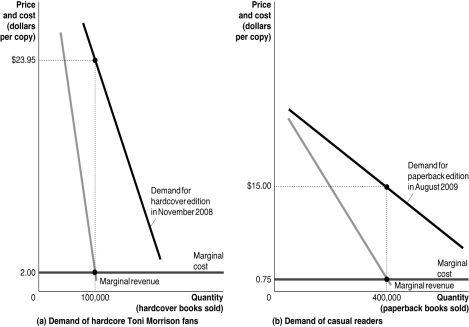
Consider three pricing strategies that the firm can pursue: a.optimal two-part tariff pricing
B)perfect price discrimination
C)single-price monopoly pricing.
Of these three strategies,which is least likely to benefit society as a whole?
A) a two-part tariff pricing because consumers have to pay a fixed fee in addition to a per-unit price
B) perfect price discrimination because those willing to pay higher prices are forced to subsidize those who are not
C) Both perfect price discrimination and two-part tariff pricing do not benefit society because the entire consumer surplus is extracted by the producer.
D) single-price monopoly pricing because there are mutually beneficial trades (between consumers and seller) that are not exploited
(Not Answered)
This question doesn't have any answer yet
If a firm could practice perfect price discrimination,it would
(Multiple Choice)
4.7/5 (91)
(91) Figure 16-4  -Refer to Figure 16-4.Suppose the firm represented in the diagram decides to use a two-part pricing strategy such that it charges a fixed fee and a per-unit price equal to the competitive price.(This is also called an optimal two-part tariff.) What is the total revenue it can expect to collect from the fixed fee portion of the price?
 (Multiple Choice)
4.8/5 (68)
(68) Consider the following pricing strategies: a.perfect price discrimination
B)charging different prices to different groups of customers
C)optimal two-part tariff
D)single-price monopoly pricing
Which of the pricing strategies allows a producer to capture the entire consumer surplus that would have gone to consumers under perfect competitive pricing?
A) a, b, c, and d
B) a, b, and c only
C) a and b only
D) a and c only
(Not Answered)
This question doesn't have any answer yet
What three conditions must hold for a firm to successfully price discriminate?
(Essay)
4.9/5 (75)
(75) Buying at a low price in one market and reselling at a higher price in another market will
(Multiple Choice)
4.8/5 (96)
(96) Figure 16-2  Plato Playhouse, a theatre company in the university town of Wegg, caters to two groups of customers: students and the non-student population. Figure 16-2 shows the demand curves for the two groups of customers.
-Refer to Figure 16-2.What is the quantity sold to each group of customer and what is the total quantity sold?
Plato Playhouse, a theatre company in the university town of Wegg, caters to two groups of customers: students and the non-student population. Figure 16-2 shows the demand curves for the two groups of customers.
-Refer to Figure 16-2.What is the quantity sold to each group of customer and what is the total quantity sold? (Multiple Choice)
4.8/5 (80)
(80) Figure 16-4
-Refer to Figure 16-4.Suppose the firm represented in the diagram decides to use a two-part pricing strategy such that it charges a fixed fee and a per-unit price equal to the monopoly price.What is the revenue collected from the fixed fee portion of the price?
-Refer to Figure 16-4.Suppose the firm represented in the diagram decides to use a two-part pricing strategy such that it charges a fixed fee and a per-unit price equal to the monopoly price.What is the revenue collected from the fixed fee portion of the price? (Multiple Choice)
4.9/5 (71)
(71) Table 16-1
 Table 16-1 shows the price for the novel, Harry Potter and The Deathly Hallows at four online bookstores.
-Refer to Table 16-1.Which of the following can one conclude from the data above?
Table 16-1 shows the price for the novel, Harry Potter and The Deathly Hallows at four online bookstores.
-Refer to Table 16-1.Which of the following can one conclude from the data above? (Multiple Choice)
4.8/5 (70)
(70) From an economic perspective,price discrimination is desirable because
(Multiple Choice)
5.0/5 (69)
(69) One reason why McDonald's charges a single price for its products is that it is difficult and costly for the company to determine each individual consumer's willingness to pay.
(True/False)
4.7/5 (75)
(75) Consider three pricing strategies that the firm can pursue: a.optimal two-part tariff pricing
B)perfect price discrimination
C)single-price monopoly pricing
Of these three strategies,which method gives the firm the highest profit?
A) optimal two-part tariff pricing
B) perfect price discrimination
C) single-price monopoly pricing
D) The profit is the same under optimal two-part tariff pricing and perfect price discrimination and the profit is higher than under single-price monopoly pricing.
(Not Answered)
This question doesn't have any answer yet
If the selling price of a firm's product is $200 and the estimated average cost of producing this product is $150,what is the firm's markup?
(Multiple Choice)
4.9/5 (86)
(86) 
Filters
- Essay(0)
- Multiple Choice(0)
- Short Answer(0)
- True False(0)
- Matching(0)