



 Chat with AI
Exam 16: Pricing Strategy

Exam 1: Economics: Foundations and Models142 Questions
Exam 2: Trade-Offs, comparative Advantage, and the Market System152 Questions
Exam 3: Where Prices Come From: the Interaction of Demand and Supply149 Questions
Exam 4: Economic Efficiency, government Price Setting, and Taxes137 Questions
Exam 5: Externalities, environmental Policy, and Public Goods139 Questions
Exam 6: Elasticity: The Responsiveness of Demand and Supply149 Questions
Exam 7: The Economics of Health Care117 Questions
Exam 8: Firms, the Stock Market, and Corporate Governance140 Questions
Exam 9: Comparative Advantage and the Gains From International Trade124 Questions
Exam 10: Consumer Choice and Behavioral Economics154 Questions
Exam 11: Technology, production, and Costs174 Questions
Exam 12: Firms in Perfectly Competitive Markets153 Questions
Exam 13: Monopolistic Competition: The Competitive Model in a More Realistic Setting137 Questions
Exam 14: Oligopoly: Firms in Less Competitive Markets129 Questions
Exam 15: Monopoly and Antitrust Policy148 Questions
Exam 16: Pricing Strategy134 Questions
Exam 17: The Markets for Labor and Other Factors of Production149 Questions
Exam 18: Public Choice, taxes, and the Distribution of Income134 Questions
Exam 19: GDP: Measuring Total Production and Income135 Questions
Exam 20: Unemployment and Inflation148 Questions
Exam 21: Economic Growth, the Financial System, and Business Cycles130 Questions
Exam 22: Long-Run Economic Growth: Sources and Policies134 Questions
Exam 23: Aggregate Expenditure and Output in the Short Run157 Questions
Exam 24: Aggregate Demand and Aggregate Supply Analysis145 Questions
Exam 25: Money, banks, and the Federal Reserve System144 Questions
Exam 26: Monetary Policy145 Questions
Exam 27: Fiscal Policy155 Questions
Exam 28: Inflation, unemployment, and Federal Reserve Policy135 Questions
Exam 29: Macroeconomics in an Open Economy145 Questions
Exam 30: The International Financial System139 Questions
Select questions type


Joss is a marketing consultant.Iris and Daphne are potential customers interested in commissioning Joss to undertake a market survey and compile the findings in a report.Iris is willing to pay $500 for the service while Daphne is willing to pay $800.Suppose that the opportunity cost of Joss's time is $1,200.Assume that Iris and Daphne do not know each other.If Joss charges the same price per copy to both Iris and Daphne,
(Multiple Choice)
4.8/5  (69)
(69) To successfully price discriminate,a firm must ensure that there are no opportunities for arbitrage.
(True/False)
4.8/5 (76)
(76) An optimal two-part tariff pricing schedule maximizes consumer surplus.
(True/False)
4.9/5 (92)
(92) Table 16-2
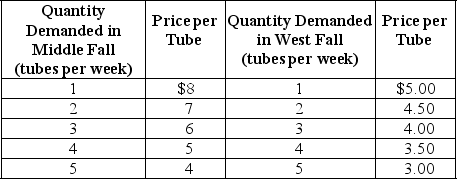 Neem Products sells its Ayurvedic Neem toothpaste in two completely isolated markets with demand schedules as shown in Table 16-2. The average cost of production is constant at $2 per tube.
-Refer to Table 16-2.How many tubes of toothpaste will Neem sell in West Fall and at what price?
Neem Products sells its Ayurvedic Neem toothpaste in two completely isolated markets with demand schedules as shown in Table 16-2. The average cost of production is constant at $2 per tube.
-Refer to Table 16-2.How many tubes of toothpaste will Neem sell in West Fall and at what price? (Multiple Choice)
4.9/5 (74)
(74) Table 16-2
Neem Products sells its Ayurvedic Neem toothpaste in two completely isolated markets with demand schedules as shown in Table 16-2. The average cost of production is constant at $2 per tube.
-Refer to Table 16-2.What are the total profits from both markets combined?
Neem Products sells its Ayurvedic Neem toothpaste in two completely isolated markets with demand schedules as shown in Table 16-2. The average cost of production is constant at $2 per tube.
-Refer to Table 16-2.What are the total profits from both markets combined? (Multiple Choice)
4.9/5 (85)
(85) An article on how prices in South Bend,Indiana rise during Notre Dame home football games noted: "For the Sept.16 game against the University of Michigan,the South Bend Marriott is charging $649 a night for a double room.......The Marriott's regular weekend price is $149 a night." Source: Ilan Brat,"Notre Dame Football Introduces Its Fans To Inflationary Spiral,Wall Street Journal,September 7,2006,p.A1.
Which of the following statements is true?
(Multiple Choice)
4.7/5 (89)
(89) If firms differentiate their products in different ways and charge different price because of these differentiation factors,then
(Multiple Choice)
4.8/5 (85)
(85) Figure 16-1 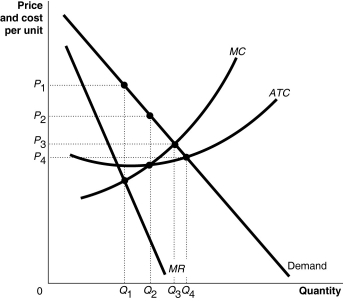 -Refer to Figure 16-1.What is the price charged under perfect price discrimination?
 (Multiple Choice)
4.9/5 (77)
(77) Suppose a restaurant is trying to determine how much to charge for a bowl of chili,and decides to run an experiment to see how much its customers are willing to pay by allowing them to set their own price for this menu item.
a.Is charging a customer the price he or she is willing to pay for the bowl of chili an example of price discrimination? Briefly explain.
b.What is it called when a firm knows every consumer's willingness to pay,and can charge every consumer a different price? What happens to consumer surplus in this situation?
(Essay)
4.9/5 (71)
(71) Consider the following actions undertaken by a firm: a.charging the same price for products of different quality
B)charging different prices to different consumers for the same product when the variation cannot be explained by cost differences
C)charging different prices for products of different qualities
D)charging a lower price to match a competitor's price
Which of the above will be considered price discrimination?
A) a, b, c, and d
B) a, b, and d only
C) b and d only
D) a and b only
(Not Answered)
This question doesn't have any answer yet
Price discrimination is possible in which of the following market structures? a.perfect competition
B)monopoly
C)oligopoly
D)monopolistic competition
A) a, b, c, and d
B) c and d only
C) b and c only
D) b, c, and d only
(Not Answered)
This question doesn't have any answer yet
Figure 16-4  -Refer to Figure 16-4.Suppose the firm represented in the diagram decides to practice perfect price discrimination.What is the profit-maximizing price it will charge?
 (Multiple Choice)
4.9/5 (76)
(76) Yield management and price discrimination have enabled firms to increase profits and,at the same time,
(Multiple Choice)
4.9/5 (78)
(78) Some consumer electronic products such as plasma TVs,DVD players and digital cameras,are introduced at very high prices but over time,their prices start falling (beyond what could be attributed to falling costs as companies take advantage of economies of scale and cheaper technologies).Which of the following is the best explanation for this observation?
(Multiple Choice)
4.8/5 (78)
(78) Figure 16-2 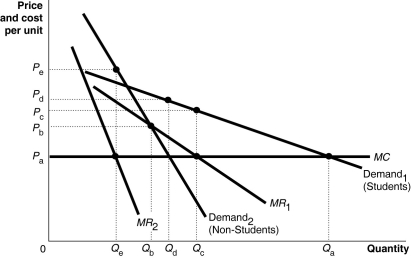 Plato Playhouse, a theatre company in the university town of Wegg, caters to two groups of customers: students and the non-student population. Figure 16-2 shows the demand curves for the two groups of customers.
-Refer to Figure 16-2.Suppose Plato Playhouse charges a single price of Pd for each performance.Which of the following statements is true?
Plato Playhouse, a theatre company in the university town of Wegg, caters to two groups of customers: students and the non-student population. Figure 16-2 shows the demand curves for the two groups of customers.
-Refer to Figure 16-2.Suppose Plato Playhouse charges a single price of Pd for each performance.Which of the following statements is true? (Multiple Choice)
4.8/5 (71)
(71) Joss is a marketing consultant.Iris and Daphne are potential customers interested in commissioning Joss to undertake a market survey and compile the findings in a report.Iris is willing to pay $500 for the service while Daphne is willing to pay $800.Suppose that the opportunity cost of Joss's time is $1,200.Assume that Iris and Daphne do not know each other.If the price is $500 per copy,
(Multiple Choice)
4.9/5 (92)
(92) Under what circumstances will the law of one price hold,and when might it not hold?
(Essay)
4.8/5 (78)
(78) 
Filters
- Essay(0)
- Multiple Choice(0)
- Short Answer(0)
- True False(0)
- Matching(0)