



 Chat with AI
Exam 16: Pricing Strategy

Exam 1: Economics: Foundations and Models142 Questions
Exam 2: Trade-Offs, comparative Advantage, and the Market System152 Questions
Exam 3: Where Prices Come From: the Interaction of Demand and Supply149 Questions
Exam 4: Economic Efficiency, government Price Setting, and Taxes137 Questions
Exam 5: Externalities, environmental Policy, and Public Goods139 Questions
Exam 6: Elasticity: The Responsiveness of Demand and Supply149 Questions
Exam 7: The Economics of Health Care117 Questions
Exam 8: Firms, the Stock Market, and Corporate Governance140 Questions
Exam 9: Comparative Advantage and the Gains From International Trade124 Questions
Exam 10: Consumer Choice and Behavioral Economics154 Questions
Exam 11: Technology, production, and Costs174 Questions
Exam 12: Firms in Perfectly Competitive Markets153 Questions
Exam 13: Monopolistic Competition: The Competitive Model in a More Realistic Setting137 Questions
Exam 14: Oligopoly: Firms in Less Competitive Markets129 Questions
Exam 15: Monopoly and Antitrust Policy148 Questions
Exam 16: Pricing Strategy134 Questions
Exam 17: The Markets for Labor and Other Factors of Production149 Questions
Exam 18: Public Choice, taxes, and the Distribution of Income134 Questions
Exam 19: GDP: Measuring Total Production and Income135 Questions
Exam 20: Unemployment and Inflation148 Questions
Exam 21: Economic Growth, the Financial System, and Business Cycles130 Questions
Exam 22: Long-Run Economic Growth: Sources and Policies134 Questions
Exam 23: Aggregate Expenditure and Output in the Short Run157 Questions
Exam 24: Aggregate Demand and Aggregate Supply Analysis145 Questions
Exam 25: Money, banks, and the Federal Reserve System144 Questions
Exam 26: Monetary Policy145 Questions
Exam 27: Fiscal Policy155 Questions
Exam 28: Inflation, unemployment, and Federal Reserve Policy135 Questions
Exam 29: Macroeconomics in an Open Economy145 Questions
Exam 30: The International Financial System139 Questions
Select questions type


Figure 16-3 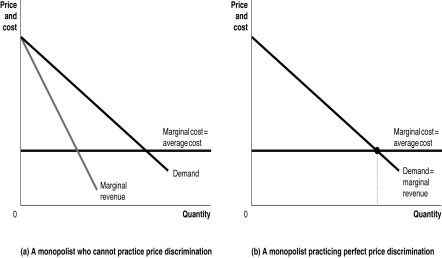 -Refer to Figure 16-3.Graph (a)represents a monopolist who cannot price discriminate and graph (b)represents a monopolist practicing perfect price discrimination.On each graph,identify the monopoly price,the monopoly output,the efficient output,and the areas representing profit,consumer surplus,and deadweight loss.
 (Essay)
4.7/5  (94)
(94) The Bay Area subway system,BART,offers senior citizens discounted fares for BART rides.This suggests that BART authorities believe that senior citizens have a ________ demand for subway rides.
(Multiple Choice)
4.8/5 (86)
(86) Figure 16-4  -Refer to Figure 16-4.Consider the following two pricing strategies:
a.a fixed fee and a per-unit price equal to the monopoly price
B.a fixed fee and a per-unit price equal to the competitive price
The firm represented in the diagram earns a higher profit under strategy ________ and deadweight loss is eliminated under ________.
-Refer to Figure 16-4.Consider the following two pricing strategies:
a.a fixed fee and a per-unit price equal to the monopoly price
B.a fixed fee and a per-unit price equal to the competitive price
The firm represented in the diagram earns a higher profit under strategy ________ and deadweight loss is eliminated under ________. (Multiple Choice)
4.8/5 (78)
(78) Both first-degree price discrimination and optimal two-part tariff pricing maximize economic surplus.
(True/False)
4.7/5 (91)
(91) Consider three pricing strategies that the firm can pursue: a.optimal two-part tariff pricing;
B)perfect price discrimination
C)single-price monopoly pricing
Of these three strategies,which is most beneficial to society as a whole?
A) Both perfect price discrimination and a two-part tariff pricing are equally beneficial in that the marginal benefit of the last unit sold equals the marginal cost of producing that unit.
B) only perfect price discrimination because this pricing method eliminates deadweight loss
C) single-price monopoly pricing because consumers enjoy at least some consumer surplus
D) only two-part tariff pricing because the per-unit portion of the price is set equal to marginal cost
(Not Answered)
This question doesn't have any answer yet
A firm using a two-part tariff can produce the economically efficient outcome by
(Multiple Choice)
4.7/5 (71)
(71) Figure 16-4
-Refer to Figure 16-4.Suppose the firm represented in the diagram decides to use a two-part pricing strategy such that such that it charges a fixed fee and a per-unit price equal to the competitive price.(This is also called an optimal two-part tariff.)What is the quantity it should produce?
-Refer to Figure 16-4.Suppose the firm represented in the diagram decides to use a two-part pricing strategy such that such that it charges a fixed fee and a per-unit price equal to the competitive price.(This is also called an optimal two-part tariff.)What is the quantity it should produce? (Multiple Choice)
4.9/5 (73)
(73) Which of the following are necessary condition(s)for successful price discrimination? a.zero transaction cost
B)a perfectly competitive market structure
C)an imperfectly competitive market structure
D)at least two different markets with different price elasticities of demand
E)at least two different markets with different price elasticities of supply
A) a, b, and d only
B) c and d only
C) a, c, d and, e only
D) a and c only
(Not Answered)
This question doesn't have any answer yet
Suppose the per-unit production cost of a book is $4.00 and the retail price is $32.If the book publisher sells books to a bookstore at a 40 percent discount,what is the amount of the publisher's markup per book? Assume that bookstores sell books at the retail price.
(Multiple Choice)
4.9/5 (87)
(87) The University of Kansas is offering football fans the chance to purchase equity seat rights in order to guarantee season ticket seats and prices for home games for 30 years.This is an example of
(Multiple Choice)
4.8/5 (71)
(71) According to a New York Times article,shoppers from New York City have played a game of "retail arbitrage" by shopping at malls in Northern New Jersey,a state where there is no tax on clothing and shoes.Even after accounting for transaction costs,shoppers could still save money on their clothing and footwear purchases. Source: Ken Belson and Nate Schweber,"Sales Tax Cut in City May Dim Allure of Stores Across Hudson," New York Times,January 18,2007.
Is the term "arbitrage" correctly used here?
(Multiple Choice)
4.9/5 (83)
(83) Figure 16-2  Plato Playhouse, a theatre company in the university town of Wegg, caters to two groups of customers: students and the non-student population. Figure 16-2 shows the demand curves for the two groups of customers.
-Refer to Figure 16-2.Suppose Plato Playhouse price discriminates.Which of the following statements is true?
Plato Playhouse, a theatre company in the university town of Wegg, caters to two groups of customers: students and the non-student population. Figure 16-2 shows the demand curves for the two groups of customers.
-Refer to Figure 16-2.Suppose Plato Playhouse price discriminates.Which of the following statements is true? (Multiple Choice)
4.8/5 (85)
(85) 
Filters
- Essay(0)
- Multiple Choice(0)
- Short Answer(0)
- True False(0)
- Matching(0)