



 Chat with AI
Exam 16: Pricing Strategy

Exam 1: Economics: Foundations and Models142 Questions
Exam 2: Trade-Offs, comparative Advantage, and the Market System152 Questions
Exam 3: Where Prices Come From: the Interaction of Demand and Supply149 Questions
Exam 4: Economic Efficiency, government Price Setting, and Taxes137 Questions
Exam 5: Externalities, environmental Policy, and Public Goods139 Questions
Exam 6: Elasticity: The Responsiveness of Demand and Supply149 Questions
Exam 7: The Economics of Health Care117 Questions
Exam 8: Firms, the Stock Market, and Corporate Governance140 Questions
Exam 9: Comparative Advantage and the Gains From International Trade124 Questions
Exam 10: Consumer Choice and Behavioral Economics154 Questions
Exam 11: Technology, production, and Costs174 Questions
Exam 12: Firms in Perfectly Competitive Markets153 Questions
Exam 13: Monopolistic Competition: The Competitive Model in a More Realistic Setting137 Questions
Exam 14: Oligopoly: Firms in Less Competitive Markets129 Questions
Exam 15: Monopoly and Antitrust Policy148 Questions
Exam 16: Pricing Strategy134 Questions
Exam 17: The Markets for Labor and Other Factors of Production149 Questions
Exam 18: Public Choice, taxes, and the Distribution of Income134 Questions
Exam 19: GDP: Measuring Total Production and Income135 Questions
Exam 20: Unemployment and Inflation148 Questions
Exam 21: Economic Growth, the Financial System, and Business Cycles130 Questions
Exam 22: Long-Run Economic Growth: Sources and Policies134 Questions
Exam 23: Aggregate Expenditure and Output in the Short Run157 Questions
Exam 24: Aggregate Demand and Aggregate Supply Analysis145 Questions
Exam 25: Money, banks, and the Federal Reserve System144 Questions
Exam 26: Monetary Policy145 Questions
Exam 27: Fiscal Policy155 Questions
Exam 28: Inflation, unemployment, and Federal Reserve Policy135 Questions
Exam 29: Macroeconomics in an Open Economy145 Questions
Exam 30: The International Financial System139 Questions
Select questions type


Arnold's Airport Transport provides passenger transportation to and from the local airport.Arnold charges a flat rate of $30 per person for round-trip service,and he gives a $5 discount to senior citizens.Assume Arnold's marginal cost is $3.00 per person.Draw two graphs,one showing demand and marginal cost for his $30 customers,of which he has 300 per month,and the other graph showing demand and marginal cost for his senior citizen customers,of which he has 100 per month.If Arnold charged all of his customers $30,he would have 325 customers per month.
(Essay)
4.8/5  (91)
(91) What is the difference between price discrimination and other forms of discrimination?
(Essay)
4.9/5 (74)
(74) Most supermarkets charge the same price for the majority of goods sold.This suggest that
(Multiple Choice)
4.9/5 (83)
(83) Joss is a marketing consultant.Iris and Daphne are potential customers interested in commissioning Joss to undertake a market survey and compile the findings in a report.Iris is willing to pay $500 for the service while Daphne is willing to pay $800.Suppose that the opportunity cost of Joss's time is $1,200.Assume that Iris and Daphne do not know each other.If the price is $800 per copy,
(Multiple Choice)
4.9/5 (89)
(89) In 2009,Netflix was charging $16.99 per month to rent three DVDs at a time.Although all subscribers under this plan pay the same rate,they do not receive the same quality of service.Subscribers who rent the fewest movies per month have the best chance of receiving the latest releases (for which there is usually a wait list)and will typically receive their DVDs faster.Based on the information above,what can you conclude about the price elasticity of demand for Netflix DVD rentals?
(Multiple Choice)
4.8/5 (83)
(83) Figure 16-1 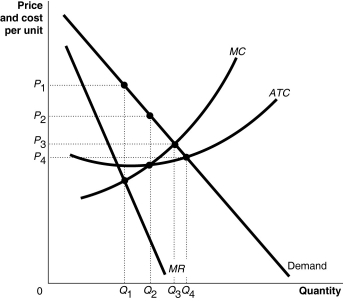 -Refer to Figure 16-1.With perfect price discrimination,the firm will produce and sell
 (Multiple Choice)
4.7/5 (86)
(86) A firm's efforts to increase profit by price discrimination can be undermined by
(Multiple Choice)
4.9/5 (72)
(72) Cost-plus pricing is a reasonable way to determine the optimal price when
(Multiple Choice)
4.9/5 (86)
(86) Which of the following statements is true about optimal two-part tariff and perfect price discrimination for a given demand curve?
(Multiple Choice)
4.9/5 (82)
(82) The law of one price states that identical products should sell for the same price everywhere as long as transactions costs are zero.
(True/False)
4.9/5 (92)
(92) One method of setting price using the cost-plus method is to add
(Multiple Choice)
4.8/5 (78)
(78) Figure 16-2 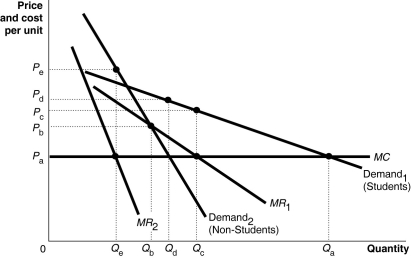 Plato Playhouse, a theatre company in the university town of Wegg, caters to two groups of customers: students and the non-student population. Figure 16-2 shows the demand curves for the two groups of customers.
-Refer to Figure 16-2.What is the price charged in the two markets?
Plato Playhouse, a theatre company in the university town of Wegg, caters to two groups of customers: students and the non-student population. Figure 16-2 shows the demand curves for the two groups of customers.
-Refer to Figure 16-2.What is the price charged in the two markets? (Multiple Choice)
4.9/5 (77)
(77) When you buy at a low price in one market then sell at a higher price in another market you are engaging in
(Multiple Choice)
4.8/5 (77)
(77) Which of the following firms is not able to practice price discrimination?
(Multiple Choice)
5.0/5 (86)
(86) The expenses you encounter when you buy in one market and sell in a distant market are known as
(Multiple Choice)
4.9/5 (70)
(70) A two-part tariff refers to a pricing schedule under which a buyer must pay a fixed fee for the right to purchase the product,in addition to a per-unit price.
(True/False)
4.7/5 (76)
(76) Figure 16-4  -Refer to Figure 16-4.Suppose the firm represented in the diagram decides to use a two-part pricing strategy such that it charges a fixed fee and a per-unit price equal to the monopoly price.What is the per-unit price?
 (Multiple Choice)
4.7/5 (70)
(70) If a firm charges different consumers different prices for the same product and the difference cannot be attributed to cost variations,then it is engaging in
(Multiple Choice)
4.9/5 (63)
(63) 
Filters
- Essay(0)
- Multiple Choice(0)
- Short Answer(0)
- True False(0)
- Matching(0)