



 Chat with AI
Exam 5: Externalities, environmental Policy, and Public Goods

Exam 1: Economics: Foundations and Models142 Questions
Exam 2: Trade-Offs, comparative Advantage, and the Market System152 Questions
Exam 3: Where Prices Come From: the Interaction of Demand and Supply149 Questions
Exam 4: Economic Efficiency, government Price Setting, and Taxes137 Questions
Exam 5: Externalities, environmental Policy, and Public Goods139 Questions
Exam 6: Elasticity: The Responsiveness of Demand and Supply149 Questions
Exam 7: The Economics of Health Care117 Questions
Exam 8: Firms, the Stock Market, and Corporate Governance140 Questions
Exam 9: Comparative Advantage and the Gains From International Trade124 Questions
Exam 10: Consumer Choice and Behavioral Economics154 Questions
Exam 11: Technology, production, and Costs174 Questions
Exam 12: Firms in Perfectly Competitive Markets153 Questions
Exam 13: Monopolistic Competition: The Competitive Model in a More Realistic Setting137 Questions
Exam 14: Oligopoly: Firms in Less Competitive Markets129 Questions
Exam 15: Monopoly and Antitrust Policy148 Questions
Exam 16: Pricing Strategy134 Questions
Exam 17: The Markets for Labor and Other Factors of Production149 Questions
Exam 18: Public Choice, taxes, and the Distribution of Income134 Questions
Exam 19: GDP: Measuring Total Production and Income135 Questions
Exam 20: Unemployment and Inflation148 Questions
Exam 21: Economic Growth, the Financial System, and Business Cycles130 Questions
Exam 22: Long-Run Economic Growth: Sources and Policies134 Questions
Exam 23: Aggregate Expenditure and Output in the Short Run157 Questions
Exam 24: Aggregate Demand and Aggregate Supply Analysis145 Questions
Exam 25: Money, banks, and the Federal Reserve System144 Questions
Exam 26: Monetary Policy145 Questions
Exam 27: Fiscal Policy155 Questions
Exam 28: Inflation, unemployment, and Federal Reserve Policy135 Questions
Exam 29: Macroeconomics in an Open Economy145 Questions
Exam 30: The International Financial System139 Questions
Select questions type


Figure 5-3 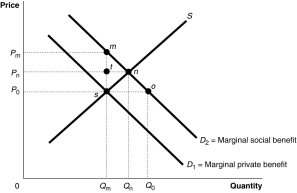 -Refer to Figure 5-3.The efficient output level is
Free
(Multiple Choice)
4.9/5  (68)
(68) Correct Answer: Verified
B
If the EPA does implement its plan to enact tougher limits on smog-forming ozone,________ would bear more of the external cost of pollution and the gap between the marginal private cost of pollution and the marginal social cost of pollution would ________.
Free
(Multiple Choice)
5.0/5 (86)
(86) Correct Answer:Verified
VerifiedC
What is an externality?
Free
(Essay)
5.0/5 (68)
(68) Correct Answer:Verified
VerifiedAn externality is a benefit or cost that affects someone who is not directly involved in the production or consumption of a good or service.
In 2011,the Environmental Protection Agency proposed a plan to enact tougher limits on smog-forming ozone.The goal of this program is to
(Multiple Choice)
5.0/5 (85)
(85) Figure 5-5 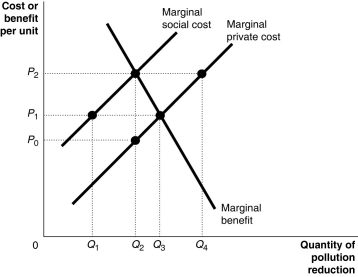 Companies producing toilet paper bleach the paper to make it white. The bleach is discharged into rivers and lakes and causes substantial environmental damage. Figure 5-5 illustrates the situation in the toilet paper market.
-Refer to Figure 5-5.Let's suppose the government imposes a tax of $50 per ton of toilet paper to bring about the efficient level of production.What happens to the market price of toilet paper?
Companies producing toilet paper bleach the paper to make it white. The bleach is discharged into rivers and lakes and causes substantial environmental damage. Figure 5-5 illustrates the situation in the toilet paper market.
-Refer to Figure 5-5.Let's suppose the government imposes a tax of $50 per ton of toilet paper to bring about the efficient level of production.What happens to the market price of toilet paper? (Multiple Choice)
4.7/5 (76)
(76) Which of the following is an example of a positive externality?
(Multiple Choice)
4.7/5 (89)
(89) Figure 5-3
-Refer to Figure 5-3.The size of marginal external benefits can be determined by
-Refer to Figure 5-3.The size of marginal external benefits can be determined by (Multiple Choice)
4.8/5 (87)
(87) Figure 5-4 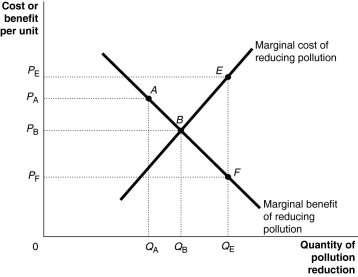 -Refer to Figure 5-4.The marginal benefit of reducing pollution curve is the same curve as
 (Multiple Choice)
4.8/5 (88)
(88) When there is a positive externality in a free market,too much of the good is produced and consumed.
(True/False)
4.7/5 (75)
(75) If you burn your trash in the back yard in spite of regulations against it,then you are
(Multiple Choice)
4.7/5 (85)
(85) How does the construction of a market demand curve for a private good differ from that for a public good?
(Multiple Choice)
4.8/5 (77)
(77) The "tragedy of the commons" refers to the phenomenon where
(Multiple Choice)
4.9/5 (96)
(96) Figure 5-2 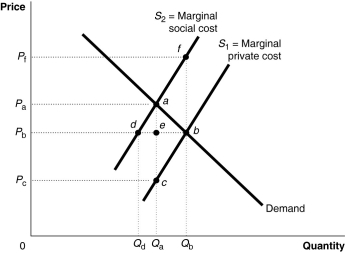 Figure 5-2 shows a market with a negative externality.
-Refer to Figure 5-2.The private profit maximizing quantity for the firm is
Figure 5-2 shows a market with a negative externality.
-Refer to Figure 5-2.The private profit maximizing quantity for the firm is (Multiple Choice)
4.9/5 (86)
(86) In 2011,New Jersey Governor Chris Christie announced that he would pull the state out of the Regional Greenhouse Gas Initiative (RGGI),which is a coalition of 10 states that agreed to reduce their emissions of carbon dioxide by 10 percent by 2018.RGGI is an example of
(Multiple Choice)
4.9/5 (73)
(73) Some policymakers have argue that products like cigarettes,alcohol,and sweetened soda generate negative externalities in consumption.All else equal,if the government decided to impose a tax on soda,the equilibrium quantity of soda would ________ and the equilibrium price of soda would ________.
(Multiple Choice)
4.7/5 (70)
(70) "When it comes to public goods,individuals do not reveal their true preferences because it is not in their self interest to do so." Evaluate this statement.
(Essay)
4.8/5 (73)
(73) 
Filters
- Essay(0)
- Multiple Choice(0)
- Short Answer(0)
- True False(0)
- Matching(0)