



 Chat with AI
Exam 5: Externalities, environmental Policy, and Public Goods

Exam 1: Economics: Foundations and Models142 Questions
Exam 2: Trade-Offs, comparative Advantage, and the Market System152 Questions
Exam 3: Where Prices Come From: the Interaction of Demand and Supply149 Questions
Exam 4: Economic Efficiency, government Price Setting, and Taxes137 Questions
Exam 5: Externalities, environmental Policy, and Public Goods139 Questions
Exam 6: Elasticity: The Responsiveness of Demand and Supply149 Questions
Exam 7: The Economics of Health Care117 Questions
Exam 8: Firms, the Stock Market, and Corporate Governance140 Questions
Exam 9: Comparative Advantage and the Gains From International Trade124 Questions
Exam 10: Consumer Choice and Behavioral Economics154 Questions
Exam 11: Technology, production, and Costs174 Questions
Exam 12: Firms in Perfectly Competitive Markets153 Questions
Exam 13: Monopolistic Competition: The Competitive Model in a More Realistic Setting137 Questions
Exam 14: Oligopoly: Firms in Less Competitive Markets129 Questions
Exam 15: Monopoly and Antitrust Policy148 Questions
Exam 16: Pricing Strategy134 Questions
Exam 17: The Markets for Labor and Other Factors of Production149 Questions
Exam 18: Public Choice, taxes, and the Distribution of Income134 Questions
Exam 19: GDP: Measuring Total Production and Income135 Questions
Exam 20: Unemployment and Inflation148 Questions
Exam 21: Economic Growth, the Financial System, and Business Cycles130 Questions
Exam 22: Long-Run Economic Growth: Sources and Policies134 Questions
Exam 23: Aggregate Expenditure and Output in the Short Run157 Questions
Exam 24: Aggregate Demand and Aggregate Supply Analysis145 Questions
Exam 25: Money, banks, and the Federal Reserve System144 Questions
Exam 26: Monetary Policy145 Questions
Exam 27: Fiscal Policy155 Questions
Exam 28: Inflation, unemployment, and Federal Reserve Policy135 Questions
Exam 29: Macroeconomics in an Open Economy145 Questions
Exam 30: The International Financial System139 Questions
Select questions type


Figure 5-5 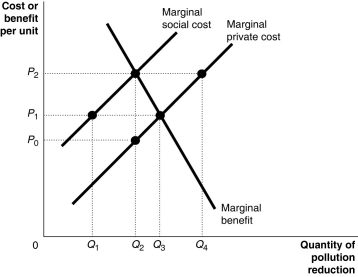 Companies producing toilet paper bleach the paper to make it white. The bleach is discharged into rivers and lakes and causes substantial environmental damage. Figure 5-5 illustrates the situation in the toilet paper market.
-Refer to Figure 5-5.An efficient way to get the firm to produce the socially optimal output level is
Companies producing toilet paper bleach the paper to make it white. The bleach is discharged into rivers and lakes and causes substantial environmental damage. Figure 5-5 illustrates the situation in the toilet paper market.
-Refer to Figure 5-5.An efficient way to get the firm to produce the socially optimal output level is (Multiple Choice)
4.8/5  (73)
(73) Figure 5-1 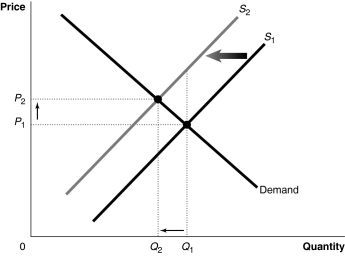 Figure 5-1 shows a market with an externality. The current market equilibrium output of Q1 is not the economically efficient output. The economically efficient output is Q2.
-Refer to Figure 5-1.If,because of an externality,the economically efficient output is Q2 and not the current equilibrium output of Q1,what does S2 represent?
Figure 5-1 shows a market with an externality. The current market equilibrium output of Q1 is not the economically efficient output. The economically efficient output is Q2.
-Refer to Figure 5-1.If,because of an externality,the economically efficient output is Q2 and not the current equilibrium output of Q1,what does S2 represent? (Multiple Choice)
5.0/5 (84)
(84) Economist A.C.Pigou argued that to deal with a negative externality in production,the government should impose a tax equal to the cost of the externality.What did Pigou believe should be done in the case of a positive externality in consumption? How would his recommendation impact the demand and market equilibrium for the product which is generating the positive externality?
(Essay)
4.8/5 (66)
(66) What is the rationale behind a marketable emission allowance scheme?
(Multiple Choice)
4.7/5 (82)
(82) Determine if each of the products below displays any of the following characteristics:
(i) rivalry
(ii)nonrivalry
(ii)excludability
(iv)nonexcludability.
a.a freeway during peak commute hours
b.an online college course
c.infectious disease prevention
d.open source software such as Linux
e.a movie showing at Century Theatres
(Essay)
4.8/5 (82)
(82) Explain how mandatory seat belt laws may reduce the negative externalities of risky behavior.
(Essay)
4.8/5 (90)
(90) Who was the economist who first proposed that governments use taxes and subsidies to correct for externalities?
(Multiple Choice)
4.8/5 (82)
(82) Which of the following criteria should be used to evaluate if government intervention in a market for the purpose of environmental protection is justified?
(Multiple Choice)
4.8/5 (74)
(74) Figure 5-5
Companies producing toilet paper bleach the paper to make it white. The bleach is discharged into rivers and lakes and causes substantial environmental damage. Figure 5-5 illustrates the situation in the toilet paper market.
-Refer to Figure 5-5.Suppose the government wants to use a Pigovian tax to bring about the efficient level of production.What should the value of the tax be?
Companies producing toilet paper bleach the paper to make it white. The bleach is discharged into rivers and lakes and causes substantial environmental damage. Figure 5-5 illustrates the situation in the toilet paper market.
-Refer to Figure 5-5.Suppose the government wants to use a Pigovian tax to bring about the efficient level of production.What should the value of the tax be? (Multiple Choice)
4.7/5 (79)
(79) A product is considered to be excludable if it is jointly owned by all members of a community.
(True/False)
4.9/5 (72)
(72) Which of the following represents the true economic cost of production when firms produce goods that cause negative externalities?
(Multiple Choice)
4.9/5 (75)
(75) Which of the following activities create a negative externality?
(Multiple Choice)
4.7/5 (82)
(82) Which of the following displays these two characteristics: rivalry and nonexcludability?
(Multiple Choice)
4.7/5 (82)
(82) James Meade,who won the Nobel Prize in Economics in 1977,argued that positive externalities resulted from
(Multiple Choice)
4.8/5 (80)
(80) Some policymakers have argue that products like cigarettes,alcohol,and sweetened soda generate negative externalities in consumption.If the government decided to impose a tax on soda,the government will cause
(Multiple Choice)
4.9/5 (87)
(87) If there is pollution in producing a product,then the market equilibrium price is too high and equilibrium quantity is too low.
(True/False)
4.9/5 (77)
(77) 
Filters
- Essay(0)
- Multiple Choice(0)
- Short Answer(0)
- True False(0)
- Matching(0)