



 Chat with AI
Exam 5: Externalities, environmental Policy, and Public Goods

Exam 1: Economics: Foundations and Models142 Questions
Exam 2: Trade-Offs, comparative Advantage, and the Market System152 Questions
Exam 3: Where Prices Come From: the Interaction of Demand and Supply149 Questions
Exam 4: Economic Efficiency, government Price Setting, and Taxes137 Questions
Exam 5: Externalities, environmental Policy, and Public Goods139 Questions
Exam 6: Elasticity: The Responsiveness of Demand and Supply149 Questions
Exam 7: The Economics of Health Care117 Questions
Exam 8: Firms, the Stock Market, and Corporate Governance140 Questions
Exam 9: Comparative Advantage and the Gains From International Trade124 Questions
Exam 10: Consumer Choice and Behavioral Economics154 Questions
Exam 11: Technology, production, and Costs174 Questions
Exam 12: Firms in Perfectly Competitive Markets153 Questions
Exam 13: Monopolistic Competition: The Competitive Model in a More Realistic Setting137 Questions
Exam 14: Oligopoly: Firms in Less Competitive Markets129 Questions
Exam 15: Monopoly and Antitrust Policy148 Questions
Exam 16: Pricing Strategy134 Questions
Exam 17: The Markets for Labor and Other Factors of Production149 Questions
Exam 18: Public Choice, taxes, and the Distribution of Income134 Questions
Exam 19: GDP: Measuring Total Production and Income135 Questions
Exam 20: Unemployment and Inflation148 Questions
Exam 21: Economic Growth, the Financial System, and Business Cycles130 Questions
Exam 22: Long-Run Economic Growth: Sources and Policies134 Questions
Exam 23: Aggregate Expenditure and Output in the Short Run157 Questions
Exam 24: Aggregate Demand and Aggregate Supply Analysis145 Questions
Exam 25: Money, banks, and the Federal Reserve System144 Questions
Exam 26: Monetary Policy145 Questions
Exam 27: Fiscal Policy155 Questions
Exam 28: Inflation, unemployment, and Federal Reserve Policy135 Questions
Exam 29: Macroeconomics in an Open Economy145 Questions
Exam 30: The International Financial System139 Questions
Select questions type


Figure 5-3  -Refer to Figure 5-3.The deadweight loss due to the externality is represented by the area
 (Multiple Choice)
4.8/5  (82)
(82) Figure 5-7  Figure 5-7 shows the market for Atlantic salmon, a common resource. The current market equilibrium output of Q1 is not the economically efficient output. The economically efficient output is Q2.
-Refer to Figure 5-7.Identify the area that shows the deadweight loss from overfishing.
Figure 5-7 shows the market for Atlantic salmon, a common resource. The current market equilibrium output of Q1 is not the economically efficient output. The economically efficient output is Q2.
-Refer to Figure 5-7.Identify the area that shows the deadweight loss from overfishing. (Multiple Choice)
4.9/5 (65)
(65) For-profit producers will produce only private goods because
(Multiple Choice)
4.8/5 (73)
(73) Which of the following is an example of a product that is nonexcludable and rivalrous?
(Multiple Choice)
4.7/5 (84)
(84) Which of the following must be present to reach a private solution to an externality problem?
(Multiple Choice)
4.9/5 (89)
(89) Figure 5-6 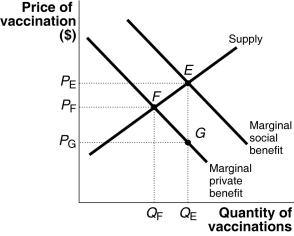 Chicken pox vaccinations for toddlers benefit society by protecting young children and by preventing an epidemic of the disease. Thus, the social benefits of chicken pox vaccinations exceed the private benefit for any quantity of vaccinations as illustrated in Figure 5-6.
-Refer to Figure 5-6.What is the value of the net gain to society as a result of subsidizing chicken pox vaccinations?
Chicken pox vaccinations for toddlers benefit society by protecting young children and by preventing an epidemic of the disease. Thus, the social benefits of chicken pox vaccinations exceed the private benefit for any quantity of vaccinations as illustrated in Figure 5-6.
-Refer to Figure 5-6.What is the value of the net gain to society as a result of subsidizing chicken pox vaccinations? (Multiple Choice)
4.8/5 (78)
(78) If the paint on your house was eaten away by the fumes from a factory nearby and you hired a lawyer to sue the polluting firm,your legal fees would be considered
(Multiple Choice)
4.9/5 (76)
(76) In the city of Alvarez,with the exception of guide dogs for blind people,all dogs are banned from its three public parks,regardless of whether the animals are leashed.Many residents are pushing for a change in policy.Canine lover Sara Northridge observed,"There are 800 or more homes here.There are three parks within 10 minutes,and almost everyone has a dog,but we can't take our dogs there." Others fear that allowing dogs would detract from their enjoyment of the parks.Tim Cortis retorted,"We're not preventing dog lovers from enjoying the park,just come without your dog." Which of the following is a way of dealing with the problem by assigning property rights to a particular group?
(Multiple Choice)
4.7/5 (80)
(80) Figure 5-3
-Refer to Figure 5-3.At the competitive market equilibrium,for the last unit produced,
-Refer to Figure 5-3.At the competitive market equilibrium,for the last unit produced, (Multiple Choice)
4.9/5 (76)
(76) A market failure arises when an entire sector of the economy (for example,the airline industry)collapses because of some unforeseen event.
(True/False)
4.8/5 (72)
(72) Figure 5-3
-Refer to Figure 5-3.In the absence of any government intervention,the private market
-Refer to Figure 5-3.In the absence of any government intervention,the private market (Multiple Choice)
4.8/5 (64)
(64) Which of the following conditions holds in an economically efficient competitive market equilibrium?
(Multiple Choice)
4.9/5 (77)
(77) What does the phrase "internalizing an external cost" mean?
(Multiple Choice)
4.8/5 (75)
(75) When a tax on output is imposed to internalize the external costs of pollution,the supply curve shifts down by the amount of the tax.
(True/False)
4.9/5 (74)
(74) Suppose a negative externality exists in a market.If transactions costs are low and parties are willing to bargain,then,according to the Coase theorem,
(Multiple Choice)
4.9/5 (64)
(64) Figure 5-6
Chicken pox vaccinations for toddlers benefit society by protecting young children and by preventing an epidemic of the disease. Thus, the social benefits of chicken pox vaccinations exceed the private benefit for any quantity of vaccinations as illustrated in Figure 5-6.
-Refer to Figure 5-6.One way to obtain the economically efficient amount of chicken pox vaccinations is for governments to subsidize these vaccinations.What is the size of the per-vaccination Pigovian subsidy that the government must provide to internalize the external benefits?
Chicken pox vaccinations for toddlers benefit society by protecting young children and by preventing an epidemic of the disease. Thus, the social benefits of chicken pox vaccinations exceed the private benefit for any quantity of vaccinations as illustrated in Figure 5-6.
-Refer to Figure 5-6.One way to obtain the economically efficient amount of chicken pox vaccinations is for governments to subsidize these vaccinations.What is the size of the per-vaccination Pigovian subsidy that the government must provide to internalize the external benefits? (Multiple Choice)
4.8/5 (82)
(82) 
Filters
- Essay(0)
- Multiple Choice(0)
- Short Answer(0)
- True False(0)
- Matching(0)