



 Chat with AI
Exam 5: Externalities, environmental Policy, and Public Goods

Exam 1: Economics: Foundations and Models142 Questions
Exam 2: Trade-Offs, comparative Advantage, and the Market System152 Questions
Exam 3: Where Prices Come From: the Interaction of Demand and Supply149 Questions
Exam 4: Economic Efficiency, government Price Setting, and Taxes137 Questions
Exam 5: Externalities, environmental Policy, and Public Goods139 Questions
Exam 6: Elasticity: The Responsiveness of Demand and Supply149 Questions
Exam 7: The Economics of Health Care117 Questions
Exam 8: Firms, the Stock Market, and Corporate Governance140 Questions
Exam 9: Comparative Advantage and the Gains From International Trade124 Questions
Exam 10: Consumer Choice and Behavioral Economics154 Questions
Exam 11: Technology, production, and Costs174 Questions
Exam 12: Firms in Perfectly Competitive Markets153 Questions
Exam 13: Monopolistic Competition: The Competitive Model in a More Realistic Setting137 Questions
Exam 14: Oligopoly: Firms in Less Competitive Markets129 Questions
Exam 15: Monopoly and Antitrust Policy148 Questions
Exam 16: Pricing Strategy134 Questions
Exam 17: The Markets for Labor and Other Factors of Production149 Questions
Exam 18: Public Choice, taxes, and the Distribution of Income134 Questions
Exam 19: GDP: Measuring Total Production and Income135 Questions
Exam 20: Unemployment and Inflation148 Questions
Exam 21: Economic Growth, the Financial System, and Business Cycles130 Questions
Exam 22: Long-Run Economic Growth: Sources and Policies134 Questions
Exam 23: Aggregate Expenditure and Output in the Short Run157 Questions
Exam 24: Aggregate Demand and Aggregate Supply Analysis145 Questions
Exam 25: Money, banks, and the Federal Reserve System144 Questions
Exam 26: Monetary Policy145 Questions
Exam 27: Fiscal Policy155 Questions
Exam 28: Inflation, unemployment, and Federal Reserve Policy135 Questions
Exam 29: Macroeconomics in an Open Economy145 Questions
Exam 30: The International Financial System139 Questions
Select questions type


If there is pollution in producing a product,then the market equilibrium price
(Multiple Choice)
4.8/5  (96)
(96) Which of the following is an example of a quasi-public good?
(Multiple Choice)
5.0/5 (71)
(71) Suppose a tax equal to the value of the marginal external cost at the optimal output is imposed on a pollution generating good.All of the following will result from the tax except
(Multiple Choice)
4.8/5 (70)
(70) In the United States,many beekeepers travel from state to state,renting out their bee colonies to farmers for pollination services.This is an example of
(Multiple Choice)
4.8/5 (79)
(79) What is a private cost of production? What is a social cost of production? When is the private cost of production equal to the social cost of production?
(Essay)
4.9/5 (76)
(76) Figure 5-5 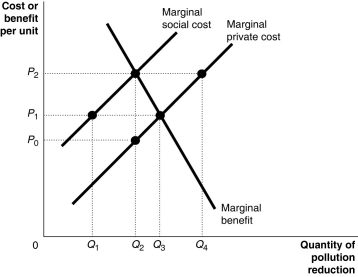 Companies producing toilet paper bleach the paper to make it white. The bleach is discharged into rivers and lakes and causes substantial environmental damage. Figure 5-5 illustrates the situation in the toilet paper market.
-Refer to Figure 5-5.The private profit-maximizing output level is
Companies producing toilet paper bleach the paper to make it white. The bleach is discharged into rivers and lakes and causes substantial environmental damage. Figure 5-5 illustrates the situation in the toilet paper market.
-Refer to Figure 5-5.The private profit-maximizing output level is (Multiple Choice)
4.9/5 (83)
(83) How does a negative externality in production reduce economic efficiency?
(Essay)
4.9/5 (85)
(85) Briefly explain the command-and-control approach in dealing with an externality such as pollution.Give an example of the U.S.government using the command-and-control approach to deal with the pollution problem.
(Essay)
4.9/5 (76)
(76) Consider the stock of ocean tuna which is massively overfished.It is rational for an individual to exploit the resource rather than to conserve the stock because
(Multiple Choice)
4.9/5 (75)
(75) According to ________,in a market with an externality,private parties would voluntarily negotiate an efficient outcome without government intervention.
(Multiple Choice)
4.9/5 (75)
(75) A major problem with using tradable emissions allowance system to control pollution is
(Multiple Choice)
4.8/5 (91)
(91) One difference between the demand for a private good and that for a public good is that
(Multiple Choice)
4.8/5 (82)
(82) In economics,the optimal level of pollution is the level for which the net benefit from reducing the pollution is the greatest.
(True/False)
4.7/5 (74)
(74) One problem with using a command and control approach to pollution reduction is that the monitoring costs may be too high.
(True/False)
4.9/5 (67)
(67) Figure 5-5
Companies producing toilet paper bleach the paper to make it white. The bleach is discharged into rivers and lakes and causes substantial environmental damage. Figure 5-5 illustrates the situation in the toilet paper market.
-Refer to Figure 5-5.The efficient output is
Companies producing toilet paper bleach the paper to make it white. The bleach is discharged into rivers and lakes and causes substantial environmental damage. Figure 5-5 illustrates the situation in the toilet paper market.
-Refer to Figure 5-5.The efficient output is (Multiple Choice)
4.8/5 (81)
(81) What is a Pigovian tax? What happens to deadweight loss when a Pigovian tax is implemented?
(Essay)
4.9/5 (86)
(86) 
Filters
- Essay(0)
- Multiple Choice(0)
- Short Answer(0)
- True False(0)
- Matching(0)