



 Chat with AI
Exam 20: Unemployment and Inflation

Exam 1: Economics: Foundations and Models142 Questions
Exam 2: Trade-Offs, comparative Advantage, and the Market System152 Questions
Exam 3: Where Prices Come From: the Interaction of Demand and Supply149 Questions
Exam 4: Economic Efficiency, government Price Setting, and Taxes137 Questions
Exam 5: Externalities, environmental Policy, and Public Goods139 Questions
Exam 6: Elasticity: The Responsiveness of Demand and Supply149 Questions
Exam 7: The Economics of Health Care117 Questions
Exam 8: Firms, the Stock Market, and Corporate Governance140 Questions
Exam 9: Comparative Advantage and the Gains From International Trade124 Questions
Exam 10: Consumer Choice and Behavioral Economics154 Questions
Exam 11: Technology, production, and Costs174 Questions
Exam 12: Firms in Perfectly Competitive Markets153 Questions
Exam 13: Monopolistic Competition: The Competitive Model in a More Realistic Setting137 Questions
Exam 14: Oligopoly: Firms in Less Competitive Markets129 Questions
Exam 15: Monopoly and Antitrust Policy148 Questions
Exam 16: Pricing Strategy134 Questions
Exam 17: The Markets for Labor and Other Factors of Production149 Questions
Exam 18: Public Choice, taxes, and the Distribution of Income134 Questions
Exam 19: GDP: Measuring Total Production and Income135 Questions
Exam 20: Unemployment and Inflation148 Questions
Exam 21: Economic Growth, the Financial System, and Business Cycles130 Questions
Exam 22: Long-Run Economic Growth: Sources and Policies134 Questions
Exam 23: Aggregate Expenditure and Output in the Short Run157 Questions
Exam 24: Aggregate Demand and Aggregate Supply Analysis145 Questions
Exam 25: Money, banks, and the Federal Reserve System144 Questions
Exam 26: Monetary Policy145 Questions
Exam 27: Fiscal Policy155 Questions
Exam 28: Inflation, unemployment, and Federal Reserve Policy135 Questions
Exam 29: Macroeconomics in an Open Economy145 Questions
Exam 30: The International Financial System139 Questions
Select questions type


Which of the following cause the unemployment rate as measured by the Bureau of Labor Statistics to overstate the true extent of joblessness?

Free
(Multiple Choice)
4.9/5  (75)
(75) Correct Answer: Verified
D
The natural rate of unemployment is the amount of unemployment
Free
(Multiple Choice)
4.9/5 (86)
(86) Correct Answer:Verified
VerifiedA
The inflation rate measures the average prices of goods and services in the economy.
Free
(True/False)
4.9/5 (80)
(80) Correct Answer:Verified
VerifiedFalse
The percent increase in the CPI from one year to the next is a measure of the
(Multiple Choice)
4.9/5 (74)
(74) Real interest rates at times have been negative.Why would anyone lending money agree to a negative real interest rate?
(Essay)
4.9/5 (60)
(60) If inflationary expectations are increasing,we would expect that the nominal interest rate would also be increasing,holding all else constant.
(True/False)
4.9/5 (72)
(72) Table 20-9
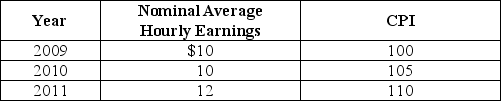 -Refer to Table 20-9.Looking at the table above,real average hourly earnings in 2009 were
 (Multiple Choice)
4.8/5 (74)
(74) Table 20-8
 The table above reports the nominal average hourly earnings in private industry and the consumer price index for 1965 and 2010.
-Refer to Table 20-8.The percentage change in real average earnings from 1965 to 2010 equals
The table above reports the nominal average hourly earnings in private industry and the consumer price index for 1965 and 2010.
-Refer to Table 20-8.The percentage change in real average earnings from 1965 to 2010 equals (Multiple Choice)
4.8/5 (100)
(100) Which of the following policies would reduce structural unemployment?
(Multiple Choice)
4.8/5 (77)
(77) Suppose the working-age population of a fictional economy falls into the following categories: 90 are retired or homemakers; 60 have full-time employment; 20 have part-time employment; 20 do not have employment,but are actively looking for employment; and 10 would like employment but do not have employment and are not actively looking for employment.The official unemployment rate as calculated by the U.S.Bureau of Labor would equal
(Multiple Choice)
4.8/5 (77)
(77) Most economists believe that the biases in the consumer price index cause the CPI to overstate the true inflation rate by about
(Multiple Choice)
5.0/5 (79)
(79) The substitution bias in the consumer price index refers to the idea that consumers ________ the quantity of products they buy in response to price,and the CPI does not reflect this and ________ the cost of the market basket.
(Multiple Choice)
4.8/5 (75)
(75) Which of the following would be a consequence of substitution bias in the CPI?
(Multiple Choice)
4.9/5 (82)
(82) Fill in the missing values in the table of data collected in the household survey for December,1996.The working-age population,employment,unemployment,and labor force are measured in thousands.Show your work.

(Essay)
4.9/5 (68)
(68) An unemployment insurance program has which of the following effects?
(Multiple Choice)
4.8/5 (85)
(85) If inflation is unanticipated,no redistribution of income can occur.
(True/False)
4.8/5 (83)
(83) Table 20-5
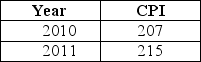 -Refer to Table 20-5.Consider the following values of the consumer price index for 2010 and 2011.The inflation rate for 2011 was equal to
 (Multiple Choice)
4.8/5 (88)
(88) Which of the following labor market statistics best indicates the amount of labor that is available to the economy from a given working-age population?
(Multiple Choice)
4.9/5 (71)
(71) The unemployment rate equals the number of unemployed divided by the ________,all times 100.
(Multiple Choice)
4.9/5 (70)
(70) 
Filters
- Essay(0)
- Multiple Choice(0)
- Short Answer(0)
- True False(0)
- Matching(0)