



 Chat with AI
Exam 20: Unemployment and Inflation

Exam 1: Economics: Foundations and Models142 Questions
Exam 2: Trade-Offs, comparative Advantage, and the Market System152 Questions
Exam 3: Where Prices Come From: the Interaction of Demand and Supply149 Questions
Exam 4: Economic Efficiency, government Price Setting, and Taxes137 Questions
Exam 5: Externalities, environmental Policy, and Public Goods139 Questions
Exam 6: Elasticity: The Responsiveness of Demand and Supply149 Questions
Exam 7: The Economics of Health Care117 Questions
Exam 8: Firms, the Stock Market, and Corporate Governance140 Questions
Exam 9: Comparative Advantage and the Gains From International Trade124 Questions
Exam 10: Consumer Choice and Behavioral Economics154 Questions
Exam 11: Technology, production, and Costs174 Questions
Exam 12: Firms in Perfectly Competitive Markets153 Questions
Exam 13: Monopolistic Competition: The Competitive Model in a More Realistic Setting137 Questions
Exam 14: Oligopoly: Firms in Less Competitive Markets129 Questions
Exam 15: Monopoly and Antitrust Policy148 Questions
Exam 16: Pricing Strategy134 Questions
Exam 17: The Markets for Labor and Other Factors of Production149 Questions
Exam 18: Public Choice, taxes, and the Distribution of Income134 Questions
Exam 19: GDP: Measuring Total Production and Income135 Questions
Exam 20: Unemployment and Inflation148 Questions
Exam 21: Economic Growth, the Financial System, and Business Cycles130 Questions
Exam 22: Long-Run Economic Growth: Sources and Policies134 Questions
Exam 23: Aggregate Expenditure and Output in the Short Run157 Questions
Exam 24: Aggregate Demand and Aggregate Supply Analysis145 Questions
Exam 25: Money, banks, and the Federal Reserve System144 Questions
Exam 26: Monetary Policy145 Questions
Exam 27: Fiscal Policy155 Questions
Exam 28: Inflation, unemployment, and Federal Reserve Policy135 Questions
Exam 29: Macroeconomics in an Open Economy145 Questions
Exam 30: The International Financial System139 Questions
Select questions type


Using a broader measure of the unemployment rate where discouraged workers and part-time workers who wished to work full time were counted as unemployed,the BLS estimates the unemployment rate in September 2011 would have ________ compared to the measured unemployment rate.
(Multiple Choice)
4.8/5  (90)
(90) In the United States,the typical person who has lost his or her job finds another one in a few months except during severe recessions.
(True/False)
4.9/5 (85)
(85) The nominal interest rate plus the inflation rate equals the real interest rate.
(True/False)
4.7/5 (73)
(73) Full employment is not considered to be zero unemployment,because
(Multiple Choice)
4.8/5 (102)
(102) The recession of 2007-2009 and its aftermath had different effects on various sectors of the economy.Which of the following sectors of the U.S.economy had the highest unemployment rate in August 2011,topping 12 percent?
(Multiple Choice)
4.7/5 (78)
(78) A consumer price index of 160 in 1996 with a base year of 1982-1984 would mean that the cost of the market basket
(Multiple Choice)
4.8/5 (97)
(97) If your nominal wage rises faster than the price level,we can say your real wage has ________ and the purchasing power of your income has ________.
(Multiple Choice)
4.9/5 (81)
(81) Eliminating frictional unemployment would be good for the economy.
(True/False)
4.8/5 (74)
(74) Discuss the likely impact of each of the following on the unemployment rate:
a.The length of time workers are eligible to receive unemployment insurance payments is cut in half.
b.The government passes a law making labor unions illegal.
c.The minimum wage is raised by 50 percent.
d.The government funds an Internet site where companies can post job openings at no charge.
(Essay)
4.9/5 (78)
(78) Suppose the labor force stays constant,and the working-age population stays constant,but a greater number of persons who were unemployed become employed.The labor force participation rate will
(Multiple Choice)
4.9/5 (91)
(91) The Bureau of Labor Statistics does not count discouraged workers as unemployed.Suppose discouraged workers were counted as unemployed.Explain how the unemployment rate and the labor force participation rate would change.
(Essay)
4.8/5 (90)
(90) Unemployment caused by a business cycle recession is called cyclical unemployment.
(True/False)
4.8/5 (82)
(82) During the 1990s,Japan experienced periods of deflation and very low nominal interest rates,approaching zero percent.Why would lenders of money agree to a nominal interest rate of almost zero?
(Essay)
4.9/5 (78)
(78) If cyclical unemployment is eliminated in the economy,then
(Multiple Choice)
4.7/5 (74)
(74) If the federal government implements programs so that the unemployed are more quickly matched with jobs,then
(Multiple Choice)
4.8/5 (82)
(82) Table 20-7
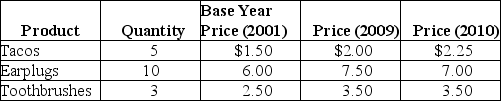 -Refer to Table 20-7.Consider a simple economy that produces only three products: tacos,earplugs,and toothbrushes.Use the information in the table to calculate the inflation rate for 2010,as measured by the consumer price index.
 (Essay)
4.9/5 (85)
(85) 
Filters
- Essay(0)
- Multiple Choice(0)
- Short Answer(0)
- True False(0)
- Matching(0)