



 Chat with AI
Exam 5: Externalities, environmental Policy, and Public Goods

Exam 1: Economics: Foundations and Models142 Questions
Exam 2: Trade-Offs, comparative Advantage, and the Market System152 Questions
Exam 3: Where Prices Come From: the Interaction of Demand and Supply149 Questions
Exam 4: Economic Efficiency, government Price Setting, and Taxes137 Questions
Exam 5: Externalities, environmental Policy, and Public Goods139 Questions
Exam 6: Elasticity: The Responsiveness of Demand and Supply149 Questions
Exam 7: The Economics of Health Care117 Questions
Exam 8: Firms, the Stock Market, and Corporate Governance140 Questions
Exam 9: Comparative Advantage and the Gains From International Trade124 Questions
Exam 10: Consumer Choice and Behavioral Economics154 Questions
Exam 11: Technology, production, and Costs174 Questions
Exam 12: Firms in Perfectly Competitive Markets153 Questions
Exam 13: Monopolistic Competition: The Competitive Model in a More Realistic Setting137 Questions
Exam 14: Oligopoly: Firms in Less Competitive Markets129 Questions
Exam 15: Monopoly and Antitrust Policy148 Questions
Exam 16: Pricing Strategy134 Questions
Exam 17: The Markets for Labor and Other Factors of Production149 Questions
Exam 18: Public Choice, taxes, and the Distribution of Income134 Questions
Exam 19: GDP: Measuring Total Production and Income135 Questions
Exam 20: Unemployment and Inflation148 Questions
Exam 21: Economic Growth, the Financial System, and Business Cycles130 Questions
Exam 22: Long-Run Economic Growth: Sources and Policies134 Questions
Exam 23: Aggregate Expenditure and Output in the Short Run157 Questions
Exam 24: Aggregate Demand and Aggregate Supply Analysis145 Questions
Exam 25: Money, banks, and the Federal Reserve System144 Questions
Exam 26: Monetary Policy145 Questions
Exam 27: Fiscal Policy155 Questions
Exam 28: Inflation, unemployment, and Federal Reserve Policy135 Questions
Exam 29: Macroeconomics in an Open Economy145 Questions
Exam 30: The International Financial System139 Questions
Select questions type


Economists Kenneth Chay and Michael Greenstone find that in the two years following the passage of the Clean Air Act of 1970,the sharp reduction in air pollution also led to a decline in infant deaths.Although this and other studies provide compelling evidence of the link between pollution and infant health,it is not clear that reductions from the much lower levels of ambient pollution today would have the same effect.Which of the following reasons could explain this?
(Multiple Choice)
4.8/5  (82)
(82) Consider a situation in which a utility company emits high levels of sulfur dioxide and the company is not liable for the damages its pollution causes.According to the Coase theorem,government action is ________ to achieve an ________ amount of pollution.
(Multiple Choice)
4.8/5 (79)
(79) Sefronia and Bella share an apartment and they are deciding whether or not to purchase a weekly housecleaning service.The value of the service to each of them is $50 and it costs $80 to hire a housecleaner.Suppose Bella is lazy and a spendthrift and Sefronia suspects that Bella will be willing to pay $80.What is Sefronia likely to do,given that she is as rational as any other person?
(Multiple Choice)
4.7/5 (75)
(75) Overuse of a common resource may be avoided by all of the following methods except
(Multiple Choice)
4.9/5 (83)
(83) For certain public projects such as building a dam on a river or a bridge to an island,what procedure is a government is likely to use to determine what quantity of a public good should be supplied?
(Multiple Choice)
4.9/5 (73)
(73) Global warming refers to the effect of global pollutants such as carbon dioxide on climates on the earth.Climate-induced changes in temperatures affect,among other things,agriculture.Which of the following is a reason why policymakers are still debating if this problem should be addressed and how it should be addressed?
(Multiple Choice)
4.8/5 (83)
(83) Private producers have no incentive to provide public goods because
(Multiple Choice)
4.9/5 (70)
(70) An advantage of imposing a tax on the producer that generates pollution is that
(Multiple Choice)
4.7/5 (75)
(75) Government imposed quantitative limits on the amount of pollution firms are allowed to produce is an example of
(Multiple Choice)
4.8/5 (91)
(91) The Wilfer Resort Hotel has a spectacular view of a pine forest along a river bank.Suppose a commercial logger has purchased the pine forest and is planning to clear-cut the forest in a way that has a negative impact on the resort.Can the two parties arrive at a Coasian solution and if so what is it?
(Essay)
4.9/5 (82)
(82) The 2005 European Union Emission Trading Scheme is an example of a
(Multiple Choice)
4.8/5 (82)
(82) The basic cause of deadweight losses from the existence of common resources and externalities is
(Multiple Choice)
4.9/5 (94)
(94) Figure 5-2 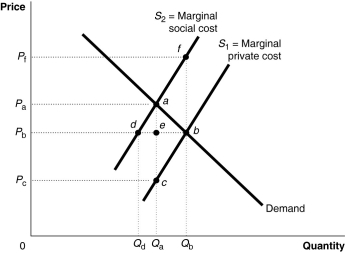 Figure 5-2 shows a market with a negative externality.
-Refer to Figure 5-2.The marginal benefit of the last unit produced is represented by the price
Figure 5-2 shows a market with a negative externality.
-Refer to Figure 5-2.The marginal benefit of the last unit produced is represented by the price (Multiple Choice)
4.7/5 (81)
(81) Figure 5-7  Figure 5-7 shows the market for Atlantic salmon, a common resource. The current market equilibrium output of Q1 is not the economically efficient output. The economically efficient output is Q2.
-Refer to Figure 5-7.The current market equilibrium output is partly the result of overfishing.In that case,what does S2 represent?
Figure 5-7 shows the market for Atlantic salmon, a common resource. The current market equilibrium output of Q1 is not the economically efficient output. The economically efficient output is Q2.
-Refer to Figure 5-7.The current market equilibrium output is partly the result of overfishing.In that case,what does S2 represent? (Multiple Choice)
4.8/5 (75)
(75) Mandatory motorcycle helmet laws are designed to reduce the severity of injuries resulting from motorcycle involvement in traffic accidents.In this sense,these mandatory helmet laws are reducing ________ of risky behavior.
(Multiple Choice)
4.9/5 (87)
(87) 
Filters
- Essay(0)
- Multiple Choice(0)
- Short Answer(0)
- True False(0)
- Matching(0)