



 Chat with AI
Exam 21: Economic Growth, the Financial System, and Business Cycles

Exam 1: Economics: Foundations and Models142 Questions
Exam 2: Trade-Offs, comparative Advantage, and the Market System152 Questions
Exam 3: Where Prices Come From: the Interaction of Demand and Supply149 Questions
Exam 4: Economic Efficiency, government Price Setting, and Taxes137 Questions
Exam 5: Externalities, environmental Policy, and Public Goods139 Questions
Exam 6: Elasticity: The Responsiveness of Demand and Supply149 Questions
Exam 7: The Economics of Health Care117 Questions
Exam 8: Firms, the Stock Market, and Corporate Governance140 Questions
Exam 9: Comparative Advantage and the Gains From International Trade124 Questions
Exam 10: Consumer Choice and Behavioral Economics154 Questions
Exam 11: Technology, production, and Costs174 Questions
Exam 12: Firms in Perfectly Competitive Markets153 Questions
Exam 13: Monopolistic Competition: The Competitive Model in a More Realistic Setting137 Questions
Exam 14: Oligopoly: Firms in Less Competitive Markets129 Questions
Exam 15: Monopoly and Antitrust Policy148 Questions
Exam 16: Pricing Strategy134 Questions
Exam 17: The Markets for Labor and Other Factors of Production149 Questions
Exam 18: Public Choice, taxes, and the Distribution of Income134 Questions
Exam 19: GDP: Measuring Total Production and Income135 Questions
Exam 20: Unemployment and Inflation148 Questions
Exam 21: Economic Growth, the Financial System, and Business Cycles130 Questions
Exam 22: Long-Run Economic Growth: Sources and Policies134 Questions
Exam 23: Aggregate Expenditure and Output in the Short Run157 Questions
Exam 24: Aggregate Demand and Aggregate Supply Analysis145 Questions
Exam 25: Money, banks, and the Federal Reserve System144 Questions
Exam 26: Monetary Policy145 Questions
Exam 27: Fiscal Policy155 Questions
Exam 28: Inflation, unemployment, and Federal Reserve Policy135 Questions
Exam 29: Macroeconomics in an Open Economy145 Questions
Exam 30: The International Financial System139 Questions
Select questions type


Since 1950,the average length of a recession in the United States has been
(Multiple Choice)
4.8/5  (76)
(76) If there is public dissaving,investment spending in the economy will decline,holding everything else constant.
(True/False)
4.9/5 (92)
(92) Figure 21-4 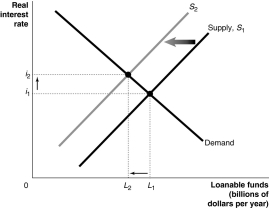 -Refer to Figure 21-4.Which of the following is consistent with the graph depicted?
 (Multiple Choice)
4.9/5 (75)
(75) In a closed economy public saving plus private saving is equal to
(Multiple Choice)
4.8/5 (86)
(86) At the end of an expansion,wages of workers are usually rising faster than prices.
(True/False)
4.8/5 (84)
(84) According to the "Rule of 70",how many years will it take for real GDP per capita to double when the growth rate of real GDP per capita is 5%?
(Multiple Choice)
4.9/5 (73)
(73) The NBER's Business Cycle Dating Committee defines a recession as at least two consecutive quarters of falling real GDP.
(True/False)
4.8/5 (84)
(84) Under which of the following circumstances would the government be running a deficit?
(Multiple Choice)
4.9/5 (98)
(98) According to the National Bureau of Economic Research,the United States experienced ________ recessions since 1950.
(Multiple Choice)
4.9/5 (77)
(77) If Ebenezer Scrooge spends rather than saves his vast wealth he will
(Multiple Choice)
4.9/5 (71)
(71) When the economy enters a recessionary phase of the business cycle,unemployment tends to
(Multiple Choice)
4.8/5 (68)
(68) Which of the following explains the cause of the change in the unemployment rate at the end of a recession?
(Multiple Choice)
4.9/5 (73)
(73) The period of expansion ends with a ________ and the period of recession ends with a ________.
(Multiple Choice)
5.0/5 (77)
(77) If real GDP grows by 3% in 2009,3.2% in 2010,and 2.5% in 2011,what is the average annual growth rate of real GDP?
(Multiple Choice)
4.9/5 (70)
(70) How has economist Robert Fogel explained that economic growth is connected to life expectancy? Based on this connection,in what country would you expect to have a longer life expectancy,the United States or India? Explain.
(Essay)
5.0/5 (87)
(87) 
Filters
- Essay(0)
- Multiple Choice(0)
- Short Answer(0)
- True False(0)
- Matching(0)