



 Chat with AI
Exam 2: Trade-Offs, comparative Advantage, and the Market System

Exam 1: Economics: Foundations and Models142 Questions
Exam 2: Trade-Offs, comparative Advantage, and the Market System152 Questions
Exam 3: Where Prices Come From: the Interaction of Demand and Supply149 Questions
Exam 4: Economic Efficiency, government Price Setting, and Taxes137 Questions
Exam 5: Externalities, environmental Policy, and Public Goods139 Questions
Exam 6: Elasticity: The Responsiveness of Demand and Supply149 Questions
Exam 7: The Economics of Health Care117 Questions
Exam 8: Firms, the Stock Market, and Corporate Governance140 Questions
Exam 9: Comparative Advantage and the Gains From International Trade124 Questions
Exam 10: Consumer Choice and Behavioral Economics154 Questions
Exam 11: Technology, production, and Costs174 Questions
Exam 12: Firms in Perfectly Competitive Markets153 Questions
Exam 13: Monopolistic Competition: The Competitive Model in a More Realistic Setting137 Questions
Exam 14: Oligopoly: Firms in Less Competitive Markets129 Questions
Exam 15: Monopoly and Antitrust Policy148 Questions
Exam 16: Pricing Strategy134 Questions
Exam 17: The Markets for Labor and Other Factors of Production149 Questions
Exam 18: Public Choice, taxes, and the Distribution of Income134 Questions
Exam 19: GDP: Measuring Total Production and Income135 Questions
Exam 20: Unemployment and Inflation148 Questions
Exam 21: Economic Growth, the Financial System, and Business Cycles130 Questions
Exam 22: Long-Run Economic Growth: Sources and Policies134 Questions
Exam 23: Aggregate Expenditure and Output in the Short Run157 Questions
Exam 24: Aggregate Demand and Aggregate Supply Analysis145 Questions
Exam 25: Money, banks, and the Federal Reserve System144 Questions
Exam 26: Monetary Policy145 Questions
Exam 27: Fiscal Policy155 Questions
Exam 28: Inflation, unemployment, and Federal Reserve Policy135 Questions
Exam 29: Macroeconomics in an Open Economy145 Questions
Exam 30: The International Financial System139 Questions
Select questions type


Figure 2-8 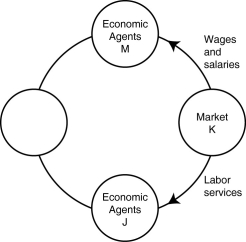 -Refer to Figure 2-8.One segment of the circular flow diagram in the figure shows the flow of labor services from market K to economic agents J.What is market K and who are economic agents J?
 (Multiple Choice)
4.8/5  (77)
(77) Figure 2-11  -Refer to Figure 2-11.Which two arrows in the diagram depict the following transaction: LaDonna sells 20 pairs of sunglasses at the Oakley store.
 (Multiple Choice)
4.8/5 (69)
(69)  -Refer to Figure 2-1.Point C is
Figure 2-10 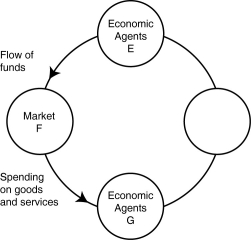 -Refer to Figure 2-10.One segment of the circular flow diagram in the figure shows the flow of funds from economic agents E to market F.Who are economic agents E and what is market F?
 (Multiple Choice)
4.9/5 (95)
(95) Table 2-3
 Table 2-3 shows the output per week of two jewelers, Serena and Haley. They can either devote their time to making bracelets or making necklaces.
-Refer to Table 2-3.What is Serena's opportunity cost of making a necklace?
Table 2-3 shows the output per week of two jewelers, Serena and Haley. They can either devote their time to making bracelets or making necklaces.
-Refer to Table 2-3.What is Serena's opportunity cost of making a necklace? (Multiple Choice)
5.0/5 (76)
(76) Table 2-4
 Table 2-4 shows the number of labor hours required to produce a digital camera and a pound of wheat in China and South Korea.
-Refer to Table 2-4.South Korea has a comparative advantage in the production of
Table 2-4 shows the number of labor hours required to produce a digital camera and a pound of wheat in China and South Korea.
-Refer to Table 2-4.South Korea has a comparative advantage in the production of (Multiple Choice)
4.9/5 (74)
(74) According to the production possibility model,if more resources are allocated to the production of physical and human capital,then which of the following is likely to happen?
(Multiple Choice)
4.8/5 (78)
(78) Table 2-4
Table 2-4 shows the number of labor hours required to produce a digital camera and a pound of wheat in China and South Korea.
-Refer to Table 2-4.What is China's opportunity cost of producing one pound of wheat?
Table 2-4 shows the number of labor hours required to produce a digital camera and a pound of wheat in China and South Korea.
-Refer to Table 2-4.What is China's opportunity cost of producing one pound of wheat? (Multiple Choice)
4.9/5 (80)
(80) The U.S.government provides health care to about 30 percent of the population through programs such as Medicare and Medicaid.The Congressional Budget Office estimates that as the U.S.population ages and medical costs continue to rise,federal government spending on Medicare will
(Multiple Choice)
4.9/5 (70)
(70) In 18th century Europe,governments gave guilds legal authority to limit production of goods.Did this authority obstruct or improve the market mechanism and how?
(Multiple Choice)
4.7/5 (81)
(81) To increase gas mileage,automobile manufacturers make cars small and light.Large cars absorb more of the impact of an accident than small cars but yield lower gas mileage.These facts suggest that a negative relationship exists between safety and gas mileage.
(True/False)
4.9/5 (79)
(79) Bella can produce either a combination of 60 silk roses and 80 silk leaves or a combination of 70 silk roses and 55 silk leaves.If she now produces 60 silk roses and 80 silk leaves,what is the opportunity cost of producing an additional 10 silk roses?
(Multiple Choice)
4.8/5 (78)
(78) The attainable production points on a production possibility curve are
(Multiple Choice)
4.8/5 (64)
(64) Table 2-4
Table 2-4 shows the number of labor hours required to produce a digital camera and a pound of wheat in China and South Korea.
-Refer to Table 2-4.What is China's opportunity cost of producing one digital camera?
Table 2-4 shows the number of labor hours required to produce a digital camera and a pound of wheat in China and South Korea.
-Refer to Table 2-4.What is China's opportunity cost of producing one digital camera? (Multiple Choice)
4.8/5 (97)
(97) Stricter laws and regulations to protect intellectual property rights
(Multiple Choice)
4.9/5 (76)
(76) Figure 2-4  Figure 2-4 shows various points on three different production possibilities frontiers for a nation.
-Refer to Figure 2-4.Consider the following movements:
a.from point V to point W
b.from point W to point Y
c.from point Y to point Z
Which of the movements listed above represents economic growth?
Figure 2-4 shows various points on three different production possibilities frontiers for a nation.
-Refer to Figure 2-4.Consider the following movements:
a.from point V to point W
b.from point W to point Y
c.from point Y to point Z
Which of the movements listed above represents economic growth? (Multiple Choice)
4.8/5 (86)
(86) Figure 2-11
-Refer to Figure 2-11.Which two arrows in the diagram depict the following transaction: Barney earns $250 for selling scissors and razors to Floyd's Barber Shop.
-Refer to Figure 2-11.Which two arrows in the diagram depict the following transaction: Barney earns $250 for selling scissors and razors to Floyd's Barber Shop. (Multiple Choice)
4.9/5 (78)
(78) Table 2-2
 -Refer to Table 2-2.The Fruit Farm produces only apples and pears.The table above shows the maximum possible output combinations of the two fruits using all resources and currently available technology.
a.Graph The Fruit Farm's production possibilities frontier.Put apples on the horizontal axis and pears on the vertical axis.Be sure to identify the output combination points on your diagram.
b.Suppose The Fruit Farm is currently producing at point D.What is the opportunity cost of producing an additional 8,000 pounds of pears?
c.Suppose The Fruit Farm is currently producing at point D.What happens to the opportunity cost of producing more and more pears? Does it increase,decrease or remain constant? Explain your answer.
d.Suppose The Fruit Farm is currently producing at point G.What happens to the opportunity cost of producing more and more apples? Does it increase,decrease or remain constant? Explain your answer.
e.Suppose The Fruit Farm is plagued by the apple maggot infestation which destroys apple trees but not pears.Show in a graph what happens to its PPF.
-Refer to Table 2-2.The Fruit Farm produces only apples and pears.The table above shows the maximum possible output combinations of the two fruits using all resources and currently available technology.
a.Graph The Fruit Farm's production possibilities frontier.Put apples on the horizontal axis and pears on the vertical axis.Be sure to identify the output combination points on your diagram.
b.Suppose The Fruit Farm is currently producing at point D.What is the opportunity cost of producing an additional 8,000 pounds of pears?
c.Suppose The Fruit Farm is currently producing at point D.What happens to the opportunity cost of producing more and more pears? Does it increase,decrease or remain constant? Explain your answer.
d.Suppose The Fruit Farm is currently producing at point G.What happens to the opportunity cost of producing more and more apples? Does it increase,decrease or remain constant? Explain your answer.
e.Suppose The Fruit Farm is plagued by the apple maggot infestation which destroys apple trees but not pears.Show in a graph what happens to its PPF. (Essay)
4.8/5 (77)
(77) It is possible to have a comparative advantage in producing a good or service without having an absolute advantage.
(True/False)
4.9/5 (81)
(81) 
Filters
- Essay(0)
- Multiple Choice(0)
- Short Answer(0)
- True False(0)
- Matching(0)