



 Chat with AI
Exam 2: Trade-Offs, comparative Advantage, and the Market System

Exam 1: Economics: Foundations and Models142 Questions
Exam 2: Trade-Offs, comparative Advantage, and the Market System152 Questions
Exam 3: Where Prices Come From: the Interaction of Demand and Supply149 Questions
Exam 4: Economic Efficiency, government Price Setting, and Taxes137 Questions
Exam 5: Externalities, environmental Policy, and Public Goods139 Questions
Exam 6: Elasticity: The Responsiveness of Demand and Supply149 Questions
Exam 7: The Economics of Health Care117 Questions
Exam 8: Firms, the Stock Market, and Corporate Governance140 Questions
Exam 9: Comparative Advantage and the Gains From International Trade124 Questions
Exam 10: Consumer Choice and Behavioral Economics154 Questions
Exam 11: Technology, production, and Costs174 Questions
Exam 12: Firms in Perfectly Competitive Markets153 Questions
Exam 13: Monopolistic Competition: The Competitive Model in a More Realistic Setting137 Questions
Exam 14: Oligopoly: Firms in Less Competitive Markets129 Questions
Exam 15: Monopoly and Antitrust Policy148 Questions
Exam 16: Pricing Strategy134 Questions
Exam 17: The Markets for Labor and Other Factors of Production149 Questions
Exam 18: Public Choice, taxes, and the Distribution of Income134 Questions
Exam 19: GDP: Measuring Total Production and Income135 Questions
Exam 20: Unemployment and Inflation148 Questions
Exam 21: Economic Growth, the Financial System, and Business Cycles130 Questions
Exam 22: Long-Run Economic Growth: Sources and Policies134 Questions
Exam 23: Aggregate Expenditure and Output in the Short Run157 Questions
Exam 24: Aggregate Demand and Aggregate Supply Analysis145 Questions
Exam 25: Money, banks, and the Federal Reserve System144 Questions
Exam 26: Monetary Policy145 Questions
Exam 27: Fiscal Policy155 Questions
Exam 28: Inflation, unemployment, and Federal Reserve Policy135 Questions
Exam 29: Macroeconomics in an Open Economy145 Questions
Exam 30: The International Financial System139 Questions
Select questions type


Figure 2-5  -Refer to Figure 2-5.If the economy is currently producing at point Y,what is the opportunity cost of moving to point W?
 (Multiple Choice)
4.9/5  (65)
(65) All of the following countries come close to the free market benchmark except
(Multiple Choice)
4.9/5 (79)
(79) Figure 2-11  -Refer to Figure 2-11.Which two arrows in the diagram depict the following transaction: Dorian Gray hires "Wild Oscar",a professional portrait artist,to paint his picture.
 (Multiple Choice)
4.8/5 (92)
(92) Table 2-4
 Table 2-4 shows the number of labor hours required to produce a digital camera and a pound of wheat in China and South Korea.
-Refer to Table 2-4.Does either China or South Korea have an absolute advantage and if so,in what product?
Table 2-4 shows the number of labor hours required to produce a digital camera and a pound of wheat in China and South Korea.
-Refer to Table 2-4.Does either China or South Korea have an absolute advantage and if so,in what product? (Multiple Choice)
5.0/5 (71)
(71) If a commercial dairy farm wants to raise funds to purchase feeding troughs,it does so in the
(Multiple Choice)
4.8/5 (92)
(92) Households ________ final goods and services in the ________ market.
(Multiple Choice)
4.7/5 (83)
(83) The production possibilities frontier shows the ________ combinations of two products that may be produced in a particular time period with available resources.
(Multiple Choice)
4.8/5 (93)
(93) Table 2-3
 Table 2-3 shows the output per week of two jewelers, Serena and Haley. They can either devote their time to making bracelets or making necklaces.
-Refer to Table 2-3.What is Haley's opportunity cost of making a bracelet?
Table 2-3 shows the output per week of two jewelers, Serena and Haley. They can either devote their time to making bracelets or making necklaces.
-Refer to Table 2-3.What is Haley's opportunity cost of making a bracelet? (Multiple Choice)
4.8/5 (80)
(80) The production possibilities frontier model assumes which of the following?
(Multiple Choice)
4.8/5 (74)
(74) For a person to have a comparative advantage in producing a product,she must be able to produce that product at a lower opportunity cost than her competitors.
(True/False)
4.9/5 (75)
(75) Table 2-3
Table 2-3 shows the output per week of two jewelers, Serena and Haley. They can either devote their time to making bracelets or making necklaces.
-Refer to Table 2-3.What is Haley's opportunity cost of making a necklace?
Table 2-3 shows the output per week of two jewelers, Serena and Haley. They can either devote their time to making bracelets or making necklaces.
-Refer to Table 2-3.What is Haley's opportunity cost of making a necklace? (Multiple Choice)
4.7/5 (92)
(92) Figure 2-8 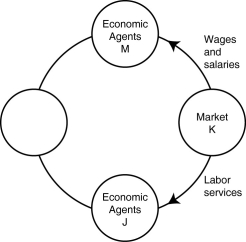 -Refer to Figure 2-8.One segment of the circular flow diagram in the figure shows the flow of wages and salaries from market K to economic agents M.What is market K and who are economic agents M?
 (Multiple Choice)
4.8/5 (71)
(71) Figure 2-7  Figure 2-7 shows the production possibilities frontiers for Pakistan and Indonesia. Each country produces two goods, cotton and cashews.
-Refer to Figure 2-7.What is the opportunity cost of producing 1 bolt of cotton in Indonesia?
Figure 2-7 shows the production possibilities frontiers for Pakistan and Indonesia. Each country produces two goods, cotton and cashews.
-Refer to Figure 2-7.What is the opportunity cost of producing 1 bolt of cotton in Indonesia? (Multiple Choice)
4.9/5 (97)
(97) Table 2-5
 -Refer to Table 2-5.This table shows the number of labor hours required to produce a digital cameras and a bushel of wheat in China and South Korea.
a.Which country has an absolute advantage in the production of digital cameras?
b.Which country has an absolute advantage in the production of wheat?
c.What is China's opportunity cost of producing one digital camera?
d.What is South Korea's opportunity cost of producing one digital camera?
e.What is China's opportunity cost of producing one pound of wheat?
f.What is South Korea's opportunity cost of producing one pound of what?
g.If each country specializes in the production of the product in which it has a comparative advantage,who should produce digital cameras?
h.If each country specializes in the production of the product in which it has a comparative advantage,who should produce wheat?
-Refer to Table 2-5.This table shows the number of labor hours required to produce a digital cameras and a bushel of wheat in China and South Korea.
a.Which country has an absolute advantage in the production of digital cameras?
b.Which country has an absolute advantage in the production of wheat?
c.What is China's opportunity cost of producing one digital camera?
d.What is South Korea's opportunity cost of producing one digital camera?
e.What is China's opportunity cost of producing one pound of wheat?
f.What is South Korea's opportunity cost of producing one pound of what?
g.If each country specializes in the production of the product in which it has a comparative advantage,who should produce digital cameras?
h.If each country specializes in the production of the product in which it has a comparative advantage,who should produce wheat? (Essay)
4.9/5 (87)
(87) If opportunity costs are constant,the production possibilities frontier would be graphed as
(Multiple Choice)
5.0/5 (73)
(73) If a country is producing efficiently and is on the production possibilities frontier,the only way to produce more of one good is to produce less of the other.
(True/False)
4.8/5 (83)
(83) If a country produces only two goods,it is possible to have a comparative advantage in the production of both those goods.
(True/False)
4.9/5 (86)
(86) Consider a country that produces only two goods: kayaks and coconuts.Suppose it is possible for this country to increase its production of kayaks without producing fewer coconuts.In this case,its current output combination is efficient.
(True/False)
4.9/5 (76)
(76) 
Filters
- Essay(0)
- Multiple Choice(0)
- Short Answer(0)
- True False(0)
- Matching(0)