



 Chat with AI
Exam 11: Technology, production, and Costs

Exam 1: Economics: Foundations and Models142 Questions
Exam 2: Trade-Offs, comparative Advantage, and the Market System152 Questions
Exam 3: Where Prices Come From: the Interaction of Demand and Supply149 Questions
Exam 4: Economic Efficiency, government Price Setting, and Taxes137 Questions
Exam 5: Externalities, environmental Policy, and Public Goods139 Questions
Exam 6: Elasticity: The Responsiveness of Demand and Supply149 Questions
Exam 7: The Economics of Health Care117 Questions
Exam 8: Firms, the Stock Market, and Corporate Governance140 Questions
Exam 9: Comparative Advantage and the Gains From International Trade124 Questions
Exam 10: Consumer Choice and Behavioral Economics154 Questions
Exam 11: Technology, production, and Costs174 Questions
Exam 12: Firms in Perfectly Competitive Markets153 Questions
Exam 13: Monopolistic Competition: The Competitive Model in a More Realistic Setting137 Questions
Exam 14: Oligopoly: Firms in Less Competitive Markets129 Questions
Exam 15: Monopoly and Antitrust Policy148 Questions
Exam 16: Pricing Strategy134 Questions
Exam 17: The Markets for Labor and Other Factors of Production149 Questions
Exam 18: Public Choice, taxes, and the Distribution of Income134 Questions
Exam 19: GDP: Measuring Total Production and Income135 Questions
Exam 20: Unemployment and Inflation148 Questions
Exam 21: Economic Growth, the Financial System, and Business Cycles130 Questions
Exam 22: Long-Run Economic Growth: Sources and Policies134 Questions
Exam 23: Aggregate Expenditure and Output in the Short Run157 Questions
Exam 24: Aggregate Demand and Aggregate Supply Analysis145 Questions
Exam 25: Money, banks, and the Federal Reserve System144 Questions
Exam 26: Monetary Policy145 Questions
Exam 27: Fiscal Policy155 Questions
Exam 28: Inflation, unemployment, and Federal Reserve Policy135 Questions
Exam 29: Macroeconomics in an Open Economy145 Questions
Exam 30: The International Financial System139 Questions
Select questions type


Due to a downturn in business and increased competition,Dave Amundson,owner of Dave's Delicious Donuts,decides to close half of his 36 donut shops.Use a graph to illustrate average total cost curves for Dave's Delicious Donuts before and after closing the 18 stores.Assume that after closing the stores,Dave's Delicious Donuts will be producing at minimum average total cost.
(Essay)
4.9/5  (78)
(78) Suppose a chain of convenience stores reorganized its system of supplying its stores with food.This led to a sharp reduction in the number of trucks that the company had to use and increased the amount of fresh food on store shelves.Which of the following statements best describes the chain stores' actions?
(Multiple Choice)
4.9/5 (85)
(85) Vipsana's Gyros House sells gyros.The cost of ingredients (pita,meat,spices,etc.)to make a gyro is $2.00.Vipsana pays her employees $60 per day.She also incurs a fixed cost of $120 per day.What is Vipsana's total cost per day when she does not produce any gyros and does not hire any workers?
(Multiple Choice)
4.8/5 (82)
(82) The slope of an isocost line determines the marginal rate of substitution.
(True/False)
4.8/5 (75)
(75) If average product is decreasing,then marginal product must be negative.
(True/False)
4.9/5 (72)
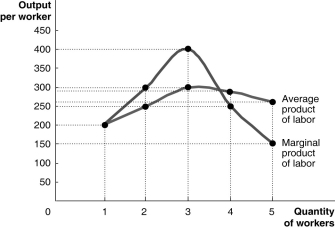
(72) Figure 11-1 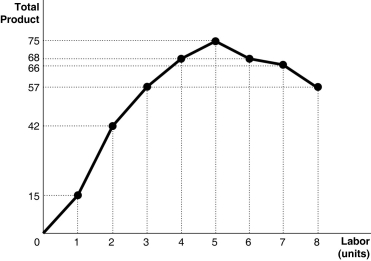 -Refer to Figure 11-1.The average product of the 4th worker
 (Multiple Choice)
4.8/5 (80)
(80) One reason why,in the short run,the marginal product of labor might increase initially as more workers are hired is that
(Multiple Choice)
4.9/5 (77)
(77) Jayanthi moves her yoga studio from her home to a space she rents in Oakland,California.Holding everything else constant,as a result of this move,
(Multiple Choice)
4.9/5 (86)
(86) What is the difference between explicit costs and implicit costs? List three examples each of explicit costs and implicit costs that may be experienced by a small business.
(Essay)
4.8/5 (79)
(79) Figure 11-9  -Refer to Figure 11-9.Suppose Hilda produces 100 gooseberry pies.What is the marginal rate of technical substitution of labor for capital when labor is increased from 10 to 20 hours?
 (Multiple Choice)
4.9/5 (82)
(82) If the total cost of producing 20 units of output is $1,000 and the average variable cost is $35,what is the firm's average fixed cost at that level of output?
(Multiple Choice)
4.8/5 (81)
(81) Figure 11-7  -Refer to Figure 11-7.The lines shown in the diagram are isocost lines.Which of the following shows an increase in the firm's total cost while the price of labor and capital remain unchanged?
 (Multiple Choice)
4.8/5 (88)
(88) The ABC Company manufactures routers that are used to provide high-speed Internet service.ABC sells an average of 1,000 routers each month,but to exhaust economies of scale in its industry ABC would have to sell 3,000 routers each month.Therefore,
(Multiple Choice)
4.9/5 (79)
(79) Fill in the missing values in the following table.Draw one graph showing how total output increases with the quantity of workers hired,and another graph showing the marginal product of labor and the average product of labor.
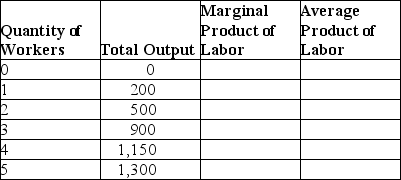
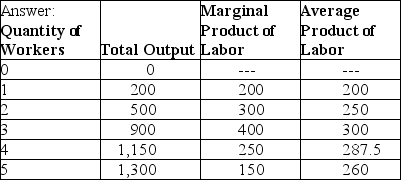
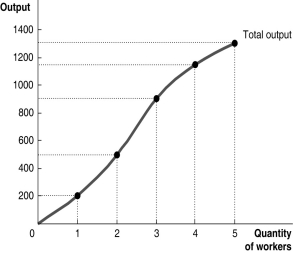
(Not Answered)
This question doesn't have any answer yet
Figure 11-1
-Refer to Figure 11-1.Diminishing marginal productivity sets in after
-Refer to Figure 11-1.Diminishing marginal productivity sets in after (Multiple Choice)
4.8/5 (69)
(69) Table 11-1
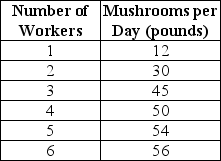 Table 11-1 shows the technology of production at the Matsuko's Mushroom Farm for the month of May 2011.
-Refer to Table 11-1.Diminishing marginal returns sets in when the ________ worker is hired.
Table 11-1 shows the technology of production at the Matsuko's Mushroom Farm for the month of May 2011.
-Refer to Table 11-1.Diminishing marginal returns sets in when the ________ worker is hired. (Multiple Choice)
4.8/5 (64)
(64) If production displays economies of scale,the long-run average cost curve is
(Multiple Choice)
4.8/5 (78)
(78) Describe how Wal-Mart has used positive technological change to manage its inventory.
(Essay)
5.0/5 (86)
(86) 
Filters
- Essay(0)
- Multiple Choice(0)
- Short Answer(0)
- True False(0)
- Matching(0)