



 Chat with AI
Exam 11: Technology, production, and Costs

Exam 1: Economics: Foundations and Models142 Questions
Exam 2: Trade-Offs, comparative Advantage, and the Market System152 Questions
Exam 3: Where Prices Come From: the Interaction of Demand and Supply149 Questions
Exam 4: Economic Efficiency, government Price Setting, and Taxes137 Questions
Exam 5: Externalities, environmental Policy, and Public Goods139 Questions
Exam 6: Elasticity: The Responsiveness of Demand and Supply149 Questions
Exam 7: The Economics of Health Care117 Questions
Exam 8: Firms, the Stock Market, and Corporate Governance140 Questions
Exam 9: Comparative Advantage and the Gains From International Trade124 Questions
Exam 10: Consumer Choice and Behavioral Economics154 Questions
Exam 11: Technology, production, and Costs174 Questions
Exam 12: Firms in Perfectly Competitive Markets153 Questions
Exam 13: Monopolistic Competition: The Competitive Model in a More Realistic Setting137 Questions
Exam 14: Oligopoly: Firms in Less Competitive Markets129 Questions
Exam 15: Monopoly and Antitrust Policy148 Questions
Exam 16: Pricing Strategy134 Questions
Exam 17: The Markets for Labor and Other Factors of Production149 Questions
Exam 18: Public Choice, taxes, and the Distribution of Income134 Questions
Exam 19: GDP: Measuring Total Production and Income135 Questions
Exam 20: Unemployment and Inflation148 Questions
Exam 21: Economic Growth, the Financial System, and Business Cycles130 Questions
Exam 22: Long-Run Economic Growth: Sources and Policies134 Questions
Exam 23: Aggregate Expenditure and Output in the Short Run157 Questions
Exam 24: Aggregate Demand and Aggregate Supply Analysis145 Questions
Exam 25: Money, banks, and the Federal Reserve System144 Questions
Exam 26: Monetary Policy145 Questions
Exam 27: Fiscal Policy155 Questions
Exam 28: Inflation, unemployment, and Federal Reserve Policy135 Questions
Exam 29: Macroeconomics in an Open Economy145 Questions
Exam 30: The International Financial System139 Questions
Select questions type


If we have information about workers' marginal products,then total and average product can be found by
(Multiple Choice)
4.8/5  (86)
(86) Figure 11-2 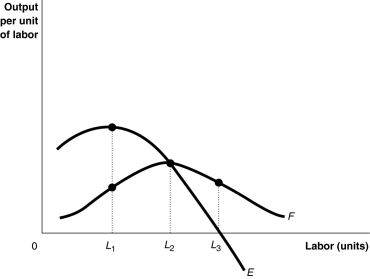 -Refer to Figure 11-2.The average product of labor declines after L2 because
 (Multiple Choice)
4.9/5 (74)
(74) Table 11-1
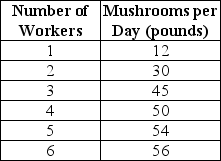 Table 11-1 shows the technology of production at the Matsuko's Mushroom Farm for the month of May 2011.
-Refer to Table 11-1.What is the average product of labor when the farm hires 5 workers?
Table 11-1 shows the technology of production at the Matsuko's Mushroom Farm for the month of May 2011.
-Refer to Table 11-1.What is the average product of labor when the farm hires 5 workers? (Multiple Choice)
4.8/5 (78)
(78) The president of Toyota's Georgetown plant was quoted as saying,"Demand for high volumes saps your energy.Over a period of time,it eroded our focus [and] thinned out the expertise and knowledge we painstakingly built up over the years." Based on this quote,what must be true of the plant's average cost of production curve?
(Multiple Choice)
4.9/5 (82)
(82) Figure 11-7  -Refer to Figure 11-7.The lines shown in the diagram are isocost lines.Which of the following shows an increase in the price of labor while the price of capital remains unchanged?
 (Multiple Choice)
4.9/5 (80)
(80) Who was the economist who first analyzed the advantages of specialization and the division of labor?
A) David Ricardo
B) Arthur C. Pigou
C) Ronald Coase
D) Adam Smith
(Not Answered)
This question doesn't have any answer yet
The president of Toyota's Georgetown plant was quoted as saying,"Demand for high volumes saps your energy.Over a period of time,it eroded our focus [and] thinned out the expertise and knowledge we painstakingly built up over the years." This quote suggests that
(Multiple Choice)
4.9/5 (77)
(77) If the marginal product of labor is decreasing,then marginal cost of production must be rising.
(True/False)
4.9/5 (73)
(73) If another worker adds 9 units of output to a group of workers who had an average product of 7 units,then the average product of labor
(Multiple Choice)
5.0/5 (82)
(82) Which of the following costs will not change as output changes?
(Multiple Choice)
4.8/5 (83)
(83) A positive technological change which decreases the price of inputs 1366 Technologies uses to produce solar wafers will cause
(Multiple Choice)
5.0/5 (92)
(92) Table 11-3
 Table 11-3 shows cost data for Lotus Lanterns, a producer of whimsical night lights.
-Refer to Table 11-3.What is the average total cost of production when the firm produces 120 lanterns?
Table 11-3 shows cost data for Lotus Lanterns, a producer of whimsical night lights.
-Refer to Table 11-3.What is the average total cost of production when the firm produces 120 lanterns? (Multiple Choice)
4.9/5 (80)
(80) Golda Rush quit her job as a manager for Home Depot to start her own hair dressing salon,Goldilocks.She gave up a salary of $40,000 per year,invested her savings of $30,000 (which was earning 5 percent interest)and borrowed $10,000 from a close friend,agreeing to pay 5 percent interest per year.In her first year,Golda spent $18,000 to rent a salon,hired a part-time assistant for $12,000 and incurred another $15,000 on equipment and hairdressing material.Based on this information,what is the amount of her explicit costs?
(Multiple Choice)
4.9/5 (92)
(92) Which of the following is a reason why a firm would experience diseconomies of scale?
(Multiple Choice)
4.9/5 (72)
(72) All of the following statements are true of the minimum efficient scale except one.Which one?
(Multiple Choice)
4.9/5 (77)
(77) 
Filters
- Essay(0)
- Multiple Choice(0)
- Short Answer(0)
- True False(0)
- Matching(0)