



 Chat with AI
Exam 11: Technology, production, and Costs

Exam 1: Economics: Foundations and Models142 Questions
Exam 2: Trade-Offs, comparative Advantage, and the Market System152 Questions
Exam 3: Where Prices Come From: the Interaction of Demand and Supply149 Questions
Exam 4: Economic Efficiency, government Price Setting, and Taxes137 Questions
Exam 5: Externalities, environmental Policy, and Public Goods139 Questions
Exam 6: Elasticity: The Responsiveness of Demand and Supply149 Questions
Exam 7: The Economics of Health Care117 Questions
Exam 8: Firms, the Stock Market, and Corporate Governance140 Questions
Exam 9: Comparative Advantage and the Gains From International Trade124 Questions
Exam 10: Consumer Choice and Behavioral Economics154 Questions
Exam 11: Technology, production, and Costs174 Questions
Exam 12: Firms in Perfectly Competitive Markets153 Questions
Exam 13: Monopolistic Competition: The Competitive Model in a More Realistic Setting137 Questions
Exam 14: Oligopoly: Firms in Less Competitive Markets129 Questions
Exam 15: Monopoly and Antitrust Policy148 Questions
Exam 16: Pricing Strategy134 Questions
Exam 17: The Markets for Labor and Other Factors of Production149 Questions
Exam 18: Public Choice, taxes, and the Distribution of Income134 Questions
Exam 19: GDP: Measuring Total Production and Income135 Questions
Exam 20: Unemployment and Inflation148 Questions
Exam 21: Economic Growth, the Financial System, and Business Cycles130 Questions
Exam 22: Long-Run Economic Growth: Sources and Policies134 Questions
Exam 23: Aggregate Expenditure and Output in the Short Run157 Questions
Exam 24: Aggregate Demand and Aggregate Supply Analysis145 Questions
Exam 25: Money, banks, and the Federal Reserve System144 Questions
Exam 26: Monetary Policy145 Questions
Exam 27: Fiscal Policy155 Questions
Exam 28: Inflation, unemployment, and Federal Reserve Policy135 Questions
Exam 29: Macroeconomics in an Open Economy145 Questions
Exam 30: The International Financial System139 Questions
Select questions type


Table 11-2
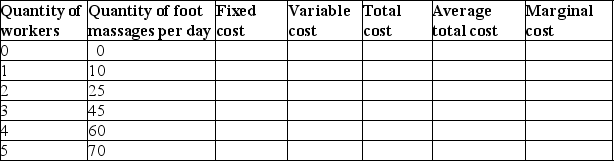 -Refer to Table 11-2.Alicia Gregory owns a foot massage business.She leases 4 computer-controlled massage booths,for which she pays $125 per day.She cannot increase the number machines she leases without giving the manufacturer 3 months notice.She can hire as many workers as she wants at a cost of $75 per day per worker.These are the only two inputs she uses in her business.Use this information to fill in the columns in the above table.
 (Essay)
4.9/5  (93)
(93) If diminishing marginal returns have already set in for Golden Lark Woodworks,and the marginal product of the 6th carpenter is 8 chairs,then the marginal product of the 7th carpenter is
(Multiple Choice)
4.8/5 (69)
(69) Table 11-1
 Table 11-1 shows the technology of production at the Matsuko's Mushroom Farm for the month of May 2011.
-Refer to Table 11-1.What is the marginal product of the 4th worker?
Table 11-1 shows the technology of production at the Matsuko's Mushroom Farm for the month of May 2011.
-Refer to Table 11-1.What is the marginal product of the 4th worker? (Multiple Choice)
4.9/5 (85)
(85) Suppose the total cost of producing 40,000 flash drives is $120,000,and the fixed cost is $30,000.
a.What is the variable cost?
b.When output is 40,000,what are the average variable cost and the average fixed cost?
c.Assuming the cost curves have the usual shape,is the dollar difference between the average total cost and the average variable cost greater when the output is 40,000 flash drives or when the output is 60,000 flash drives? Explain.
(Essay)
4.9/5 (76)
(76) Figure 11-8 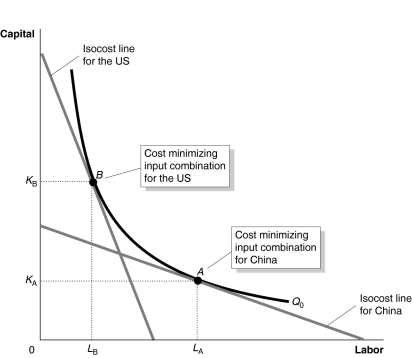 Figure 11-8 shows the optimal input combinations for the production of a given quantity of cotton in the United States and in China.
-Refer to Figure 11-8.Which of the following could explain why the United States and China use different input combinations to produce a given quantity of cotton and yet,each country produces that quantity at the lowest possible cost?
Figure 11-8 shows the optimal input combinations for the production of a given quantity of cotton in the United States and in China.
-Refer to Figure 11-8.Which of the following could explain why the United States and China use different input combinations to produce a given quantity of cotton and yet,each country produces that quantity at the lowest possible cost? (Multiple Choice)
4.7/5 (78)
(78) If the marginal cost curve is below the average variable cost curve,then
(Multiple Choice)
4.9/5 (92)
(92) In the short run,if marginal product is at its maximum,then
(Multiple Choice)
4.9/5 (75)
(75) Figure 11-4  -Refer to Figure 11-4.Identify the curves in the diagram.
 (Multiple Choice)
4.9/5 (72)
(72) Figure 11-5 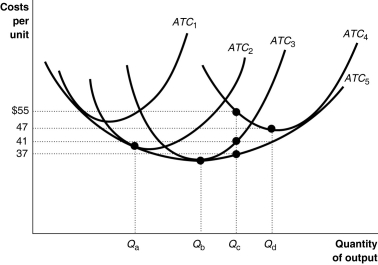 -Refer to Figure 11-5.Identify the minimum efficient scale of production.
 (Multiple Choice)
4.9/5 (86)
(86) If 11 workers can produce a total of 54 units of a product and a 12th worker has a marginal product of 6 units,then the average product of 12 workers is
(Multiple Choice)
4.8/5 (72)
(72) What is the difference between "diminishing marginal returns" and "diseconomies of scale"?
(Multiple Choice)
4.8/5 (77)
(77) Figure 11-4
-Refer to Figure 11-4.Curve G approaches curve F because
-Refer to Figure 11-4.Curve G approaches curve F because (Multiple Choice)
4.9/5 (74)
(74) Figure 11-2  -Refer to Figure 11-2.Diminishing returns to labor set in
 (Multiple Choice)
4.9/5 (79)
(79) 
Filters
- Essay(0)
- Multiple Choice(0)
- Short Answer(0)
- True False(0)
- Matching(0)