



 Chat with AI
Exam 22: Mammalian Fuel Metabolism: Integration and Regulation

Exam 1: Introduction to the Chemistry of Life56 Questions
Exam 2: Water59 Questions
Exam 3: Nucleotides, Nucleic Acids, and Genetic Information68 Questions
Exam 4: Amino Acids68 Questions
Exam 5: Proteins: Primary Structure68 Questions
Exam 6: Proteins: Three-Dimensional Structure60 Questions
Exam 7: Protein Function Part I: Myoglobin and Hemoglobin74 Questions
Exam 8: Carbohydrates66 Questions
Exam 9: Lipids and Biological Membranes59 Questions
Exam 10: Membrane Transport50 Questions
Exam 11: Enzyme Catalysis53 Questions
Exam 12: Enzyme Kinetics, Inhibition and Control55 Questions
Exam 13: Biochemical Signaling50 Questions
Exam 14: Introduction to Metabolism52 Questions
Exam 15: Glycogen Metabolism and Gluconeogenesis50 Questions
Exam 16: Glucose Catabolism50 Questions
Exam 17: Citric Acid Cycle50 Questions
Exam 18: Electron Transport and Oxidative Phosphorylation50 Questions
Exam 19: Photosynthesis50 Questions
Exam 20: Lipid Metabolism51 Questions
Exam 21: Amino Acid Metabolism50 Questions
Exam 22: Mammalian Fuel Metabolism: Integration and Regulation50 Questions
Exam 23: Nucleotide Metabolism50 Questions
Exam 24: Nucleic Acid Structure50 Questions
Exam 25: Dna Replication, Repair and Recombination50 Questions
Exam 26: Transcription and Rna Processing50 Questions
Exam 27: Translation49 Questions
Exam 28: Regulation of Gene Expression50 Questions
Select questions type


Which of the following reactions is catalyzed by adenylate cyclase?

Free
(Multiple Choice)
4.8/5  (77)
(77) Correct Answer: Verified
A
The common products of fuel metabolism in mammals are
Free
(Multiple Choice)
4.9/5 (73)
(73) Correct Answer:Verified
VerifiedB
Metabolism in the muscle is controlled hormonally by
Free
(Multiple Choice)
4.9/5 (73)
(73) Correct Answer:Verified
VerifiedE
A balanced meal containing fatty acids, carbohydrates, and protein is digested.Which of the following is TRUE?
I.Carbohydrates are absorbed by the stomach and delivered to the liver.
II.Fatty acids are absorbed by the intestinal mucosa and circulated through the lymph.
III.Proteins are digested into monomer amino acids and absorbed by the intestinal mucosa after which the majority is delivered to the liver.
(Multiple Choice)
4.8/5 (88)
(88) Matching
Choose the correct answer from the list. Not all the answers will be used.
-During starvation the _____ generate as much as 50% of the body's glucose supply.
(Multiple Choice)
4.8/5 (75)
(75) Based on the information given in the chapter complete the following statement about the graph shown below: The curve labeled ___ corresponds to activity of glucokinase under conditions with no inhibition.The binding of ____ to the regulating protein would result in kinetic behavior represented by curve ____. 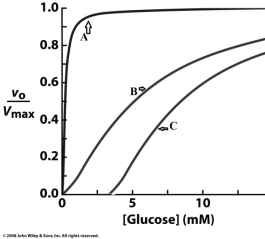
(Multiple Choice)
4.9/5 (81)
(81) Metformin and thiazolidinediones (TZDs)are used to treat ____ and produce a(an)______ in AMPK activity.
(Multiple Choice)
4.8/5 (80)
(80) Which of the following is part of the regulation of metabolism?
(Multiple Choice)
4.7/5 (88)
(88) Which of the following metabolizes ketone bodies?
I.brain
II.liver
III.muscle
IV.adipose tissue
(Multiple Choice)
4.8/5 (80)
(80) Matching
Choose the correct answer from the list. Not all the answers will be used.
-Mice lacking the protein ______ are genetically obese.
(Multiple Choice)
4.9/5 (90)
(90) During prolonged starvation the majority of the stored caloric energy comes from fat stores.Which of the following provides the second largest caloric energy total?
(Multiple Choice)
4.9/5 (76)
(76) Matching
Choose the correct answer from the list. Not all the answers will be used.
-______ and other waste products from the blood are excreted by the kidney.
(Multiple Choice)
4.9/5 (86)
(86) 
Filters
- Essay(0)
- Multiple Choice(0)
- Short Answer(0)
- True False(0)
- Matching(0)