



 Chat with AI
Exam 27: Translation

Exam 1: Introduction to the Chemistry of Life56 Questions
Exam 2: Water59 Questions
Exam 3: Nucleotides, Nucleic Acids, and Genetic Information68 Questions
Exam 4: Amino Acids68 Questions
Exam 5: Proteins: Primary Structure68 Questions
Exam 6: Proteins: Three-Dimensional Structure60 Questions
Exam 7: Protein Function Part I: Myoglobin and Hemoglobin74 Questions
Exam 8: Carbohydrates66 Questions
Exam 9: Lipids and Biological Membranes59 Questions
Exam 10: Membrane Transport50 Questions
Exam 11: Enzyme Catalysis53 Questions
Exam 12: Enzyme Kinetics, Inhibition and Control55 Questions
Exam 13: Biochemical Signaling50 Questions
Exam 14: Introduction to Metabolism52 Questions
Exam 15: Glycogen Metabolism and Gluconeogenesis50 Questions
Exam 16: Glucose Catabolism50 Questions
Exam 17: Citric Acid Cycle50 Questions
Exam 18: Electron Transport and Oxidative Phosphorylation50 Questions
Exam 19: Photosynthesis50 Questions
Exam 20: Lipid Metabolism51 Questions
Exam 21: Amino Acid Metabolism50 Questions
Exam 22: Mammalian Fuel Metabolism: Integration and Regulation50 Questions
Exam 23: Nucleotide Metabolism50 Questions
Exam 24: Nucleic Acid Structure50 Questions
Exam 25: Dna Replication, Repair and Recombination50 Questions
Exam 26: Transcription and Rna Processing50 Questions
Exam 27: Translation49 Questions
Exam 28: Regulation of Gene Expression50 Questions
Select questions type


Matching
Choose the correct answer from the list. Not all the answers will be used.
-Almost all known tRNAs can be arranged in the so-called ______ secondary structure.

Free
(Multiple Choice)
4.7/5  (83)
(83) Correct Answer: Verified
Q
During translation, translocation of the ribosome is driven by which of the following?
Free
(Multiple Choice)
4.8/5 (78)
(78) Correct Answer:Verified
VerifiedC
Posttranslational modifications to proteins include all of the following, except
(Multiple Choice)
4.9/5 (82)
(82) A mutation in the DNA sequence prior to (on the 5ꞌside of)the ATG start site will result in which of the following?
I.decreased binding efficiency of the TATA binding protein
II.decreased promoter efficiency
III.frameshift mutation
(Multiple Choice)
4.8/5 (92)
(92) Which of the following is(are)used to assist in protein folding?
I.calnexin
II.calreticulin
III.DnaK
IV.GroEL
(Multiple Choice)
4.9/5 (75)
(75) Which of the following is a function of the ribosome?
I.bind mRNA and allow codon recognition
II.mediate the binding of proteins necessary for initiation, elongation, and termination
III.catalyze synthesis of peptide bonds
IV.translocates such that multiple codons can be read
(Multiple Choice)
4.9/5 (100)
(100) Codons that do not specify amino acids but signal the ribosome to terminate polypeptide chain elongation are termed
(Multiple Choice)
4.8/5 (79)
(79) In E.coli, which of the following factors function to ensure the proper binding of tRNAfMet during mRNA binding and ribosomal subunit assembly?
I.IF-1
II.IF-2
III.IF-3
IV.EF-Ts
(Multiple Choice)
4.9/5 (77)
(77) Which of the following is NOT associated with eukaryotic translation initiation?
(Multiple Choice)
4.8/5 (80)
(80) Based on the structure shown below, which of the following correctly represents the sequence that would be present at the "XYZ" position? 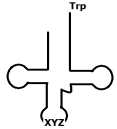
(Multiple Choice)
4.8/5 (77)
(77) A silent mutation occurs when a nucleotide mutation results in the identical amino acid in place upon completion of translation.If the original sequence is as follows, which example below represents a silent mutation?
GUACAAGCAUGAAGUUUGGUAAGCG
(Multiple Choice)
4.8/5 (77)
(77) Matching
Choose the correct answer from the list. Not all the answers will be used.
-The start codon is usually ______.
(Multiple Choice)
4.7/5 (85)
(85) The steps required for peptide elongation at the ribosome are, respectively,
(Multiple Choice)
4.9/5 (90)
(90) Which of the following best describes the preparation of fMet-tRNAfmet for translation in prokaryotes?
(Multiple Choice)
4.9/5 (84)
(84) The triplet code allows many amino acids to be specified by more than one codon.Such a code is said to be
(Multiple Choice)
4.8/5 (92)
(92) Insertions or deletions of one or two nucleotides can cause
(Multiple Choice)
4.8/5 (85)
(85) Which of the following correctly describes the sequence of events in formation of the ribosome assembly and associated RNAs and proteins?
(Multiple Choice)
4.9/5 (84)
(84) 
Filters
- Essay(0)
- Multiple Choice(0)
- Short Answer(0)
- True False(0)
- Matching(0)