



 Chat with AI
Exam 11: Enzyme Catalysis

Exam 1: Introduction to the Chemistry of Life56 Questions
Exam 2: Water59 Questions
Exam 3: Nucleotides, Nucleic Acids, and Genetic Information68 Questions
Exam 4: Amino Acids68 Questions
Exam 5: Proteins: Primary Structure68 Questions
Exam 6: Proteins: Three-Dimensional Structure60 Questions
Exam 7: Protein Function Part I: Myoglobin and Hemoglobin74 Questions
Exam 8: Carbohydrates66 Questions
Exam 9: Lipids and Biological Membranes59 Questions
Exam 10: Membrane Transport50 Questions
Exam 11: Enzyme Catalysis53 Questions
Exam 12: Enzyme Kinetics, Inhibition and Control55 Questions
Exam 13: Biochemical Signaling50 Questions
Exam 14: Introduction to Metabolism52 Questions
Exam 15: Glycogen Metabolism and Gluconeogenesis50 Questions
Exam 16: Glucose Catabolism50 Questions
Exam 17: Citric Acid Cycle50 Questions
Exam 18: Electron Transport and Oxidative Phosphorylation50 Questions
Exam 19: Photosynthesis50 Questions
Exam 20: Lipid Metabolism51 Questions
Exam 21: Amino Acid Metabolism50 Questions
Exam 22: Mammalian Fuel Metabolism: Integration and Regulation50 Questions
Exam 23: Nucleotide Metabolism50 Questions
Exam 24: Nucleic Acid Structure50 Questions
Exam 25: Dna Replication, Repair and Recombination50 Questions
Exam 26: Transcription and Rna Processing50 Questions
Exam 27: Translation49 Questions
Exam 28: Regulation of Gene Expression50 Questions
Select questions type


Simultaneous stimulation of a reaction by general acid and general base catalysis is defined as

Free
(Multiple Choice)
4.8/5  (73)
(73) Correct Answer: Verified
D
Lysozyme requires _____ for effective catalysis.
I.an Asp in a nonpolar environment
II.a negatively charged Asp
III.a Glu that functions as an acid catalyst
IV.a Glu that is deprotonated
Free
(Multiple Choice)
4.8/5 (84)
(84) Correct Answer:Verified
VerifiedC
In the lysozome reaction the D ring in NAM is in the ________ conformation providing a contribution of catalytic energy via the ____ distortion.
Free
(Multiple Choice)
4.9/5 (82)
(82) Correct Answer:Verified
VerifiedE
Enzyme X catalyzes the addition of a hydroxyl group to substrate Y.In the process a metal cofactor is reduced and then reoxidized.What class of enzyme is X?
(Multiple Choice)
4.8/5 (69)
(69) Carbohydrate metabolic enzymes bind D-glucose specifically.D-glucose has an estimated caloric value of 1 kcal per 4 grams of carbohydrate.Based on the methods used to convert the energy of D-glucose into a useable form, what would you estimate the caloric value of L-glucose to be using the same method?
(Multiple Choice)
4.7/5 (94)
(94) Proton transfer from an acid, lowering the free energy of a reaction's transition state, is characteristic of
(Multiple Choice)
4.8/5 (85)
(85) In the serine protease trypsin, the specificity for one substrate over another describes what type of catalysis?
(Multiple Choice)
4.9/5 (72)
(72) Which of the following is TRUE about enzymes?
I.Enzymes typically catalyze reactions at much higher rates than chemical catalyst.
II.Enzymes are often very specific for their substrates.
III.Enzyme activities can often be regulated.
IV.Enzymes typically act under milder conditions of temperature and pH than chemical catalysts.
(Multiple Choice)
4.9/5 (77)
(77) A pH versus rate curve with an inflection point at pH~4 suggests the involvement of a(n)________ in the catalytic step.
(Multiple Choice)
4.9/5 (71)
(71) Which of the following amino acid residues would provide a side chain capable of increasing the hydrophobicity of a binding site?
(Multiple Choice)
4.9/5 (75)
(75) Matching
-Clustering several amino acid residues with appropriate pK values at an active site can promote a(n)_________ catalytic mechanism.
(Multiple Choice)
4.8/5 (81)
(81) Research scientists are trying to clone a gene.In order to accomplish this task they join two pieces of DNA.Which class of the enzymes below might accomplish this task?
(Multiple Choice)
4.9/5 (80)
(80) Which one of the following is correct?
I.All enzymes are highly specific for the reactions they catalyze.
II.Prosthetic groups are loosely associated with the polypeptide chain of an enzyme.
III.If an enzyme-catalyzed reaction requires a group with a low pK to be deprotonated and a group with a higher pK to be protonated, the pH vs.rate curve will have a peak in the middle of the two pK values.
IV.When comparing types of catalysis, the proximity effect provides the largest rate enhancement.
(Multiple Choice)
4.7/5 (89)
(89) During the course of a catalytic reaction the following occurs: 1)Substrate is covalently bound and oriented with proximity to the active site residues.2)Negative charge builds up on the substrate and is stabilized.3)Oxidation of the enzyme followed by reduction to complete the catalytic cycle.What type of chemical species can facilitate these reactions?
(Multiple Choice)
4.8/5 (89)
(89) Matching
-Some serine proteases are believed to have developed by convergent evolution, because the ______ sequences of some serine proteases show no resemblance to those of others.
(Multiple Choice)
4.8/5 (74)
(74) Matching
-Metal ion cofactors offer various ______ states that allow enzymes to accomplished oxidation reduction reactions.
(Multiple Choice)
4.9/5 (69)
(69) The enzyme pictured below is shown in two configurations, A (open)and B (closed).Upon binding substrate in the active site, the enzyme converts the structure shown in B.Which of the following is true based on the given information? 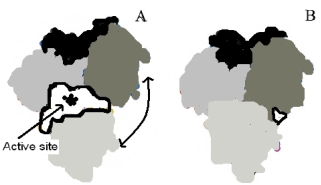
(Multiple Choice)
4.9/5 (76)
(76) Matching
-On a transition state diagram for a one-step very spontaneous reaction a large peak (high G‡)would imply a ______ rate for the reaction.
(Multiple Choice)
4.9/5 (82)
(82) Which type of catalysis may be carried out using redistribution of electron density to facilitate the transfer of a proton?
I.proximity
II.acid-base
III.covalent
IV.strain
(Multiple Choice)
4.9/5 (80)
(80) 
Filters
- Essay(0)
- Multiple Choice(0)
- Short Answer(0)
- True False(0)
- Matching(0)